Taxation and Other Laws Amendment Bill 2026 Explained
#GS-2 #GS-3 #Economy #Taxation #Fiscal Policy #Governance & Social Justice #Regulatory Bodies #Infrastructure #Government Policies & Interventions
Key takeaways
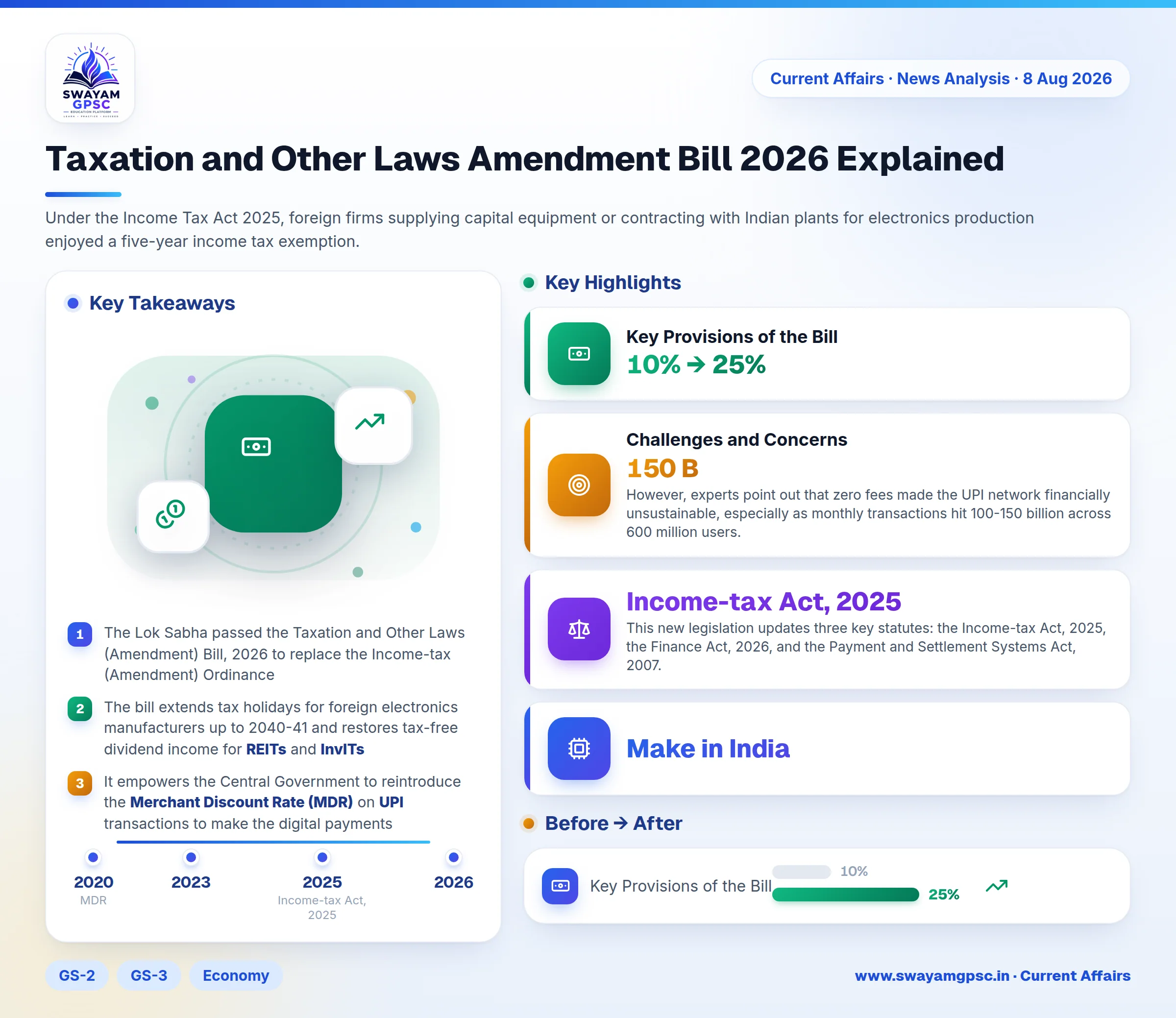
- The Lok Sabha passed the Taxation and Other Laws (Amendment) Bill, 2026 to replace the Income-tax (Amendment) Ordinance, 2026 and update three major financial acts.
- The bill extends tax holidays for foreign electronics manufacturers up to 2040-41 and restores tax-free dividend income for REITs and InvITs investors.
- It empowers the Central Government to reintroduce the Merchant Discount Rate (MDR) on UPI transactions to make the digital payments ecosystem financially viable.
- The UPI network is projected to serve 600 million users and handle 100-150 billion transactions monthly, requiring sustainable investment beyond government subsidies.
Why in News
- The Lok Sabha passed the Taxation and Other Laws (Amendment) Bill, 2026, which replaces the Income-tax (Amendment) Ordinance, 2026.
- This new legislation updates three key statutes: the Income-tax Act, 2025, the Finance Act, 2026, and the Payment and Settlement Systems Act, 2007.
- The main goals of the bill are to bring in foreign capital, support the Make in India program, make business operations simpler, and build a stronger digital financial system.
Key Provisions of the Bill
- Under the Income Tax Act 2025, foreign firms supplying capital equipment or contracting with Indian plants for electronics production enjoyed a five-year income tax exemption.
- The new bill clearly specifies covered goods like mobile phones, laptops, servers, and wearables, while extending this tax holiday by ten years up to 2040-41.
- The bill gives tax exemptions to eligible foreign diamond businesses and electronics producers, covering earnings from rough diamond sales and component storage in bonded warehouses.
- It exempts Foreign Institutional Investors (FIIs) and the Bank for International Settlements (BIS) from paying income tax on interest and capital gains from government securities.
- Simple tax rules now allow foreign fund managers to move their offices to India without making their offshore funds taxable, while keeping strict controls against tax evasion.
- The bill removes complex multi-level government approvals previously required for foreign cloud companies using Indian data centers.
- Indian data centers can now operate through leasing arrangements instead of mandatory direct ownership, creating a more flexible business environment.
- The law restores tax-free dividend income for investors in Real Estate Investment Trusts (REITs) and Infrastructure Investment Trusts (InvITs), while raising the surcharge on Special Purpose Vehicles from 10% to 25%.
- Amendments to the Payment and Settlement Systems Act, 2007 give the Central Government power to let banks and payment service providers charge fees on UPI and other digital payment options.
- This fee policy aims to build a lasting revenue model for banks, payment service providers, and infrastructure companies while backing digital growth.
- The new changes enable the government to introduce the Merchant Discount Rate (MDR) on UPI transactions and other notified digital payment channels.
- Currently, Section 269SU of the Income-tax Act, 1961 bans banks and payment service providers from imposing any direct or indirect fees on notified digital transactions.
Significance of the Legislation
- The bill encourages higher foreign direct investment and attracts global capital into Indian financial markets.
- It gives a strong push to the Make in India initiative by supporting local electronics manufacturing.
- It builds India's reputation as an attractive global hub for data centers and cloud computing networks.
- It creates favorable conditions that position India as a top choice for global investment fund managers.
- The clear tax benefits drive larger investments into real estate and infrastructure through REITs and InvITs.
- It improves overall ease of doing business by cutting down regulatory steps and offering predictable tax rules.
Understanding REITs and InvITs
- REITs are specialized companies that own, run, or finance income-generating real estate assets such as office towers, shopping malls, and hotels.
- They let individual investors earn steady dividends from real estate without purchasing or managing properties directly, operating much like mutual funds.
- An InvIT works as a collective investment platform that pools funds from investors to fund infrastructure assets like toll roads and power lines.
- SEBI regulates these investment trusts under the Securities and Exchange Board of India (Infrastructure Investment Trusts) Regulations, 2014.
Merchant Discount Rate Explained
- MDR is the service fee a merchant pays to banks and payment providers to process digital customer transactions.
- The fee is usually calculated as a small percentage of the total transaction value.
- Since 2020, the government set MDR to zero for UPI and RuPay debit card transactions to encourage widespread digital payment adoption.
What is Round-Tripping
- Round-tripping is an illegal money tactic where domestic entities send untaxed money out to offshore tax havens like Mauritius, then bring it back as legitimate foreign investment.
Challenges and Concerns
- Parliament passed the bill quickly during house disruptions, leading to limited debate and reduced legislative review.
- Removing the zero fee policy might lead to charges on UPI payments, which could slow digital adoption among small shopkeepers and low-income citizens.
- However, experts point out that zero fees made the UPI network financially unsustainable, especially as monthly transactions hit 100-150 billion across 600 million users.
- Long-term tax relief for foreign firms and investors could lower government revenues and make managing public deficits harder.
- Eased rules for fund managers might increase the risk of tax evasion and round-tripping despite regulatory safety checks.
- Focused tax breaks given to big foreign companies could put domestic micro, small, and medium enterprises at a business disadvantage.
Way Forward
- The government should tie tax breaks to actual results like job creation, exports, and technology transfer using regular reviews and clear end dates.
- Tax benefits for cloud firms and data centers must line up with the Digital Personal Data Protection Act, 2023 to balance economic growth with user privacy.
- Policymakers should combine tax incentives with expanded PLI schemes and research support for small businesses to build strong local supply chains.
- Regulators like SEBI and the CBDT should use AI tools and enforce GAAR rules strictly to stop illegal tax avoidance and round-tripping.
Frequently Asked Questions
- The primary goal of the bill is to attract foreign capital, boost local manufacturing, improve business ease, and modernize tax laws.
- The bill amends three major laws: the Income-tax Act, 2025, the Finance Act, 2026, and the Payment and Settlement Systems Act, 2007.
- It supports electronics production by extending tax holidays for foreign suppliers of equipment and components up to 2040-41.
- It restores dividend tax exemptions for REITs and InvITs investors, which helps channel private money into infrastructure and real estate.
- Key concerns include rushed parliamentary approval, potential charges on UPI payments, potential tax revenue loss, and competition risks for small domestic firms.