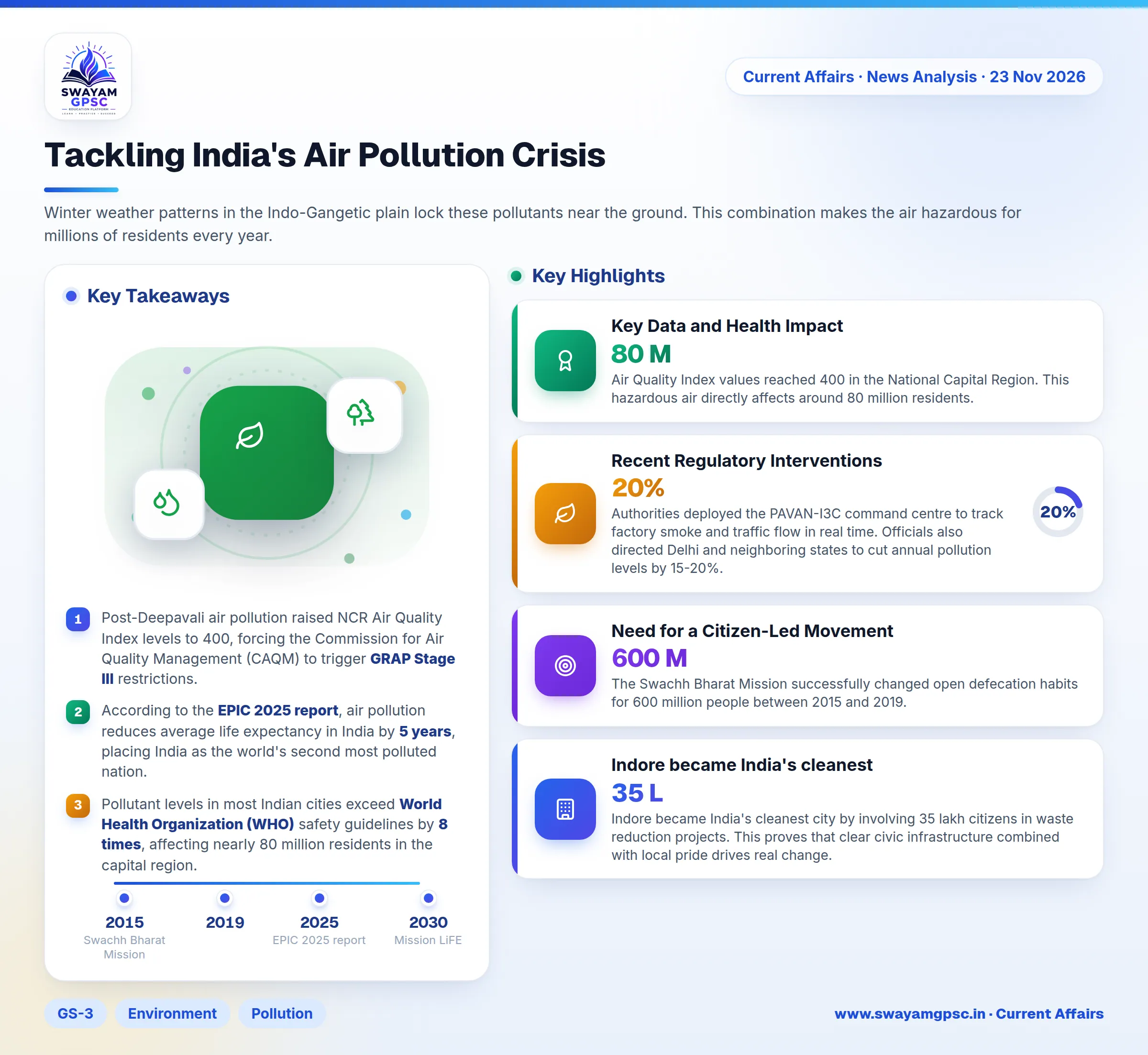
Tackling India's Air Pollution Crisis
#GS-3 #Environment #Pollution #Climate Change #Sustainable Development #Governance & Social Justice #Current Events #National
Key takeaways
- Post-Deepavali air pollution raised NCR Air Quality Index levels to 400, forcing the Commission for Air Quality Management (CAQM) to trigger GRAP Stage III restrictions.
- According to the EPIC 2025 report, air pollution reduces average life expectancy in India by 5 years, placing India as the world's second most polluted nation.
- Pollutant levels in most Indian cities exceed World Health Organization (WHO) safety guidelines by 8 times, affecting nearly 80 million residents in the capital region.
- Authorities deployed the PAVAN-I3C command centre for real-time monitoring and instructed NCR states to reduce annual pollution by 15-20%.
- Experts recommend a year-round citizen movement following the Swachh Bharat Mission model, alongside Mission LiFE goals to reduce global carbon emissions by 2 billion tonnes by 2030.
Why in News
- Air quality index levels soared to 400 across Delhi-NCR after Deepavali celebrations. This sharp rise triggered GRAP Stage III emergency measures.
- Experts are now asking the government to launch a year-round anti-pollution campaign driven by citizens. This movement should follow the success model of the Swachh Bharat Mission.
Understanding the Pollution Crisis
- Air pollution in India is a repeating public health emergency that involves many sectors. Vehicle exhausts, construction dust, factory smoke, crop stubble burning, and trash fires cause this problem.
- Winter weather patterns in the Indo-Gangetic plain lock these pollutants near the ground. This combination makes the air hazardous for millions of residents every year.
Key Data and Health Impact
- Air pollutant concentrations in most Indian cities now exceed World Health Organization (WHO) safe guidelines by 8 times.
- Air Quality Index values reached 400 in the National Capital Region. This hazardous air directly affects around 80 million residents.
- The EPIC 2025 report from the University of Chicago reveals that air pollution cuts average Indian life expectancy by 5 years. The report ranks India as the second most polluted country in the world.
Recent Regulatory Interventions
- The Commission for Air Quality Management (CAQM) raised emergency restrictions from Stage I to Stage III within 15 days.
- This escalation stopped construction activities, increased vehicle emission test checks, and sent inspection teams to farm stubble sites in Punjab.
- Authorities deployed the PAVAN-I3C command centre to track factory smoke and traffic flow in real time. Officials also directed Delhi and neighboring states to cut annual pollution levels by 15-20%.
Need for a Citizen-Led Movement
- Fines, construction bans, and border truck checks offer temporary relief during winter. However, these top-down rules cause traffic jams and fail to change daily habits.
- The Swachh Bharat Mission successfully changed open defecation habits for 600 million people between 2015 and 2019.
- That mission delivered 2,500 to 3,300 targeted awareness messages per person. It also used top political leaders and local public figures to inspire action.
- Indore became India's cleanest city by involving 35 lakh citizens in waste reduction projects. This proves that clear civic infrastructure combined with local pride drives real change.
- Adopting the Mission LiFE framework globally could lower annual carbon emissions by 2 billion tonnes by 2030.
- This green behavior framework works alongside tree-planting campaigns like Ek Ped Maa Ke Naam, which planted over 260 crore trees in two years.
Challenges in Tackling Air Pollution
- Car and bike owners resist switching to public transport or working from home. People want clean air under GRAP rules, yet many still burn waste and light Deepavali firecrackers.
- Environmental agencies issue panic warnings during winter instead of running steady awareness drives. This sudden enforcement causes traffic jams at Delhi borders when non-compliant vehicles get stopped without warning.
- City officials spend funds on temporary fixes like anti-smog guns, water sprays, and cloud seeding. These cosmetic choices take resources away from long-term solutions like electric buses and public education.
- General requests to help the environment fail to change behavior. Citizens only change their daily habits when they see clear health benefits and personal money savings.
Way Forward
- Shift funds away from temporary smog devices toward continuous public media campaigns. Teach people how electric vehicles, CNG, and cleaner habits save money and protect family health.
- State Pollution Control Boards should host regular workshops for neighborhood associations, schools, colleges, farmers, drivers, and factory workers.
- Improve city bus routes, waste separation services, and crop management tools. Easy access to proper systems helps citizens practice reduce, reuse, and recycle habits without burning waste.
- National leaders and community figures must unite to turn clean air into a year-round national movement rather than a brief winter emergency.
Conclusion
- Emergency bans and winter regulations cannot solve India's air crisis on their own. Authorities must combine strong legal monitoring with public engagement throughout the year.
- Using lessons from the Swachh Bharat Mission and Mission LiFE will make clean air a daily duty. This shift is essential to protect public health and support India's long-term growth.