Tackling Adolescent Malnutrition and Lifestyle Diseases in India
#GS-2 #Governance & Social Justice #Poverty #Health #Issues Relating to Poverty & Hunger #Issues Related to Children #Government Policies & Interventions
Key takeaways
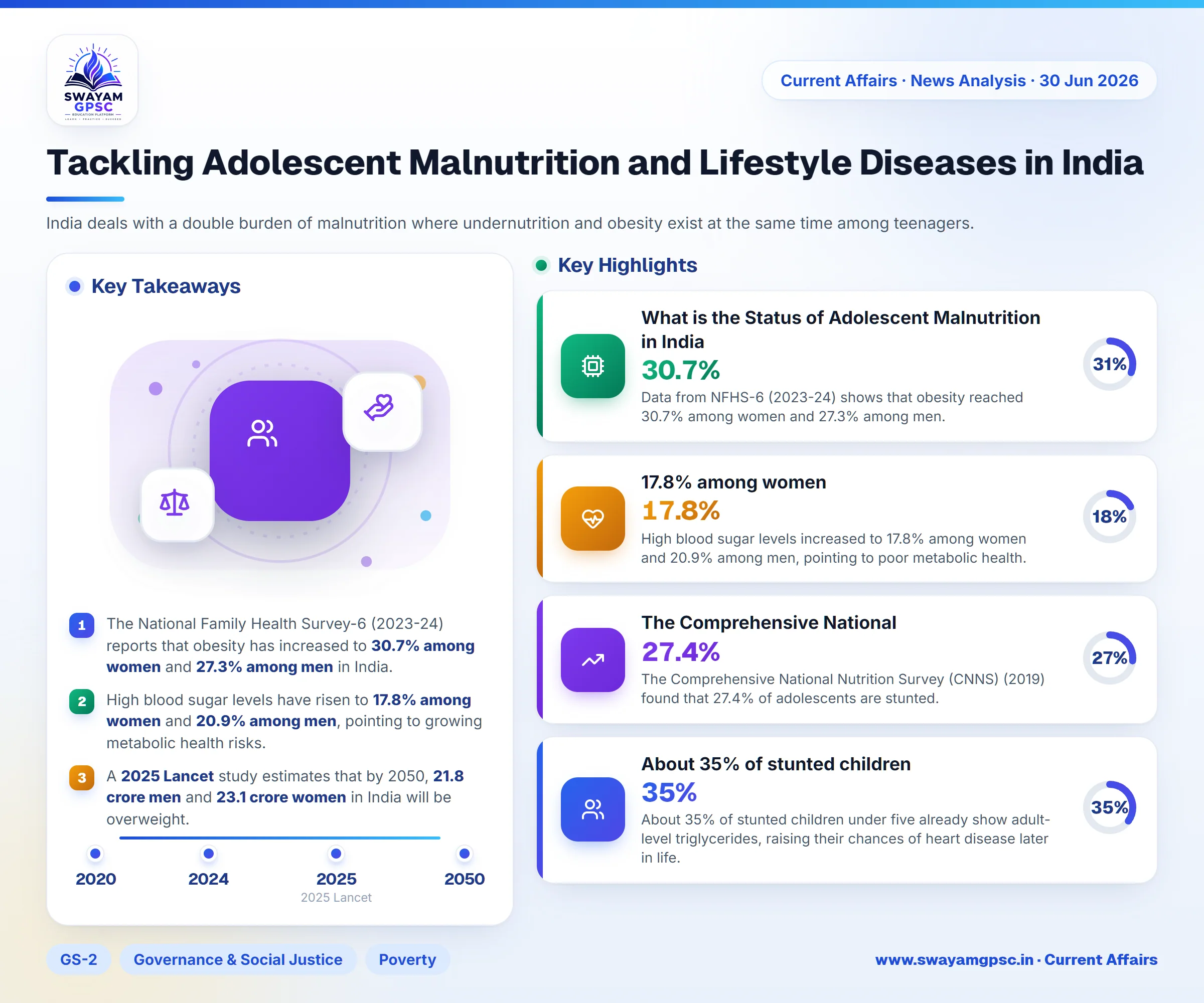
- The National Family Health Survey-6 (2023-24) reports that obesity has increased to 30.7% among women and 27.3% among men in India.
- High blood sugar levels have risen to 17.8% among women and 20.9% among men, pointing to growing metabolic health risks.
- A 2025 Lancet study estimates that by 2050, 21.8 crore men and 23.1 crore women in India will be overweight.
- The CBSE has mandated over 24,000 schools to install "Sugar Boards" to educate students about hidden sugars in packaged food items.
- Consumption of ultra-processed foods is growing rapidly, with UPF consumption increasing by over 13.7% annually among adolescents.
Why in News
- The National Family Health Survey-6 (NFHS-6) (2023-24) shows a big rise in adolescent malnutrition across the country.
- There is a sharp increase in obesity, high blood sugar, and lifestyle-related diseases among young people.
- Experts point out that schools must start focusing heavily on nutrition and physical activity to deal with this crisis.
What is the Status of Adolescent Malnutrition in India
- India deals with a double burden of malnutrition where undernutrition and obesity exist at the same time among teenagers.
- Data from NFHS-6 (2023-24) shows that obesity reached 30.7% among women and 27.3% among men.
- High blood sugar levels increased to 17.8% among women and 20.9% among men, pointing to poor metabolic health.
- These health problems are no longer confined to cities because rural teenagers are also affected by lack of movement, stress, and junk food.
- Many youngsters have a thin-fat phenotype, meaning they look slim on the outside but carry hidden visceral fat.
- This hidden fat puts them at high risk for early-onset Type-2 diabetes, hypertension, and cardiovascular diseases.
- The Comprehensive National Nutrition Survey (CNNS) (2019) found that 27.4% of adolescents are stunted.
- About 35% of stunted children under five already show adult-level triglycerides, raising their chances of heart disease later in life.
- Teenagers mostly eat cereal-heavy diets while lacking proper intake of proteins, fruits, vegetables, and dairy products.
- Consumption of High Fat, Sugar and Salt (HFSS) foods and Ultra-Processed Foods (UPFs) is growing fast, with UPF consumption increasing by over 13.7% annually.
- Dietary habits fall far below the standards set by the Dietary Guidelines for Indians 2024.
- A 2025 Lancet study warns that by 2050, 21.8 crore men and 23.1 crore women in India will be overweight.
- The highest increase in overweight individuals will happen in the 15-24 years age group.
- Lack of physical activity has become a major public health threat in both rural and urban areas.
- Too much screen time and sitting for long hours lead to bad eating habits and higher risks of obesity and cardiovascular diseases.
How can Schools Address Adolescent Malnutrition in India
- Schools need to teach practical skills like reading food labels, understanding portion sizes, and identifying misleading junk food marketing.
- The Indian Council of Medical Research-National Institute of Nutrition (ICMR-NIN) leads the *Let’s Fix Our Food (LFOF) consortium to improve campus food habits.
- In a major 2025 decision, the CBSE has mandated over 24,000 schools to install "Sugar Boards" to show students the hidden sugar in packaged items.
- Teachers can use interactive books like the NCERT-UNESCO "Let's Move Forward" comic book to spread awareness about healthy eating.
- Educational institutions must build UPF-free campuses by following FSSAI 's Eat Right School Initiative.
- Schools are required to strictly enforce FSSAI's 2020 regulations, which restrict the sale of foods High in Fat, Salt, and Sugar (HFSS) within 50 meters of their gates.
- Programs like PM POSHAN must promote protein-rich, millet-based balanced meals to improve student nutrition.
- Schools should overhaul their daily study plans by making nutrition education a core part of everyday learning.
- Authorities must include structured physical education and sports as a core part of the daily curriculum rather than optional periods.
- Campuses should set up regular health checks by linking up with the Rashtriya Bal Swasthya Karyakram (RBSK).
- Holding periodic Adolescent Health and Wellness Days (AHD) helps catch early signs of metabolic issues, Body Mass Index (BMI) changes, and anaemia.
- Working closely with parents is vital because children usually eat what is bought for the household.
- Governments must also support these efforts by taxing sugary drinks and stopping misleading food ads directed at children.
Conclusion
- Turning schools into centers of preventive health helps build a truly healthy nation.
- Using simple steps like nutrition boards and active sports can stop lifestyle diseases early.
- These measures ensure that India's demographic dividend becomes a national asset instead of a burden on the health system.