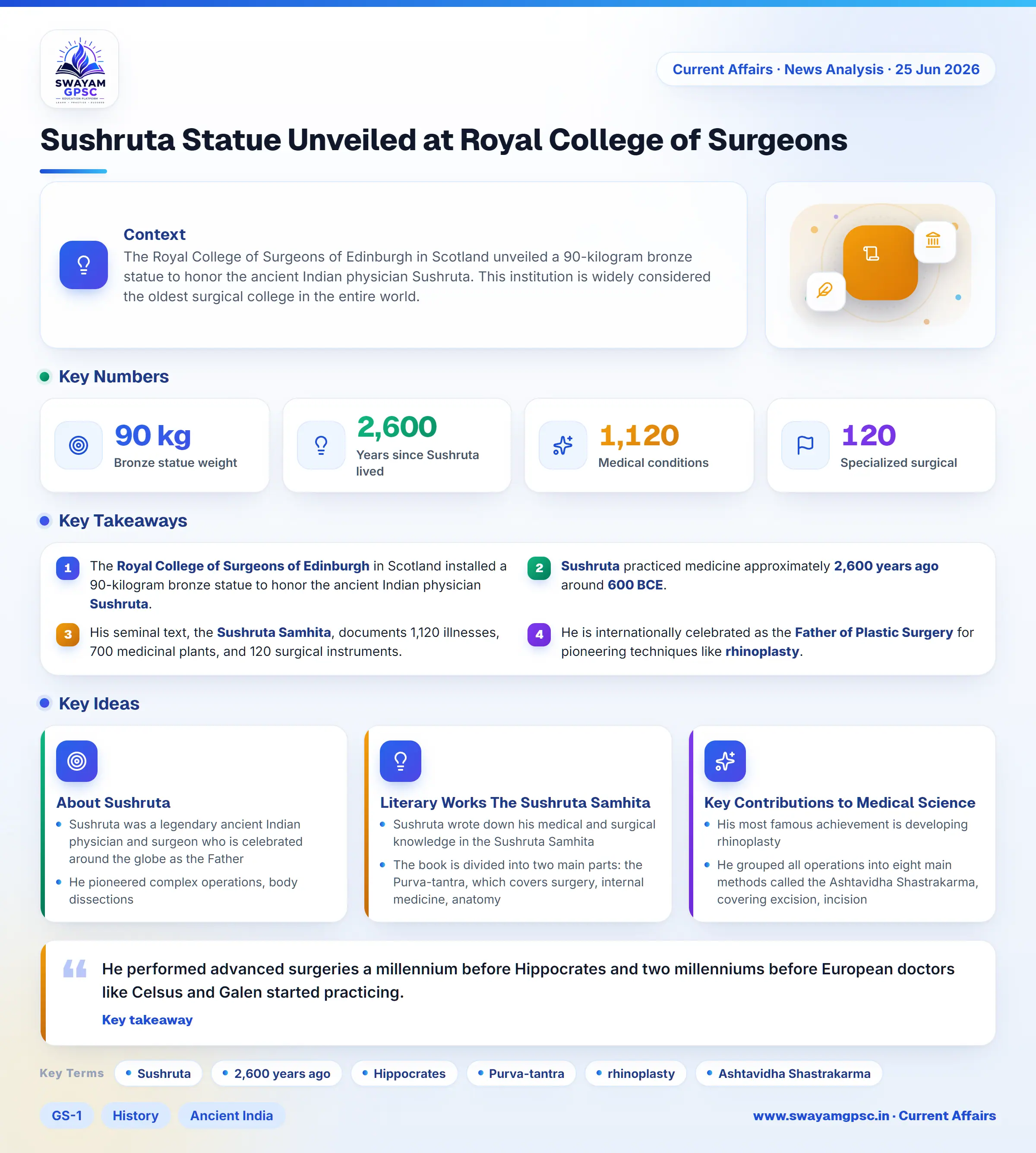
Sushruta Statue Unveiled at Royal College of Surgeons
#GS-1 #History #Ancient India #Culture #Heritage #Science & Technology #Medicine #Current Events
Key takeaways
- The Royal College of Surgeons of Edinburgh in Scotland installed a 90-kilogram bronze statue to honor the ancient Indian physician Sushruta.
- Sushruta practiced medicine approximately 2,600 years ago around 600 BCE.
- His seminal text, the *Sushruta Samhita*, documents 1,120 illnesses, 700 medicinal plants, and 120 surgical instruments.
- He is internationally celebrated as the Father of Plastic Surgery for pioneering techniques like rhinoplasty.
Context
- The Royal College of Surgeons of Edinburgh in Scotland unveiled a 90-kilogram bronze statue to honor the ancient Indian physician Sushruta.
- This institution is widely considered the oldest surgical college in the entire world.
About Sushruta
- Sushruta was a legendary ancient Indian physician and surgeon who is celebrated around the globe as the Father of Plastic Surgery and the Father of Surgery.
- He pioneered complex operations, body dissections, and medical education thousands of years before similar practices started in the West.
- Historians believe he lived and practiced approximately 2,600 years ago around 600 BCE.
- He performed advanced surgeries a millennium before Hippocrates and two millenniums before European doctors like Celsus and Galen started practicing.
Literary Works The Sushruta Samhita
- Sushruta wrote down his medical and surgical knowledge in the *Sushruta Samhita*, which is one of the most detailed surviving medical books from the ancient world.
- The book is divided into two main parts: the Purva-tantra, which covers surgery, internal medicine, anatomy, and pediatrics, and the Uttara-tantra, which covers eye, ear, nose, throat, and psychiatry.
- The text documents a massive medical collection that includes 1,120 distinct illnesses and medical conditions.
- It describes over 700 medicinal plants and hundreds of treatments from animal and mineral sources.
- The book details more than 300 complex medical and surgical operations.
- It also explains around 120 unique and specialized surgical instruments.
Key Contributions to Medical Science
- His most famous achievement is developing rhinoplasty, which is the surgical rebuilding of a cut nose using skin from the forehead or cheek.
- He grouped all operations into eight main methods called the Ashtavidha Shastrakarma, covering excision, incision, scraping, puncturing, probing, extraction, drainage, and suturing.
- He created a classification system for burns, heat stroke, frostbite, and lightning strikes long before Western medicine did.
- He identified lifestyle conditions that look very similar to modern diabetes, obesity, and heart disease.
- He made it mandatory for medical students to practice on inanimate objects to build precision before treating human patients.