Sushruta Statue Unveiled in Edinburgh
#GS-1 #History #Ancient India #Culture #Heritage #Science & Technology #Rapid Fire CA #Quick Facts For Prelims
Key takeaways
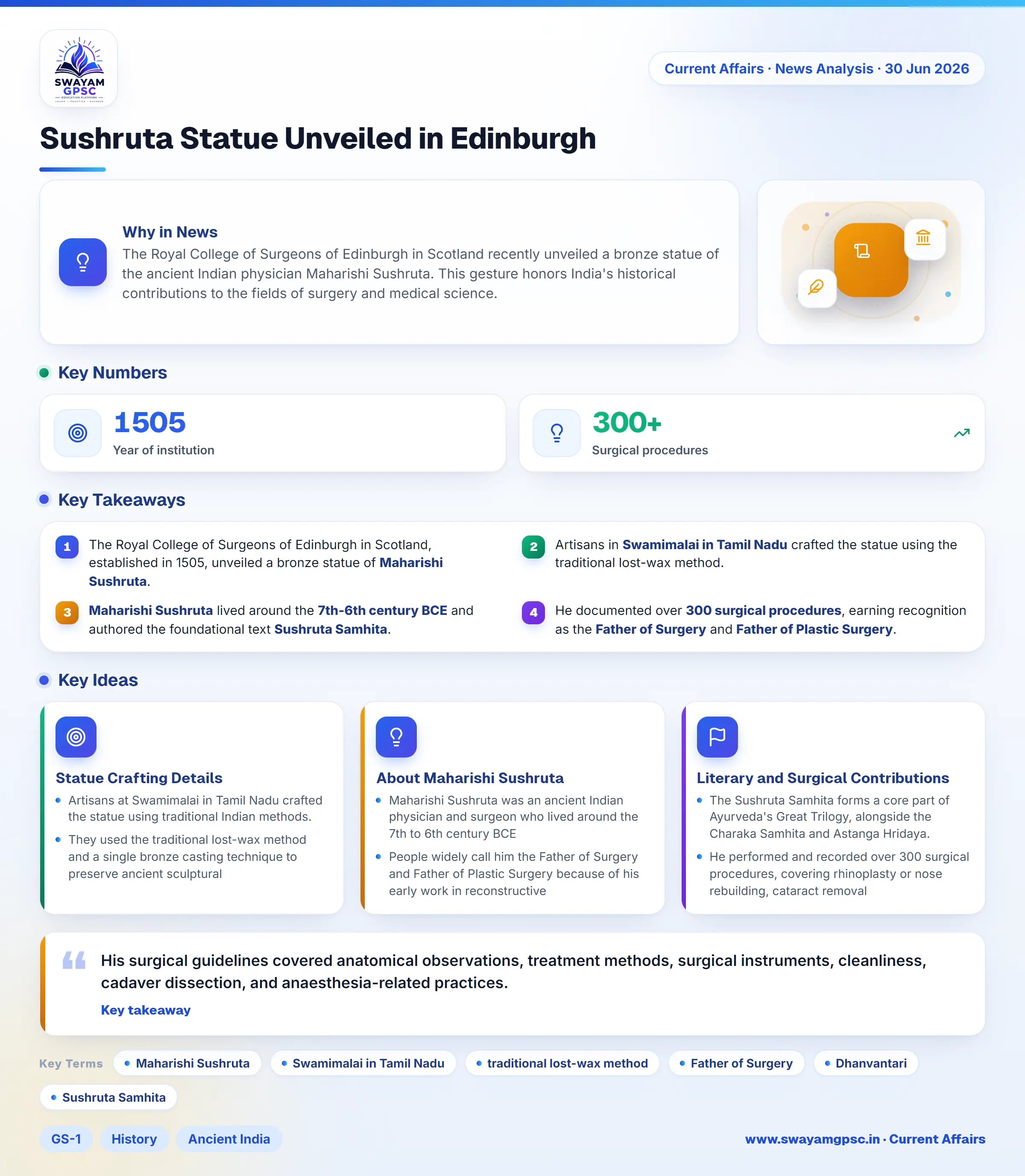
- The Royal College of Surgeons of Edinburgh in Scotland, established in 1505, unveiled a bronze statue of Maharishi Sushruta.
- Artisans in Swamimalai in Tamil Nadu crafted the statue using the traditional lost-wax method.
- Maharishi Sushruta lived around the 7th-6th century BCE and authored the foundational text Sushruta Samhita.
- He documented over 300 surgical procedures, earning recognition as the Father of Surgery and Father of Plastic Surgery.
Why in News
- The Royal College of Surgeons of Edinburgh in Scotland recently unveiled a bronze statue of the ancient Indian physician Maharishi Sushruta.
- This gesture honors India's historical contributions to the fields of surgery and medical science.
- King James IV established the institute in 1505, making it one of the oldest surgical institutions in the world.
Statue Crafting Details
- Artisans at Swamimalai in Tamil Nadu crafted the statue using traditional Indian methods.
- They used the traditional lost-wax method and a single bronze casting technique to preserve ancient sculptural craftsmanship.
About Maharishi Sushruta
- Maharishi Sushruta was an ancient Indian physician and surgeon who lived around the 7th to 6th century BCE and is closely associated with Varanasi.
- People widely call him the Father of Surgery and Father of Plastic Surgery because of his early work in reconstructive and operative surgery.
- Traditional stories describe him as a student of Dhanvantari, who is connected with Ayurveda and linked to the Navratnas of King Vikramaditya or Chandragupta II.
- He wrote the Sushruta Samhita, which remains one of the earliest known texts on plastic surgery.
Literary and Surgical Contributions
- The Sushruta Samhita forms a core part of Ayurveda's Great Trilogy, alongside the Charaka Samhita and Astanga Hridaya.
- He performed and recorded over 300 surgical procedures, covering rhinoplasty or nose rebuilding, cataract removal, fracture treatment, and caesarean delivery.
- His medical records also include Oshtha Sandhan for lip repair and Karna Sandhan for earlobe reconstruction.
- His surgical guidelines covered anatomical observations, treatment methods, surgical instruments, cleanliness, cadaver dissection, and anaesthesia-related practices.
- He gave great importance to practical training by making students practice on inanimate objects and dead animals before treating living humans.