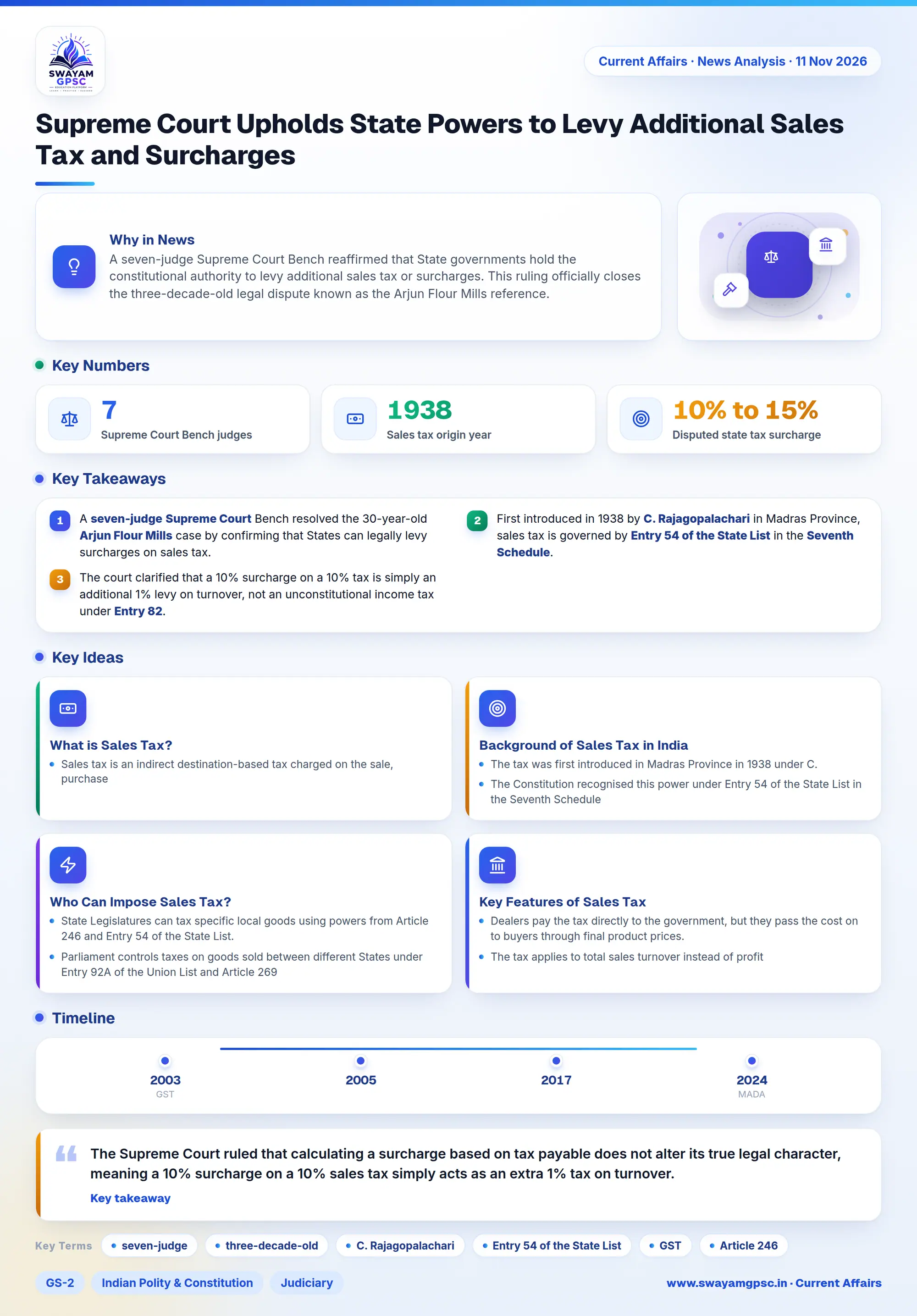
Supreme Court Upholds State Powers to Levy Additional Sales Tax and Surcharges
#GS-2 #Indian Polity & Constitution #Judiciary #Federalism #Constitutional Bodies #GS-3 #Economy #Taxation
Key takeaways
- A seven-judge Supreme Court Bench resolved the 30-year-old Arjun Flour Mills case by confirming that States can legally levy surcharges on sales tax.
- First introduced in 1938 by C. Rajagopalachari in Madras Province, sales tax is governed by Entry 54 of the State List in the Seventh Schedule.
- The court clarified that a 10% surcharge on a 10% tax is simply an additional 1% levy on turnover, not an unconstitutional income tax under Entry 82.
Why in News
- A seven-judge Supreme Court Bench reaffirmed that State governments hold the constitutional authority to levy additional sales tax or surcharges.
- This ruling officially closes the three-decade-old legal dispute known as the Arjun Flour Mills reference.
What is Sales Tax?
- Sales tax is an indirect destination-based tax charged on the sale, purchase, or exchange of specific goods within a State.
Background of Sales Tax in India
- The tax was first introduced in Madras Province in 1938 under C. Rajagopalachari to cover revenue lost from prohibition.
- The Constitution recognised this power under Entry 54 of the State List in the Seventh Schedule, making it a main revenue source for States.
- Value Added Tax replaced most sales taxes between 2003 and 2005, and GST replaced them in 2017, though States kept taxation rights over alcohol and specific petroleum items.
Who Can Impose Sales Tax?
- State Legislatures can tax specific local goods using powers from Article 246 and Entry 54 of the State List.
- Parliament controls taxes on goods sold between different States under Entry 92A of the Union List and Article 269, primarily through the Central Sales Tax Act, 1956.
Key Features of Sales Tax
- Dealers pay the tax directly to the government, but they pass the cost on to buyers through final product prices.
- The tax applies to total sales turnover instead of profit, so businesses must pay it even when suffering financial losses.
- State governments historically set different tax rates for different items, offering exemptions for basic necessities and charging higher rates for luxury items.
- The tax triggers when the ownership of goods transfers during a sale, rather than when goods are stored or produced.
- State legislatures could pass laws to add surcharges or extra sales taxes for dealers who cross specific sales turnover limits.
The Legal Issue: Tax on Tax Controversy
- States like Odisha and Punjab introduced extra levies of 10% to 15% on existing sales tax for dealers with high total turnover.
- Traders challenged this move in court, claiming that adding a tax on top of an existing tax violates Entry 54 of the State List and acts like an income tax under Entry 82.
Settled Constitutional Doctrine
- The Supreme Court ruled that calculating a surcharge based on tax payable does not alter its true legal character, meaning a 10% surcharge on a 10% sales tax simply acts as an extra 1% tax on turnover.
- Since sales tax applies directly to trade transactions rather than net profits, an additional surcharge cannot be treated as an income tax under Entry 82.
- The 2024 MADA judgment confirmed that mineral royalty is not a tax, overruling the India Cement decision and resolving past conflicts with the S. Kodar ruling.