Supreme Court Sets Aside Death Sentence and Reaffirms Right to Fair Trial
#GS-2 #Judiciary #Constitution #Social Justice #Fair Trial #Legal Aid
Why in News
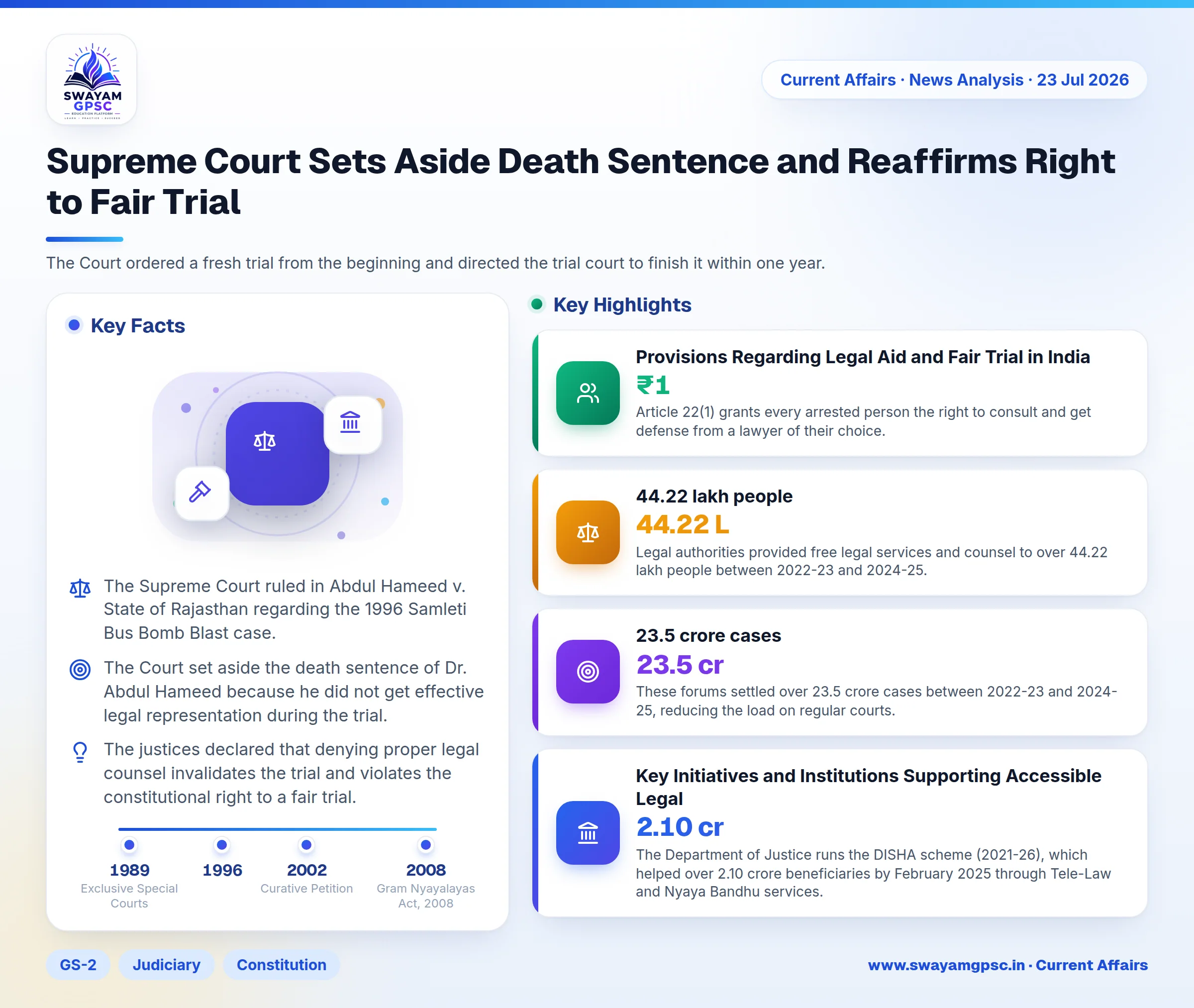
- The Supreme Court ruled in Abdul Hameed v. State of Rajasthan regarding the 1996 Samleti Bus Bomb Blast case.
- The Court set aside the death sentence of Dr. Abdul Hameed because he did not get effective legal representation during the trial.
- The justices declared that denying proper legal counsel invalidates the trial and violates the constitutional right to a fair trial.
- The Court ordered a fresh trial from the beginning and directed the trial court to finish it within one year.
Observations of the SC Regarding Fair Trial
- The Supreme Court stated that a fair trial is a non-negotiable constitutional guarantee that cannot be compromised for practical convenience.
- Criminal justice depends on maintaining a fair and reasonable procedure, not just on securing convictions.
- The Court clarified that a confession from a co-accused person is not primary evidence and can only support independent legal evidence.
- The bench noted that true justice comes from legal discipline and restraint rather than quick revenge.
- The verdict recalled the well-known legal principle that protecting one innocent person matters more than punishing a hundred guilty ones.
- Instead of acquitting the accused, the Court ordered a fresh trial with qualified defense lawyers provided to him.
- Constitutional guarantees and procedures must remain intact even while handling serious offenses like terrorism.
- Trial judges must actively ensure that every accused person has competent legal help before examining witnesses or passing sentences.
Provisions Regarding Legal Aid and Fair Trial in India
- Article 21 guarantees the right to a fair trial and free legal aid as core parts of the fundamental right to life and personal liberty.
- Article 22(1) grants every arrested person the right to consult and get defense from a lawyer of their choice.
- The 42nd Constitutional Amendment Act, 1976 added Article 39A, which directs the government to offer free legal aid so poverty does not block justice.
- Section 341 of the Bharatiya Nagarik Suraksha Sanhita (BNSS), 2023 requires courts to assign a lawyer to an accused person who cannot afford one.
- The State pays the full cost of this court-appointed advocate to protect the fairness of the trial.
- The Legal Services Authorities Act, 1987 established NALSA, SLSAs, and DLSAs across India to offer free legal support to vulnerable sections.
- Eligible groups include SCs/STs, women and children, human trafficking victims, disabled persons, and individuals earning below prescribed limits such as Rs 1 to 3 lakh annually.
- Legal authorities provided free legal services and counsel to over 44.22 lakh people between 2022-23 and 2024-25.
- The Legal Services Authorities Act, 1987 gives formal legal status to Lok Adalats for quick and mutual dispute settlement.
- These forums settled over 23.5 crore cases between 2022-23 and 2024-25, reducing the load on regular courts.
- In Hussainara Khatoon v. Home Secretary, State of Bihar (1979), the Supreme Court ruled that free legal service is part of a fair legal procedure under Article 21.
- In Khatri v. State of Bihar (1981), the Court mandated that the State must offer legal aid right from the first time an accused appears before a magistrate.
Key Initiatives and Institutions Supporting Accessible Legal Aid
- NALSA created the Legal Aid Defense Counsel System (LADCS) to provide dedicated lawyers for criminal cases to eligible individuals.
- The Department of Justice runs the DISHA scheme (2021-26), which helped over 2.10 crore beneficiaries by February 2025 through Tele-Law and Nyaya Bandhu services.
- India has 865 functional Fast-Track Courts (FTCs) as of June 2025 to speed up trials for serious crimes against women, children, and senior citizens.
- The government established 725 Fast-Track Special Courts (FTSCs), including 392 exclusive POCSO courts, to handle rape and child abuse cases quickly.
- Under the Gram Nyayalayas Act, 2008, 488 village courts are working as of March 2025 to provide low-cost justice in rural areas.
- Nari Adalats operate under Mission Shakti at the village level to resolve local family and women-related disputes through mediation.
- The government set up Exclusive Special Courts under the SC/ST (Prevention of Atrocities) Act, 1989 for quick trials of atrocity cases.
Death Penalty in India
- The Death Penalty is the legal execution of an offender after a complete judicial trial.
- This punishment relies on retributive justice, where severe crimes receive equal legal consequences.
- Ancient texts like Manusmriti contained capital punishment provisions, and the Indian Penal Code (1860) formally added it to modern Indian law.
- The Bharatiya Nyaya Sanhita (BNS), 2023 keeps the death penalty for 14 offences, including murder, terrorism, mob lynching causing death, and child rape.
- The law strictly prohibits executing juveniles, pregnant women, and persons with mental illness.
- A Sessions Court death sentence requires mandatory approval from the High Court, and the convict can further appeal to the Supreme Court.
- Convicts can submit a Mercy Petition to the President under Article 72 or to the Governor under Article 161.
- Convicts can also file a Curative Petition under the rules of Rupa Ashok Hurra v. Ashok Hurra (2002) as a last resort against gross injustice.
Conclusion
- The Supreme Court judgment reaffirms that proper legal defense and fair procedures form the heart of the rule of law.
- Protecting rights under Article 21, Article 22, and Article 39A ensures that public faith in the criminal justice system remains strong.