Supreme Court Rules on OBC Creamy Layer Determination Criteria
#GS-2 #Indian Polity & Constitution #Constitution #Governance & Social Justice #Current Events #National #Judgements & Cases #Other Backward Classes #Creamy Layer #Article 15 #Article 16
Key takeaways
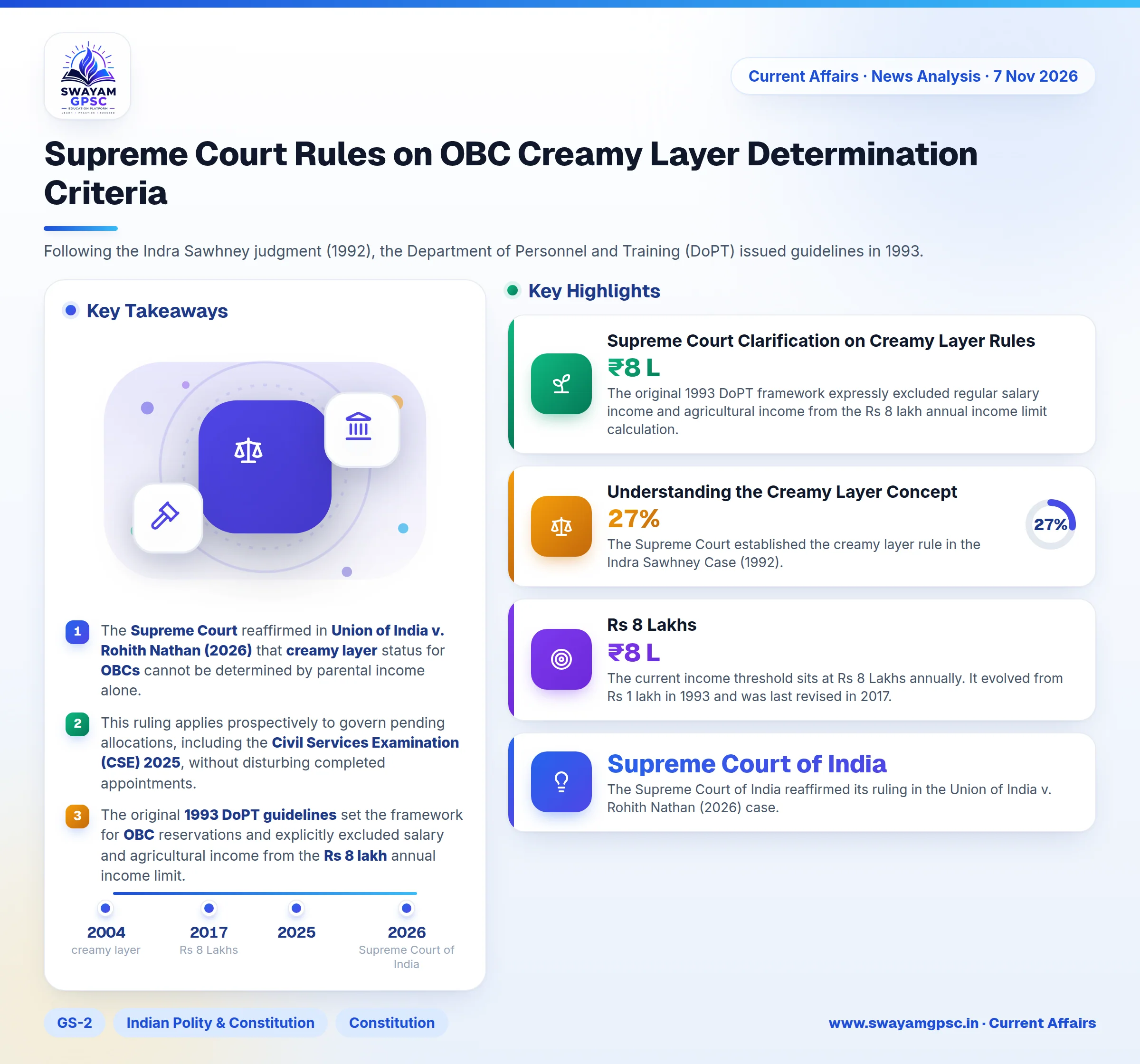
- The Supreme Court reaffirmed in Union of India v. Rohith Nathan (2026) that creamy layer status for OBCs cannot be determined by parental income alone.
- This ruling applies prospectively to govern pending allocations, including the Civil Services Examination (CSE) 2025, without disturbing completed appointments.
- The original 1993 DoPT guidelines set the framework for OBC reservations and explicitly excluded salary and agricultural income from the Rs 8 lakh annual income limit.
- The current income threshold of Rs 8 Lakhs per year for three consecutive years has remained unrevised since 2017, creating challenges amid rising inflation.
Why in News
- The Supreme Court of India reaffirmed its ruling in the Union of India v. Rohith Nathan (2026) case. The Court decided that the creamy layer status of Other Backward Classes (OBCs) cannot be calculated based only on parental income.
- The Supreme Court clarified that this decision will apply only prospectively. It will not change older job appointments or seniority lists, but it will apply to all pending seat allocations, including the Civil Services Examination (CSE) 2025.
Summary of Court Findings
- The Supreme Court emphasized that parental income alone cannot decide creamy layer status. Authorities must strictly follow occupational status as outlined in the original 1993 DoPT guidelines.
- The ruling applies prospectively to pending allocations such as CSE 2025. It protects all completed government appointments and established seniority lists from being reopened.
Supreme Court Clarification on Creamy Layer Rules
- Following the Indra Sawhney judgment (1992), the Department of Personnel and Training (DoPT) issued guidelines in 1993. These guidelines created occupational status ranks (Categories I to V) and a residual income test (Category VI) to identify the creamy layer.
- The original 1993 DoPT framework expressly excluded regular salary income and agricultural income from the Rs 8 lakh annual income limit calculation.
- In 2004, a government letter directed that employees in Public Sector Undertakings (PSUs) and private companies without established rank equivalence to government posts must have their actual salary income added up to determine creamy layer status.
- The Supreme Court struck down this 2004 letter in Union of India v. Rohith Nathan (2026). The Court held that determining creamy layer status solely by adding up salary brackets leads to unfair discrimination against middle-class salaried families.
- The Court clarified that this judgment applies prospectively to avoid administrative chaos. Finished selections and seniority lists remain untouched, but all pending allocations must follow the revised criteria.
Understanding the Creamy Layer Concept
- The Supreme Court established the creamy layer rule in the Indra Sawhney Case (1992). While upholding a 27% reservation for OBCs, the Court required advanced members to be excluded so that reservation benefits reach those who need them most.
- This principle relies on relative equality. Treating a wealthy person and a poor person within the same caste as identical equals violates basic equality rights under the Constitution of India.
- The government formed the Ram Nandan Prasad Committee (1993) to define specific socio-economic criteria, which led to the official 1993 DoPT memorandum.
- Children of constitutional office holders, judges, Group A and Group B officers, and military colonels automatically fall under the creamy layer based on their parent's official status.
- The current income threshold sits at Rs 8 Lakhs annually. It evolved from Rs 1 lakh in 1993 and was last revised in 2017.
- A candidate enters the creamy layer if their parents earn Rs 8 Lakhs or more per year for three consecutive years. However, salary and agricultural income are excluded from this standard limit calculation.
Challenges in Implementing the Creamy Layer Rule
- The government has failed to establish clear post equivalence between PSUs, banks, private companies, and official Group A or Group B government posts since 1993.
- The income threshold of Rs 8 Lakhs has remained unrevised since 2017. Failing to adjust this limit for inflation and rising per capita income unfairly removes truly deserving candidates.
- Treating the entire OBC category as a single group allows a few dominant castes to take most reservation benefits. The Justice G. Rohini Commission (2017) noted that Most Backward Classes (MBCs) often remain left out.
- Different states have varying land ceiling laws and definitions for irrigated land. This creates confusion and unequal standards when applying the agricultural land test for OBC certificates.
- Legal experts debate extending the creamy layer rule to SC/ST categories. Reservations for SCs and STs address deep social exclusion and historical untouchability rather than simple economic standing.
Way Forward
- The government should create an automatic system to revise the income ceiling every three years. Linking this ceiling to the Consumer Price Index (CPI) will protect low-income candidates from inflation.
- Authorities must establish clear and uniform criteria to evaluate rank equivalence across government departments, PSUs, and private sector jobs.
- Policy formulations must follow Article 15(4) and Article 16(4) of the Constitution of India. Economic measures like salary must not overshadow the core goal of correcting historical social backwardness.
- Institutions like National Career Service Centres (NCSCs) should offer targeted training programs for OBC-NCL candidates. Building communication and interview skills helps candidates succeed in high-level selection processes.