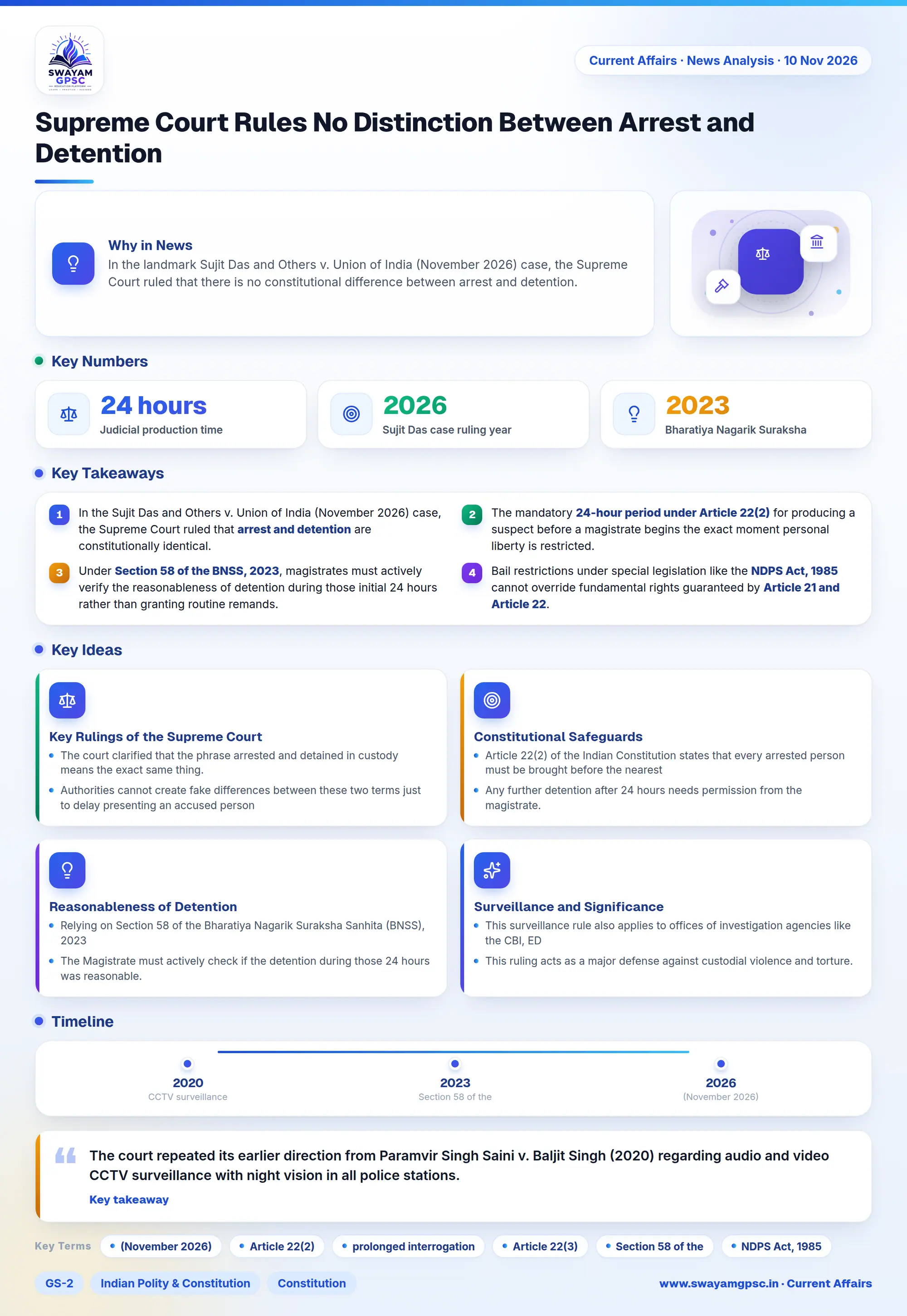
Supreme Court Rules No Distinction Between Arrest and Detention
#GS-2 #Indian Polity & Constitution #Constitution #Judiciary #Fundamental Rights #Rapid Fire CA #Quick Facts For Prelims #Judgements & Cases
Key takeaways
- In the Sujit Das and Others v. Union of India (November 2026) case, the Supreme Court ruled that arrest and detention are constitutionally identical.
- The mandatory 24-hour period under Article 22(2) for producing a suspect before a magistrate begins the exact moment personal liberty is restricted.
- Under Section 58 of the BNSS, 2023, magistrates must actively verify the reasonableness of detention during those initial 24 hours rather than granting routine remands.
- Bail restrictions under special legislation like the NDPS Act, 1985 cannot override fundamental rights guaranteed by Article 21 and Article 22.
Why in News
- In the landmark *Sujit Das and Others v. Union of India* (November 2026) case, the Supreme Court ruled that there is no constitutional difference between arrest and detention.
- The court declared that the mandatory 24-hour period for judicial production under Article 22(2) starts the exact moment a person loses their freedom.
- This rule applies regardless of whether the police have formally recorded the arrest yet.
Key Rulings of the Supreme Court
- The court clarified that the phrase arrested and detained in custody means the exact same thing.
- Authorities cannot create fake differences between these two terms just to delay presenting an accused person before a Magistrate.
- The bench ruled that holding people for prolonged interrogation or searches without a formal arrest is unconstitutional.
- There is no legal buffer period allowed before an official arrest is recorded.
- The constitutional 24-hour countdown starts immediately upon actual detention.
- The only time that does not count toward this 24-hour limit is the actual travel time to the Magistrate's court.
Constitutional Safeguards and Violations
- Article 22(2) of the Indian Constitution states that every arrested person must be brought before the nearest magistrate within 24 hours of arrest.
- Any further detention after 24 hours needs permission from the magistrate.
- This safety rule does not apply to enemy aliens and people held under preventive detention laws as stated in Article 22(3).
- Holding a suspect for more than 24 hours without seeing a magistrate is a direct violation of fundamental rights.
- Such a violation gives the detained person the right to be released immediately.
Reasonableness of Detention and Statutory Laws
- Relying on Section 58 of the Bharatiya Nagarik Suraksha Sanhita (BNSS), 2023, the court noted that staying within the 24-hour limit does not automatically make a detention lawful.
- The Magistrate must actively check if the detention during those 24 hours was reasonable.
- Magistrates can refuse police custody if there is an unexplained and unreasonable gap between physical detention and formal arrest.
- Rules limiting bail under special laws like the NDPS Act, 1985 cannot override fundamental rights under Article 21 and Article 22.
- The Constitution guides how laws are interpreted, and not the other way around.
Surveillance and Significance
- The court repeated its earlier direction from Paramvir Singh Saini v. Baljit Singh (2020) regarding audio and video CCTV surveillance with night vision in all police stations.
- This surveillance rule also applies to offices of investigation agencies like the CBI, ED, and NIA where questioning and holding take place.
- This ruling acts as a major defense against custodial violence and torture.
- It strictly limits arbitrary government actions and stops the habit of automatically granting police remands by shifting oversight duties onto Magistrates.