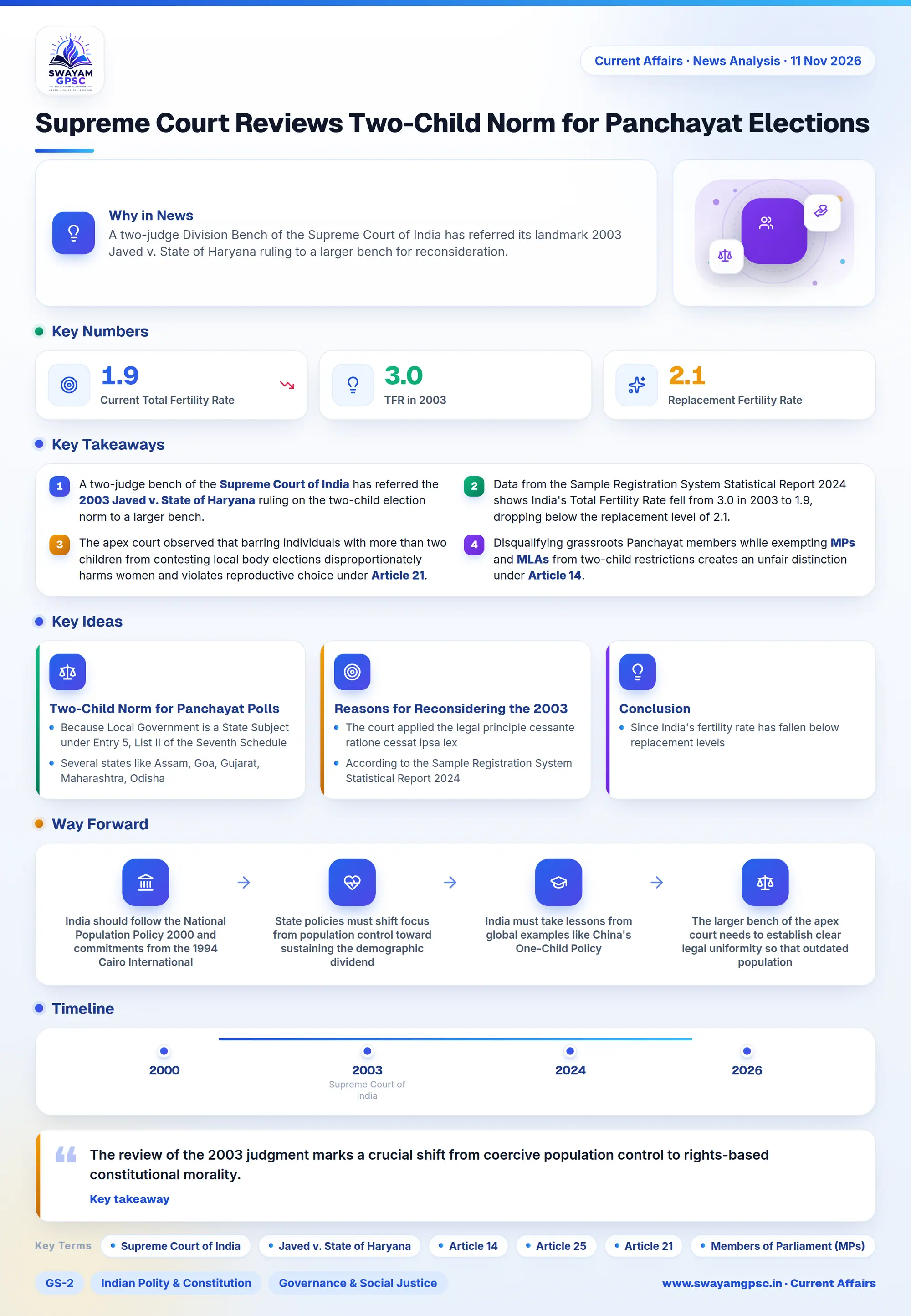
Supreme Court Reviews Two-Child Norm for Panchayat Elections
#GS-2 #Indian Polity & Constitution #Governance & Social Justice #Current Events #GS-3 #Geography #Local Self Governance #Issues Arising Out of Design & Implementation of Policies #Issues Related to Women #Government Policies & Interventions #Demographics #National #Women #Local Government #Population
Key takeaways
- A two-judge bench of the Supreme Court of India has referred the 2003 Javed v. State of Haryana ruling on the two-child election norm to a larger bench.
- Data from the Sample Registration System Statistical Report 2024 shows India's Total Fertility Rate fell from 3.0 in 2003 to 1.9, dropping below the replacement level of 2.1.
- The apex court observed that barring individuals with more than two children from contesting local body elections disproportionately harms women and violates reproductive choice under Article 21.
- Disqualifying grassroots Panchayat members while exempting MPs and MLAs from two-child restrictions creates an unfair distinction under Article 14.
Why in News
- A two-judge Division Bench of the Supreme Court of India has referred its landmark 2003 Javed v. State of Haryana ruling to a larger bench for reconsideration.
- The original 2003 verdict had upheld the constitutional validity of state laws that disqualify individuals with more than two children from contesting local Panchayat elections.
- While hearing Mangala Bhimrao Ingle v. The Additional Commissioner (2026), the court observed that shifting demographic realities have invalidated the original fear of overpopulation.
Two-Child Norm for Panchayat Polls
- Because Local Government is a State Subject under Entry 5, List II of the Seventh Schedule, India has no uniform national law for local election qualifications.
- Several states like Assam, Goa, Gujarat, Maharashtra, Odisha, and Uttarakhand passed laws to incentivize family planning by adding electoral disqualifications for having over two children.
- The Maharashtra Village Panchayats Act, 1959 explicitly prevents anyone with a third child born after the cut-off date from becoming or remaining a Gram Panchayat member.
- The K. Karunakaran Committee on Population (1992-1993) recommended central legislation to bar people with more than two children from all elected posts, but Parliament never passed such a law.
- State legislations contain specific statutory exceptions, such as excluding adopted children from the count or applying special counting rules for multiple births.
- In the 2003 landmark case Javed v. State of Haryana, the apex court upheld the Haryana Panchayati Raj Act, 1994 which restricted candidates with over two children.
- The court ruled that contesting an election is a statutory right rather than a fundamental right, making it subject to legislative conditions.
- The court held that the rule was constitutionally valid under Article 14 because it had a rational link to national socio-economic welfare and family planning goals.
- The judges also rejected religious freedom arguments under Article 25, establishing that non-mandatory personal laws must yield to secular social welfare legislation.
Reasons for Reconsidering the 2003 Judgement
- The court applied the legal principle cessante ratione cessat ipsa lex, meaning a law must cease when its underlying reason no longer exists.
- According to the Sample Registration System Statistical Report 2024, India's Total Fertility Rate dropped from 3.0 in 2003 down to 1.9, falling below the replacement level of 2.1.
- The bench highlighted that forcing citizens to choose between their political rights and personal choices severely violates reproductive autonomy under Article 21.
- The rule places an unfair burden on women in a patriarchal society where they lack control over reproductive decisions, leading to desertion, forced sex-selective abortions, and denied paternity.
- The court questioned the logic connecting family size to administrative competence, noting that excluding citizens from grassroots representation lacks a rational nexus.
- Applying demographic restrictions strictly to local representatives while exempting Members of Parliament (MPs) and Members of Legislative Assemblies (MLAs) raises serious fairness concerns under Article 14.
Way Forward
- India should follow the National Population Policy 2000 and commitments from the 1994 Cairo International Conference on Population and Development (ICPD) to keep family planning voluntary.
- State policies must shift focus from population control toward sustaining the demographic dividend through investments in maternal health, education, and human capital.
- India must take lessons from global examples like China's One-Child Policy, which created aging populations and severe socio-economic crises.
- The larger bench of the apex court needs to establish clear legal uniformity so that outdated population assumptions do not undermine grassroots democracy.
Conclusion
- The review of the 2003 judgment marks a crucial shift from coercive population control to rights-based constitutional morality.
- Since India's fertility rate has fallen below replacement levels, election law must safeguard women's reproductive autonomy under Article 21 instead of relying on outdated demographic fears.