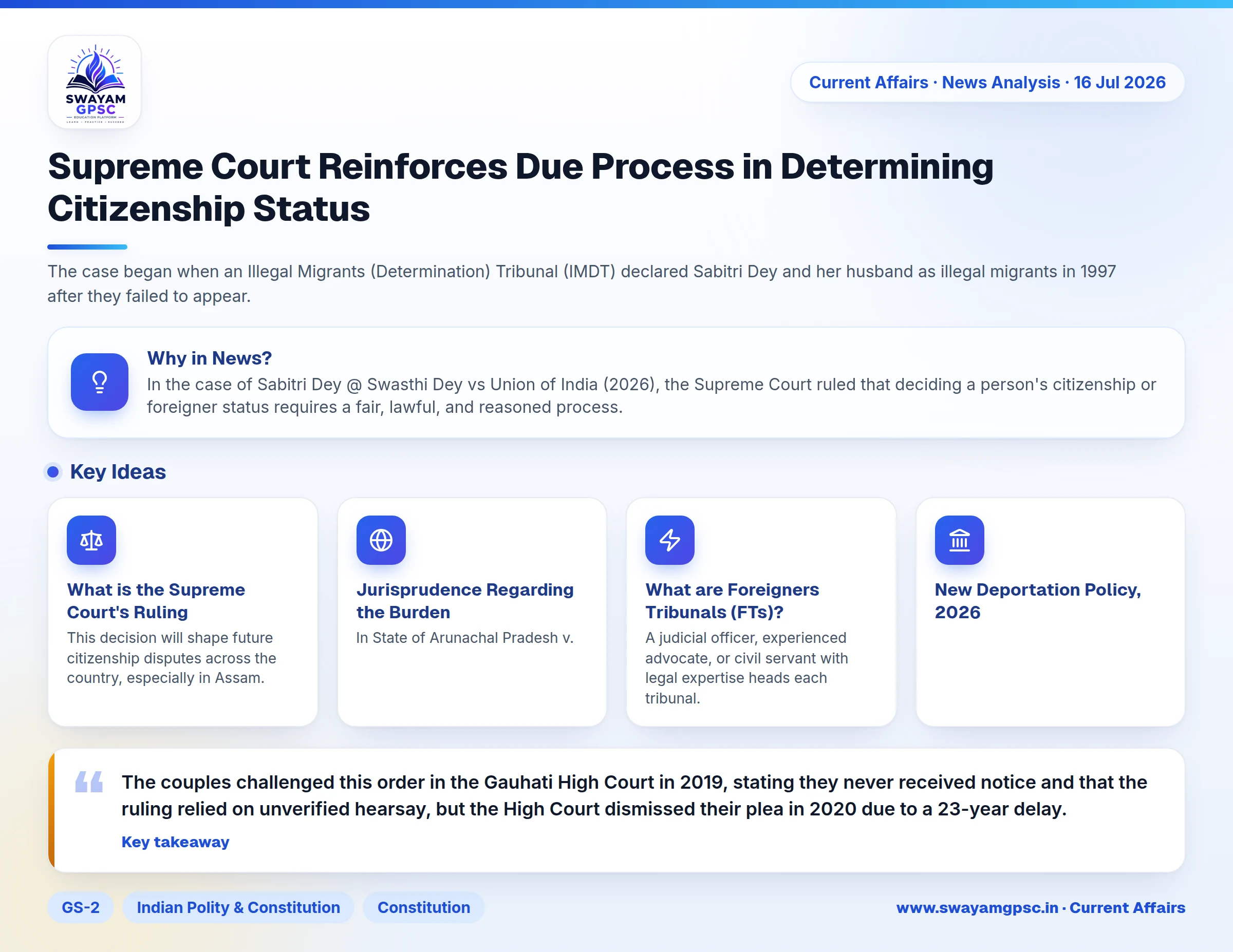
Supreme Court Reinforces Due Process in Determining Citizenship Status
#GS-2 #Indian Polity & Constitution #Constitution #Governance & Social Justice #Regulatory Bodies #GS-3 #Current Events #National #Citizenship #Foreigners Act #Foreigners Tribunals
Why in News?
- In the case of Sabitri Dey @ Swasthi Dey vs Union of India (2026), the Supreme Court ruled that deciding a person's citizenship or foreigner status requires a fair, lawful, and reasoned process.
- The Supreme Court set aside 27 Gauhati High Court judgments that had confirmed orders from Foreigners Tribunals declaring several individuals in Assam as foreigners, and directed new hearings following proper legal principles.
What is the Supreme Court's Ruling Regarding Citizenship Determination?
- The case began when an Illegal Migrants (Determination) Tribunal (IMDT) declared Sabitri Dey and her husband as illegal migrants in 1997 after they failed to appear.
- The couples challenged this order in the Gauhati High Court in 2019, stating they never received notice and that the ruling relied on unverified hearsay, but the High Court dismissed their plea in 2020 due to a 23-year delay.
- The Supreme Court clarified that proceedings under the Foreigners Act, 1946 must remain fair and lawful rather than being one-sided or done without proper thought.
- The Court held that constitutional protections under Article 14 for equality and Article 21 for personal liberty apply to non-citizens as well.
- Referring to Section 9 of the Foreigners Act, 1946, the Court noted that while the person must prove their citizenship, the tribunal cannot make an automatic declaration just because the individual was absent.
- The Tribunal must independently verify evidence from the State, ensure proper notice delivery, grant a fair hearing, explain the grounds, and write down clear reasons before declaring someone a foreigner.
- This ruling ensures that citizenship cases focus on constitutional fairness rather than procedural technicalities, making tribunals more accountable.
- It protects people from being declared foreigners without a hearing, preventing severe outcomes like detention, deportation, and statelessness.
- This decision will shape future citizenship disputes across the country, especially in Assam.
Jurisprudence Regarding the Burden of Proof in Citizenship Determination
- Section 9 of the Foreigners Act, 1946 introduced the reverse burden of proof, requiring the accused individual to prove that they are an Indian citizen.
- The Illegal Migrants (Determination by Tribunals) Act, 1983 applied only to Assam and shifted the burden of proof to the government, making deportation harder.
- In State of Arunachal Pradesh v. Khudiram Chakma (1994), the Supreme Court held that any person claiming Indian citizenship must prove it.
- In Sarbananda Sonowal v. Union of India (2005), the Supreme Court struck down the IMDT Act, 1983 under Article 355 and restored Section 9 of the Foreigners Act, 1946.
What are Foreigners Tribunals (FTs)?
- Foreigners Tribunals are quasi-judicial bodies established under the Foreigners (Tribunals) Order, 1964 using powers from Section 3 of the Foreigners Act, 1946.
- While the order applies nationwide, these tribunals mainly operate in Assam to decide citizenship cases linked to the National Register of Citizens (NRC).
- A judicial officer, experienced advocate, or civil servant with legal expertise heads each tribunal.
- These tribunals hold civil court powers, allowing them to summon witnesses, take oaths, and inspect documents.
- Under the Immigration and Foreigners Order, 2025, tribunal members also exercise powers of a Judicial Magistrate First Class to issue arrest warrants and order detention.
- When receiving a case, the tribunal issues a notice, hears the evidence, and gives a reasoned order that could lead to detention and deportation if the person is declared a foreigner.
New Deportation Policy, 2026
- The Ministry of Home Affairs introduced the New Deportation Policy, 2026 to create a uniform procedure for identifying, detaining, and deporting illegal migrants from Bangladesh and Myanmar.
- This policy covers undocumented migrants, individuals staying past their visa expiry, and individuals declared as foreigners by tribunals.
- States and Union Territories must create district Special Task Forces, operate Holding Centres, and use the Foreigners Identification Portal for biometric records.
- The government must complete nationality verification for suspected illegal migrants from Bangladesh and Myanmar within 90 days.
How has India's Citizenship Framework Evolved from Jus Soli to Jus Sanguinis?
- In 1950, the Constituent Assembly chose a birth-based approach under Articles 5 to 11 of the Constitution.
- The Citizenship Act, 1955 set legal pathways to gain citizenship through birth, descent, registration, naturalisation, and territory acquisition.
- Following the Assam Accord (1985), the Citizenship (Amendment) Act, 1986 required at least one parent to be an Indian citizen, moving toward citizenship by bloodline.
- The Citizenship (Amendment) Act, 2003 required that one parent be an Indian citizen and the other not be an illegal migrant.
- The 2003 Amendment also defined illegal migrants, created Section 14A for the National Register of Indian Citizens, and introduced Overseas Citizen of India status.
- The Citizenship (Amendment) Act, 2019 allowed fast-track citizenship for persecuted minorities from Pakistan, Bangladesh, and Afghanistan, cutting the naturalisation requirement from 11 years to 5 years.
- Citizens acquiring status through birth or descent do not get formal certificates, whereas those joining through registration or naturalisation receive official citizenship certificates.
- For people born between 26th January 1950 and 1st July 1987, birth in India granted citizenship regardless of parentage.
- For people born between 1st July 1987 and 3rd December 2004, at least one parent had to be an Indian citizen.
- For people born on or after 3rd December 2004, one parent must be an Indian citizen and the other parent must not be an illegal migrant.
- People born outside India gain citizenship by descent if their parents register the birth at an Indian consulate within the specified timeline.
- Foreign nationals and Persons of Indian Origin can apply through registration or naturalisation after living in India for 12 years, as India does not allow dual citizenship.