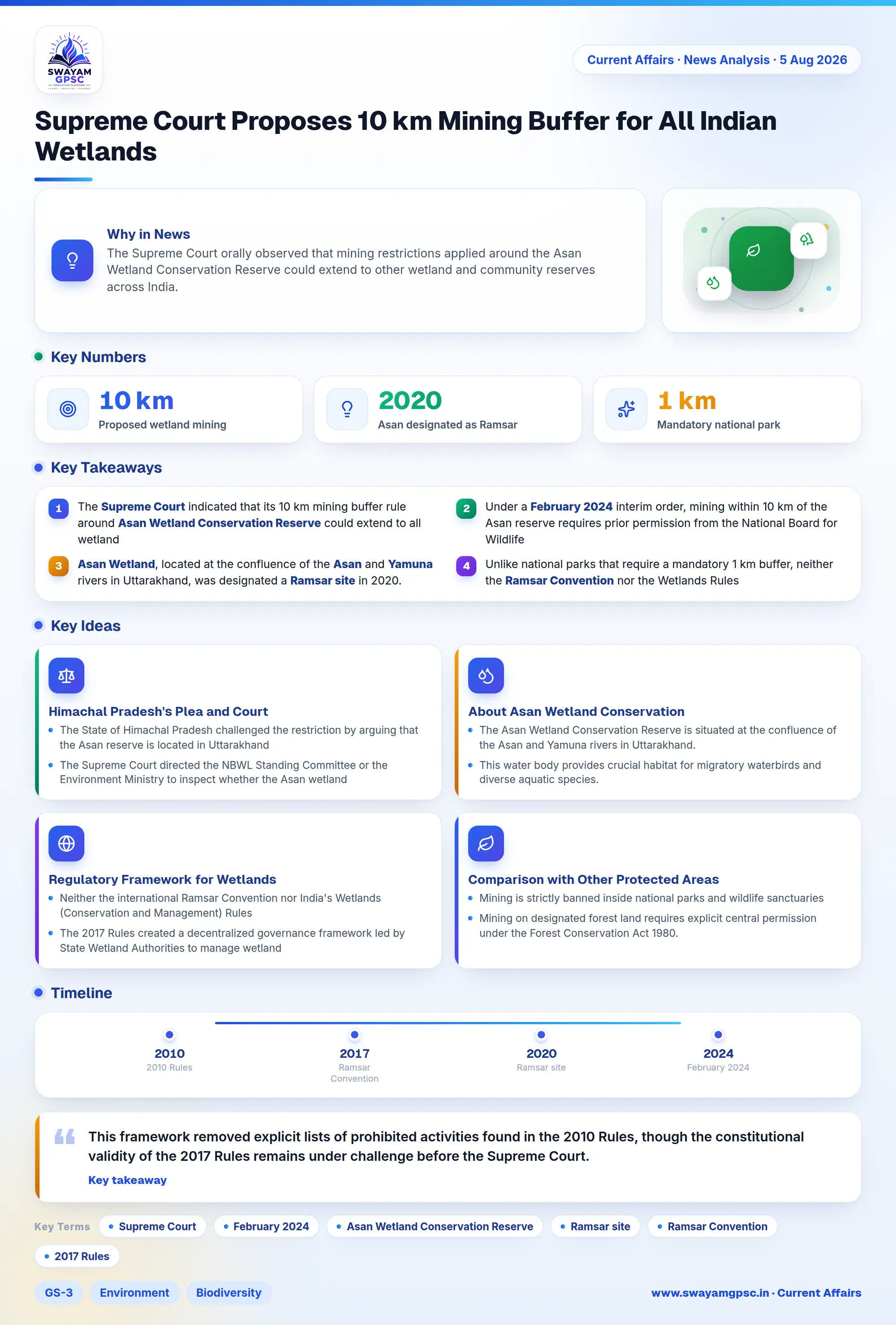
Supreme Court Proposes 10 km Mining Buffer for All Indian Wetlands
#GS-3 #Environment #Biodiversity #GS-2 #Indian Polity & Constitution #Judiciary #Current Events #National #Wetlands Conservation
Key takeaways
- The Supreme Court indicated that its 10 km mining buffer rule around Asan Wetland Conservation Reserve could extend to all wetland and community reserves across India.
- Under a February 2024 interim order, mining within 10 km of the Asan reserve requires prior permission from the National Board for Wildlife (NBWL) or MoEFCC.
- Asan Wetland, located at the confluence of the Asan and Yamuna rivers in Uttarakhand, was designated a Ramsar site in 2020.
- Unlike national parks that require a mandatory 1 km buffer, neither the Ramsar Convention nor the Wetlands Rules, 2017 specifies a fixed buffer distance for wetlands.
Why in News
- The Supreme Court orally observed that mining restrictions applied around the Asan Wetland Conservation Reserve could extend to other wetland and community reserves across India.
- In February 2024, the Court issued an interim order that prohibited any mining activity within a 10 km radius of the Asan reserve.
- Miners must obtain prior permission from the Standing Committee of the National Board for Wildlife (NBWL) or the Ministry of Environment, Forest and Climate Change (MoEFCC) before starting operations.
Himachal Pradesh's Plea and Court Direction
- The State of Himachal Pradesh challenged the restriction by arguing that the Asan reserve is located in Uttarakhand and wetlands do not automatically need external buffer zones.
- The Supreme Court directed the NBWL Standing Committee or the Environment Ministry to inspect whether the Asan wetland boundary touches Himachal Pradesh.
- If the wetland area extends into Himachal Pradesh, the 2024 restrictions will apply there, otherwise standard statutory frameworks will decide mining applications.
About Asan Wetland Conservation Reserve
- The Asan Wetland Conservation Reserve is situated at the confluence of the Asan and Yamuna rivers in Uttarakhand.
- This water body provides crucial habitat for migratory waterbirds and diverse aquatic species.
- The site received international recognition when declared a Ramsar site in 2020.
Regulatory Framework for Wetlands
- Neither the international Ramsar Convention nor India's Wetlands (Conservation and Management) Rules, 2017 mandates a fixed buffer zone distance around wetlands.
- The 2017 Rules created a decentralized governance framework led by State Wetland Authorities to manage wetland ecosystems.
- This framework removed explicit lists of prohibited activities found in the 2010 Rules, though the constitutional validity of the 2017 Rules remains under challenge before the Supreme Court.
Comparison with Other Protected Areas
- Mining is strictly banned inside national parks and wildlife sanctuaries, with a mandatory 1 km safety buffer around their boundaries under Supreme Court orders.
- Mining on designated forest land requires explicit central permission under the Forest Conservation Act 1980.
- Commercial mining projects must also clear environmental assessment procedures mandated under the Environment Impact Assessment Notification, 2006.