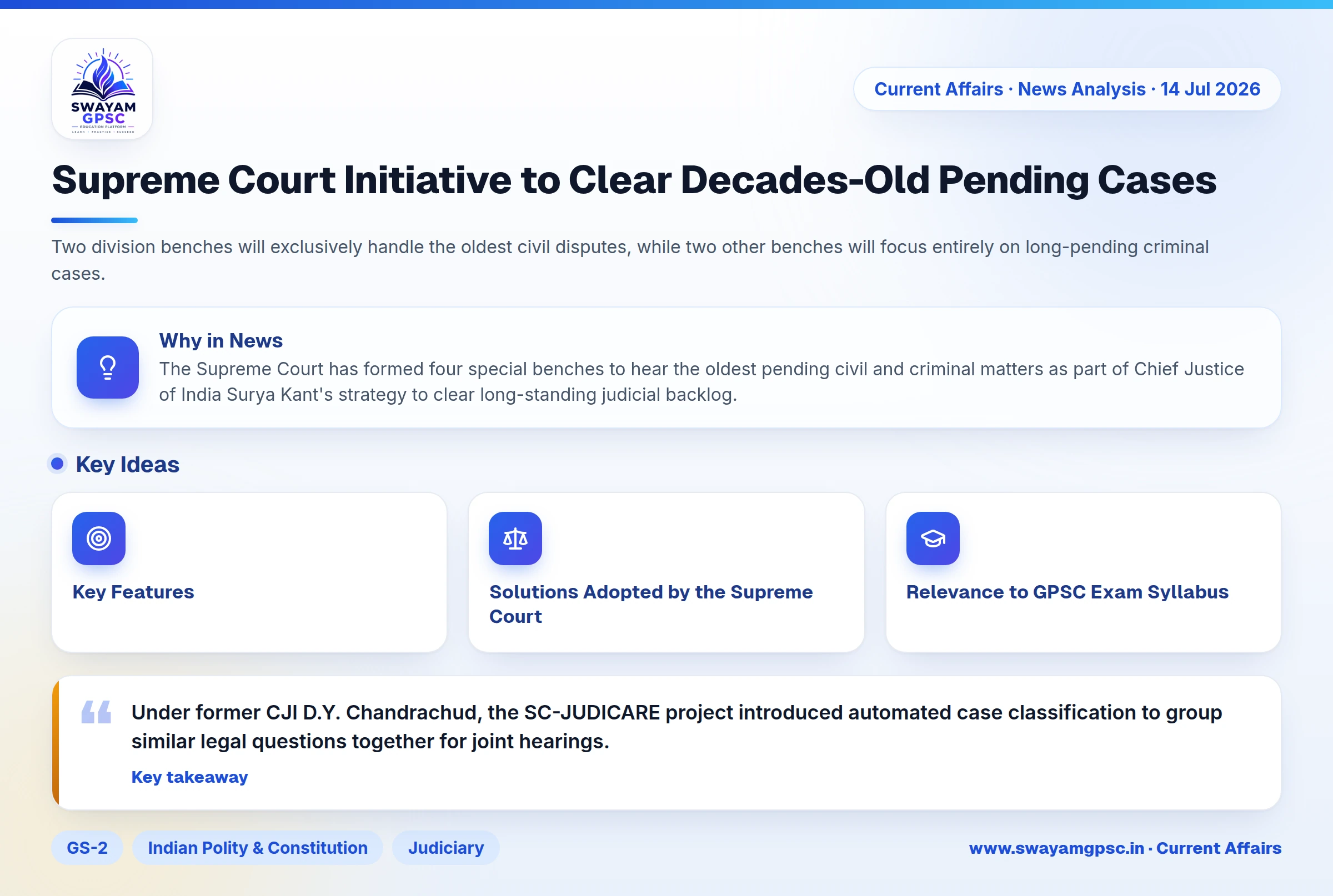
Supreme Court Initiative to Clear Decades-Old Pending Cases
#GS-2 #Indian Polity & Constitution #Judiciary #Governance & Social Justice #Good Governance #Current Events #National #Supreme Court Backlog
Why in News
- The Supreme Court has formed four special benches to hear the oldest pending civil and criminal matters as part of Chief Justice of India Surya Kant's strategy to clear long-standing judicial backlog.
- This special case management mechanism allows dedicated benches to resolve decades-old cases without taking up daily fresh petitions.
Key Features
- Two division benches will exclusively handle the oldest civil disputes, while two other benches will focus entirely on long-pending criminal cases.
- These special benches will operate on Tuesdays, Wednesdays and Thursdays, which are reserved for detailed regular hearings.
- High priority will go to legacy disputes, including civil cases pending since 1986 and criminal cases dating back to 1991.
- Excluding routine miscellaneous matters gives judges continuous time to hear complex arguments and deliver final judgments.
Solutions Adopted by the Supreme Court
- Chief Justice Surya Kant created four exclusive benches specifically to systematically clear old civil and criminal matters.
- Former CJI U.U. Lalit introduced separate time slots for fresh cases and old regular matters so older disputes are not neglected.
- Under former CJI D.Y. Chandrachud, the SC-JUDICARE project introduced automated case classification to group similar legal questions together for joint hearings.
- The court also organized dedicated Lok Adalat weeks and thematic benches for specialized cases like death penalty references to speed up disposal rates.
Relevance to GPSC Exam Syllabus
- Under GS Paper II, this topic relates to the structure, functioning, and dispute-resolution mechanisms of the Indian Judiciary.
- It covers key governance issues such as judicial pendency, access to justice, court efficiency, and legal reforms.
- For essay writing, it provides practical examples for themes like justice delayed is justice denied and institutional reforms.