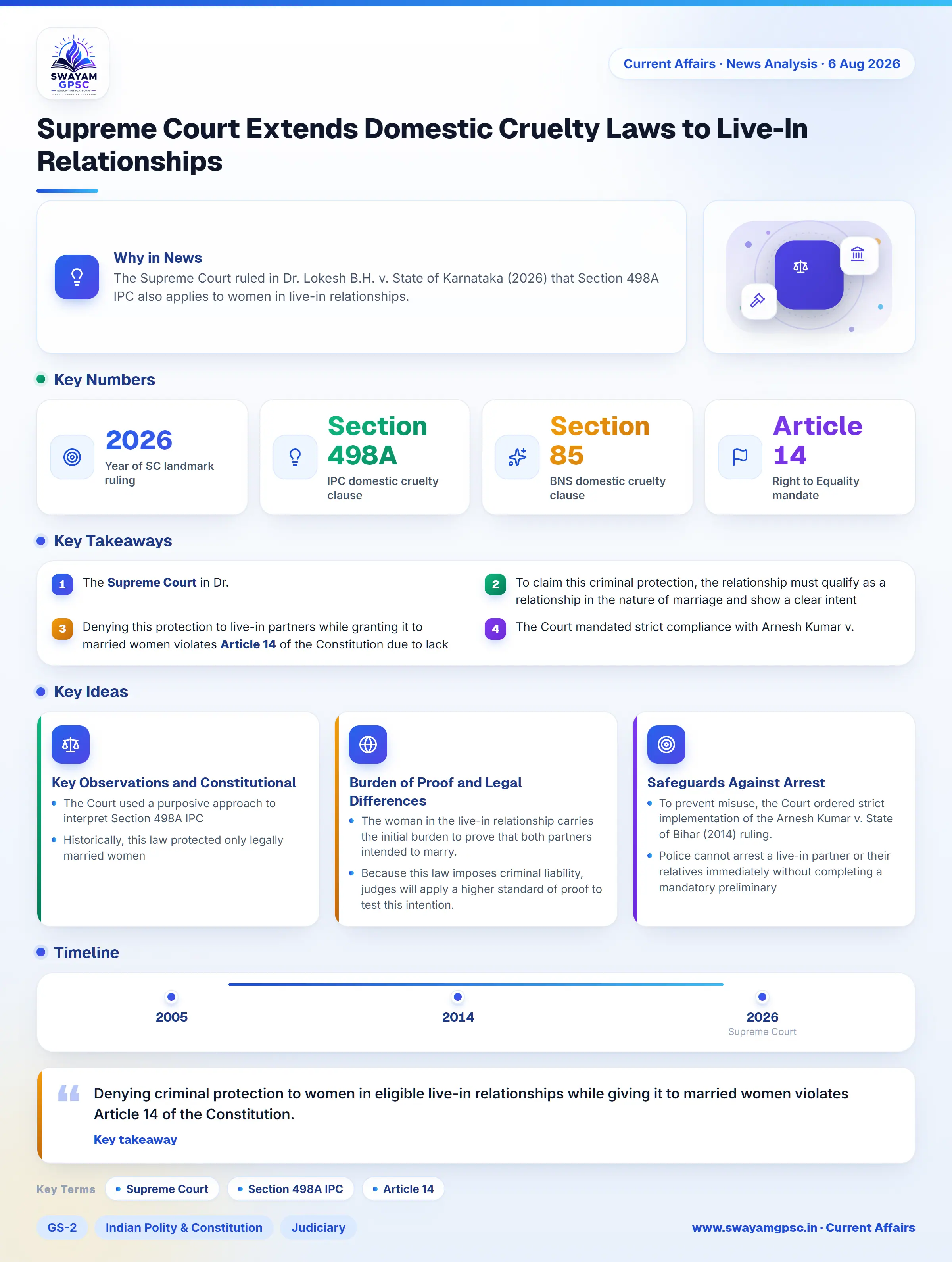
Supreme Court Extends Domestic Cruelty Laws to Live-In Relationships
#GS-2 #Indian Polity & Constitution #Judiciary #Governance & Social Justice #Women #Vulnerable Sections #Current Events #National
Key takeaways
- The Supreme Court in Dr. Lokesh B.H. v. State of Karnataka (2026) extended protection against domestic cruelty under Section 498A IPC (now Section 85 BNS) to women in live-in relationships.
- To claim this criminal protection, the relationship must qualify as a relationship in the nature of marriage and show a clear intent to marry.
- Denying this protection to live-in partners while granting it to married women violates Article 14 of the Constitution due to lack of rational nexus.
- The Court mandated strict compliance with Arnesh Kumar v. State of Bihar (2014) guidelines, requiring a mandatory preliminary inquiry before any arrest.
Why in News
- The Supreme Court ruled in Dr. Lokesh B.H. v. State of Karnataka (2026) that Section 498A IPC also applies to women in live-in relationships.
- This provision, which is now Section 85 of Bharatiya Nyaya Sanhita (BNS), protects live-in partners if the relationship resembles a marriage and shows an intent to marry.
Key Observations and Constitutional Protection
- The Court used a purposive approach to interpret Section 498A IPC, focusing on its main goal to prevent domestic cruelty regardless of formal marriage status.
- Historically, this law protected only legally married women, but courts gradually extended it to women tricked into void or voidable marriages.
- Denying criminal protection to women in eligible live-in relationships while giving it to married women violates Article 14 of the Constitution.
- The Court borrowed the term 'relationship in the nature of marriage' from the Protection of Women from Domestic Violence Act, 2005.
- Such relationships must show shared finances, a common household, long-term stability, and public recognition as husband and wife.
Burden of Proof and Legal Differences
- The woman in the live-in relationship carries the initial burden to prove that both partners intended to marry.
- Because this law imposes criminal liability, judges will apply a higher standard of proof to test this intention.
- The Protection of Women from Domestic Violence Act, 2005 offers civil solutions like financial maintenance and protection orders.
- In contrast, Section 498A IPC and Section 85 BNS deal with criminal punishment to deter abusers directly.
Safeguards Against Arrest
- To prevent misuse, the Court ordered strict implementation of the Arnesh Kumar v. State of Bihar (2014) ruling.
- Police cannot arrest a live-in partner or their relatives immediately without completing a mandatory preliminary inquiry first.