Supreme Court Declares Right to Walk a Fundamental Right
#GS-2 #Indian Polity & Constitution #Fundamental Rights #Governance & Social Justice #Good Governance #Current Events #National #Rapid Fire CA
Key takeaways
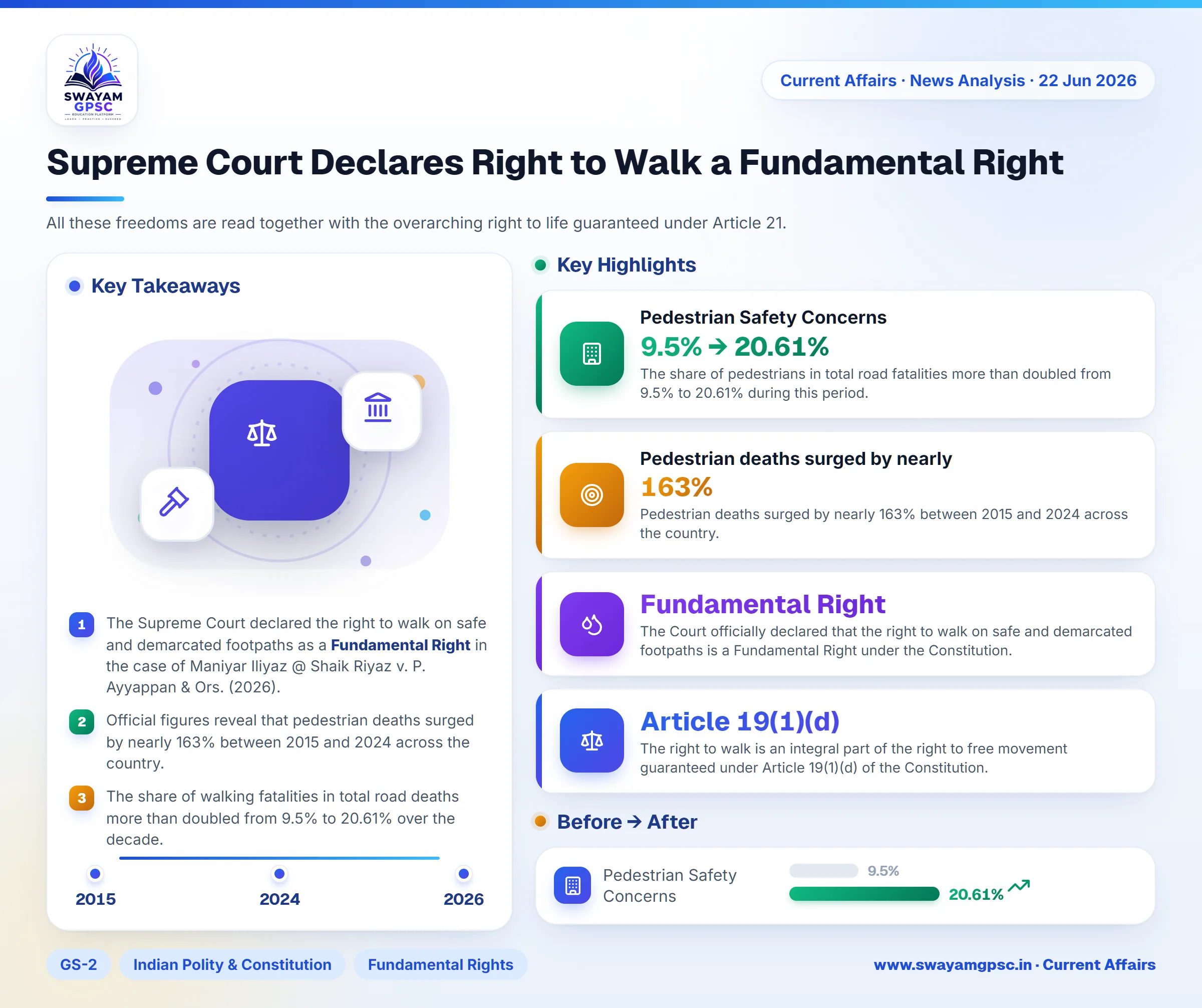
- The Supreme Court declared the right to walk on safe and demarcated footpaths as a Fundamental Right in the case of *Maniyar Iliyaz @ Shaik Riyaz v. P. Ayyappan & Ors. (2026)*.
- Official figures reveal that pedestrian deaths surged by nearly 163% between 2015 and 2024 across the country.
- The share of walking fatalities in total road deaths more than doubled from 9.5% to 20.61% over the decade.
- The right to walk is legally protected under Article 19(1)(d) and Article 21 of the Constitution.
- The Court directed the government to involve the Law Commission of India and key ministries in establishing proper pedestrian safety laws.
Why in News
- The Supreme Court of India gave a very important judgment in the case of *Maniyar Iliyaz @ Shaik Riyaz v. P. Ayyappan & Ors. (2026)*.
- The Court officially declared that the right to walk on safe and demarcated footpaths is a Fundamental Right under the Constitution.
Pedestrian Safety Concerns
- Official data highlights a huge and alarming increase in risks faced by people who walk on roads.
- Pedestrian deaths surged by nearly 163% between 2015 and 2024 across the country.
- The share of pedestrians in total road fatalities more than doubled from 9.5% to 20.61% during this period.
Constitutional Basis
- The right to walk is an integral part of the right to free movement guaranteed under Article 19(1)(d) of the Constitution.
- It also connects closely with the rights of expression, assembly, and association under Articles 19(1)(a), 19(1)(b), and 19(1)(c).
- All these freedoms are read together with the overarching right to life guaranteed under Article 21.
Priority and Legal Duties
- The Court ruled that pedestrians possess absolute priority over motor vehicles when using designated paths.
- While this freedom has reasonable limits, public spaces cannot be completely controlled by drivers of motorized vehicles.
- The existence of a road creates a legal duty for public bodies like Urban Development Authorities, Municipal Corporations, Municipalities, and Panchayats to build and maintain safe walking paths.
Legal Remedies and Critique
- Citizens can now approach courts for constitutional remedies if authorities fail to provide safe footpaths.
- This new legal route is completely separate from regular compensation rules found under the Motor Vehicles Act, 1988.
- The Supreme Court strongly criticized the Motor Vehicles Act, 1988 for treating cars and vehicles as the main focus while treating human walkers as an afterthought.
Way Forward and Directives
- The Court stressed the urgent need for modern governance and dedicated laws to protect pedestrians.
- It suggested setting up a special, full-time regulatory body with proper expert knowledge for pedestrian planning.
- The Court asked its Registry to send the judgment to the Law Commission of India and important central ministries like Housing and Urban Affairs, Rural Development, and Road Transport and Highways to start framing new rules.