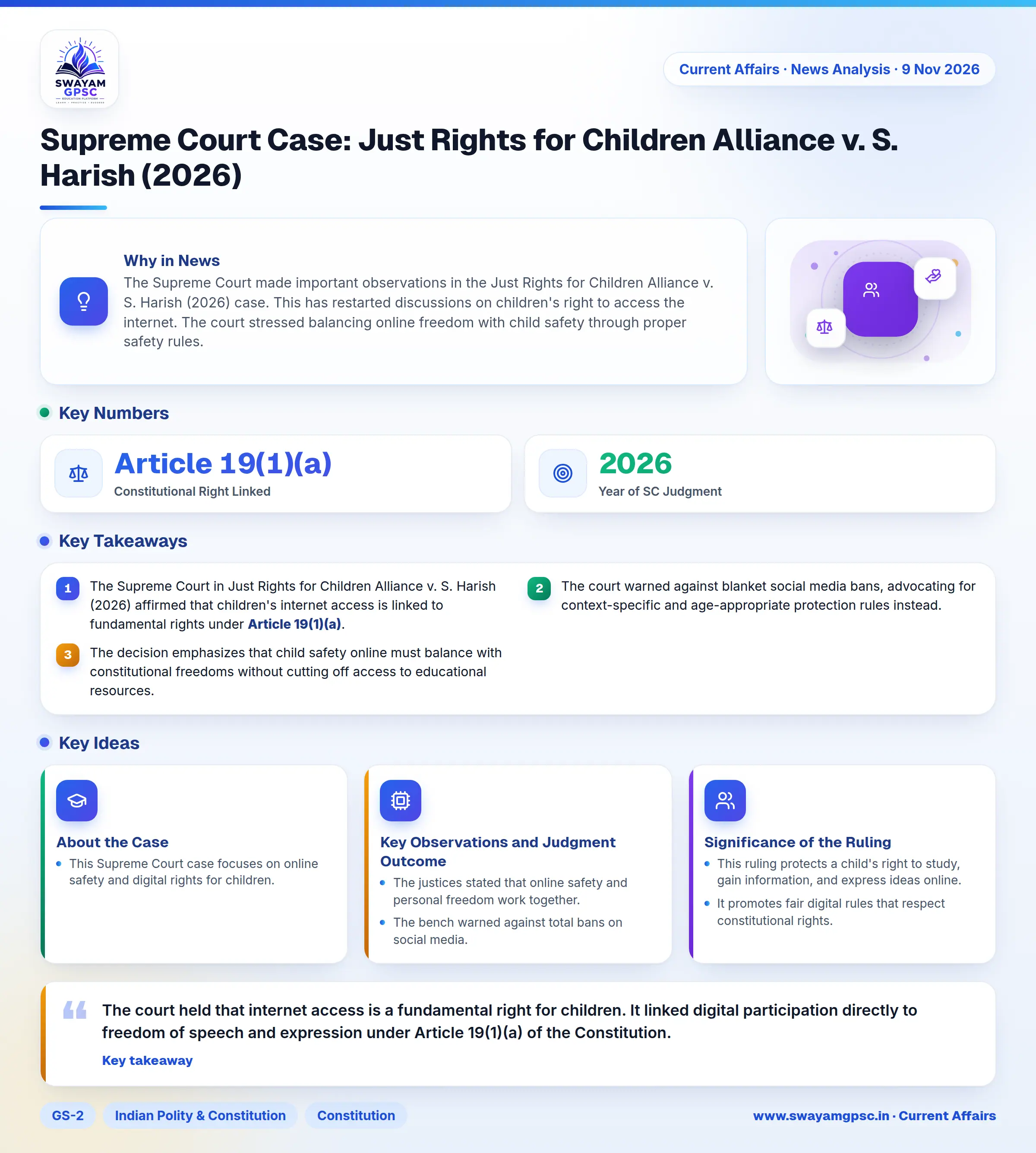
Supreme Court Case: Just Rights for Children Alliance v. S. Harish (2026)
#GS-2 #Indian Polity & Constitution #Constitution #Governance & Social Justice #Vulnerable Sections #Social Justice #Current Events #National #GS-4 #Ethics #Child Rights #Fundamental Rights
Key takeaways
- The Supreme Court in Just Rights for Children Alliance v. S. Harish (2026) affirmed that children's internet access is linked to fundamental rights under Article 19(1)(a).
- The court warned against blanket social media bans, advocating for context-specific and age-appropriate protection rules instead.
- The decision emphasizes that child safety online must balance with constitutional freedoms without cutting off access to educational resources.
Why in News
- The Supreme Court made important observations in the Just Rights for Children Alliance v. S. Harish (2026) case. This has restarted discussions on children's right to access the internet. The court stressed balancing online freedom with child safety through proper safety rules.
About the Case
- This Supreme Court case focuses on online safety and digital rights for children. It shows the need to protect minors from harmful content while keeping their access to knowledge and education open.
Key Observations and Judgment Outcome
- The court held that internet access is a fundamental right for children. It linked digital participation directly to freedom of speech and expression under Article 19(1)(a) of the Constitution.
- The justices stated that online safety and personal freedom work together. Protecting children from online harms should not mean cutting off their digital rights.
- The bench warned against total bans on social media. It suggested creating balanced rules tailored to Indian conditions rather than blindly copying foreign laws.
- The court emphasized age-appropriate safety measures. These measures must block dangerous content while keeping learning tools open for young minds.
Significance of the Ruling
- This ruling protects a child's right to study, gain information, and express ideas online. It recognizes that the internet is vital for a child's mental and social growth.
- It promotes fair digital rules that respect constitutional rights. Government measures should protect children without putting blanket bans on their online activities.
- It reminds parents, schools, governments, and tech companies of their shared duty. Everyone must work together to stop cyberbullying, data privacy violations, and bad online content.