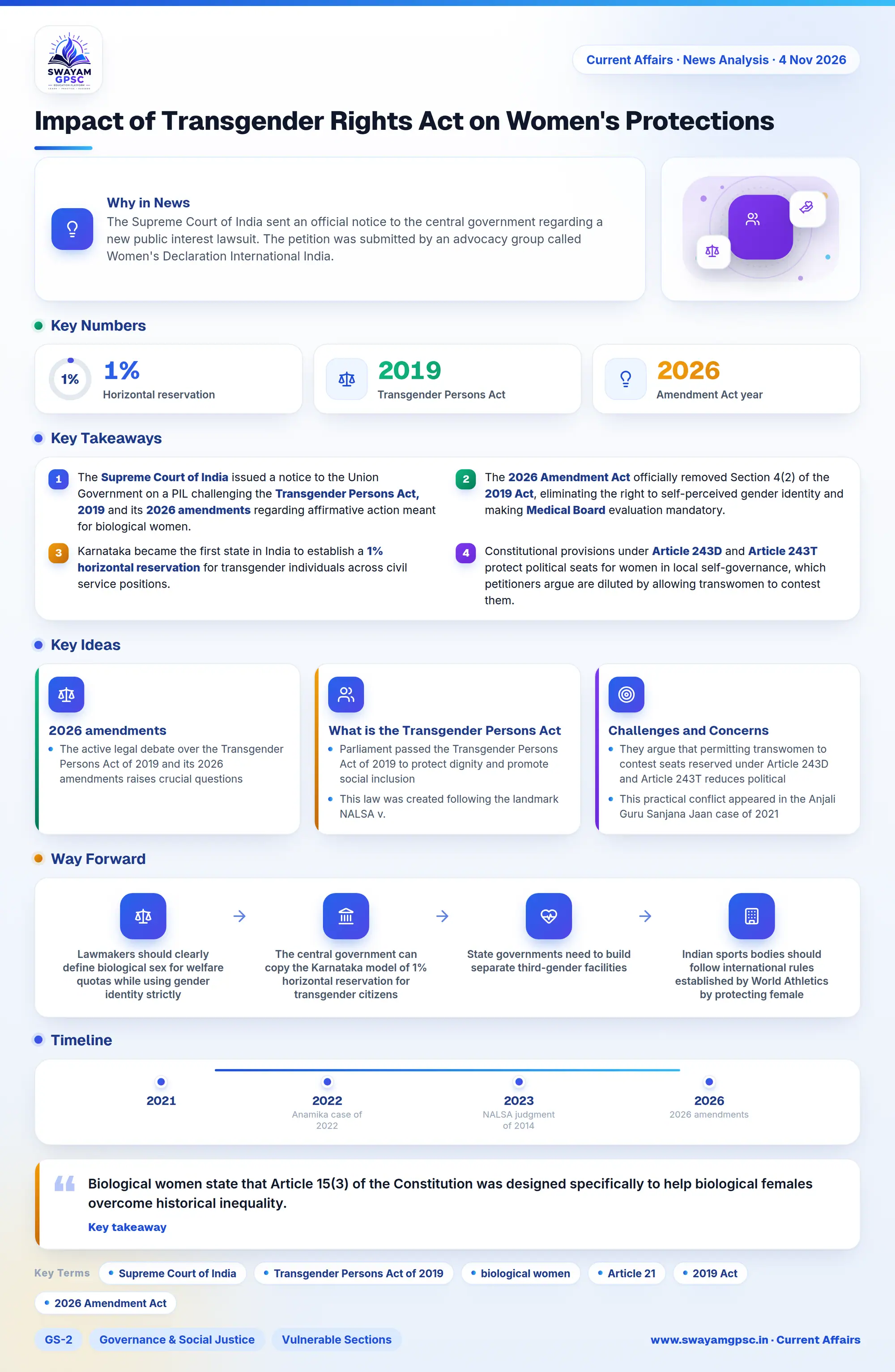
Impact of Transgender Rights Act on Women's Protections
#GS-2 #Governance & Social Justice #Vulnerable Sections #Indian Polity & Constitution #Constitution #Issues Related to Transgenders #Welfare Schemes #Gender Equality #Government Policies & Interventions
Key takeaways
- The Supreme Court of India issued a notice to the Union Government on a PIL challenging the Transgender Persons Act, 2019 and its 2026 amendments regarding affirmative action meant for biological women.
- The 2026 Amendment Act officially removed Section 4(2) of the 2019 Act, eliminating the right to self-perceived gender identity and making Medical Board evaluation mandatory.
- Karnataka became the first state in India to establish a 1% horizontal reservation for transgender individuals across civil service positions.
- Constitutional provisions under Article 243D and Article 243T protect political seats for women in local self-governance, which petitioners argue are diluted by allowing transwomen to contest them.
- Under the BNSS 2023 legal framework, gender certification ambiguity creates procedural hurdles regarding body searches and sunset arrest rules for police authorities.
Why in News
- The Supreme Court of India sent an official notice to the central government regarding a new public interest lawsuit.
- The petition was submitted by an advocacy group called Women's Declaration International India.
- This legal challenge targets the Transgender Persons Act of 2019 along with its recent 2026 amendments.
- The petitioners argue that legal recognition of gender identity must not automatically give transgender individuals access to constitutional benefits reserved exclusively for biological women.
Summary
- The active legal debate over the Transgender Persons Act of 2019 and its 2026 amendments raises crucial questions about constitutional rights and political representation.
- To resolve this issue, the government must balance transgender equality with safeguards for female safety and bodily privacy.
What is the Transgender Persons Act of 2019
- Parliament passed the Transgender Persons Act of 2019 to protect dignity and promote social inclusion for the transgender community.
- This law was created following the landmark NALSA v. Union of India judgment of 2014, which formally recognized transgender people as a third gender.
- The original law strictly forbids discrimination against transgender people in schools, hospitals, and workplaces.
- It also recognized an individual's right to choose their gender identity, which matches the privacy protections under Article 21 established in the K.S. Puttaswamy judgment of 2017.
- Under Section 6 of the original 2019 Act, a District Magistrate could issue an official identity certificate recognizing a person as transgender.
- Section 7 allowed individuals to update their official gender to male or female after undergoing gender-affirming medical procedures.
- The law established the National Council for Transgender Persons to advise the central government on national policy decisions.
- However, the 2026 Amendment Act narrowed the official legal definition of transgender persons by focusing mostly on traditional groups like hijras or kinnars.
- The 2026 amendment also removed Section 4(2) from the original law, which ended the statutory right to self-perceived gender identity.
- Now, identity certificates require mandatory screening by a state-level Medical Board led by a Chief Medical Officer.
- Legal experts note a growing tension between the NALSA judgment of 2014 and the Supriyo ruling of 2023 regarding eligibility for female-specific quotas.
Challenges and Concerns
- Biological women state that Article 15(3) of the Constitution was designed specifically to help biological females overcome historical inequality.
- They argue that permitting transwomen to contest seats reserved under Article 243D and Article 243T reduces political opportunities for biological women.
- This practical conflict appeared in the Anjali Guru Sanjana Jaan case of 2021, where a transwoman contested a village panchayat seat reserved for women.
- Women's rights groups point out that allowing individuals born male into female-only shelters and prisons compromises safety and trauma recovery.
- The new criminal procedure rules under BNSS 2023 create operational confusion for police officers regarding search protocols and sunset arrest rules.
- Sports experts emphasize that transwomen retain permanent physical advantages like greater muscle mass and bone density from male puberty.
- Even so, the Kerala High Court permitted transgender athletes to compete based on self-perceived identity in the Anamika case of 2022.
Way Forward
- Lawmakers should clearly define biological sex for welfare quotas while using gender identity strictly for anti-discrimination protections.
- The central government can copy the Karnataka model of 1% horizontal reservation for transgender citizens to avoid cutting into female quotas.
- State governments need to build separate third-gender facilities, including specialized hospital wards and dedicated washrooms.
- Indian sports bodies should follow international rules established by World Athletics by protecting female categories while establishing open competition classes.
- Public agencies like the National Crime Records Bureau should use dual-recording systems that list both biological sex at birth and legal gender identity.
Conclusion
- Courts must apply the principle of Harmonious Construction to protect transgender individuals without eroding historical safeguards for women.
- True social progress requires creating fresh resources and specialized infrastructure rather than forcing different vulnerable groups to compete for the same protections.