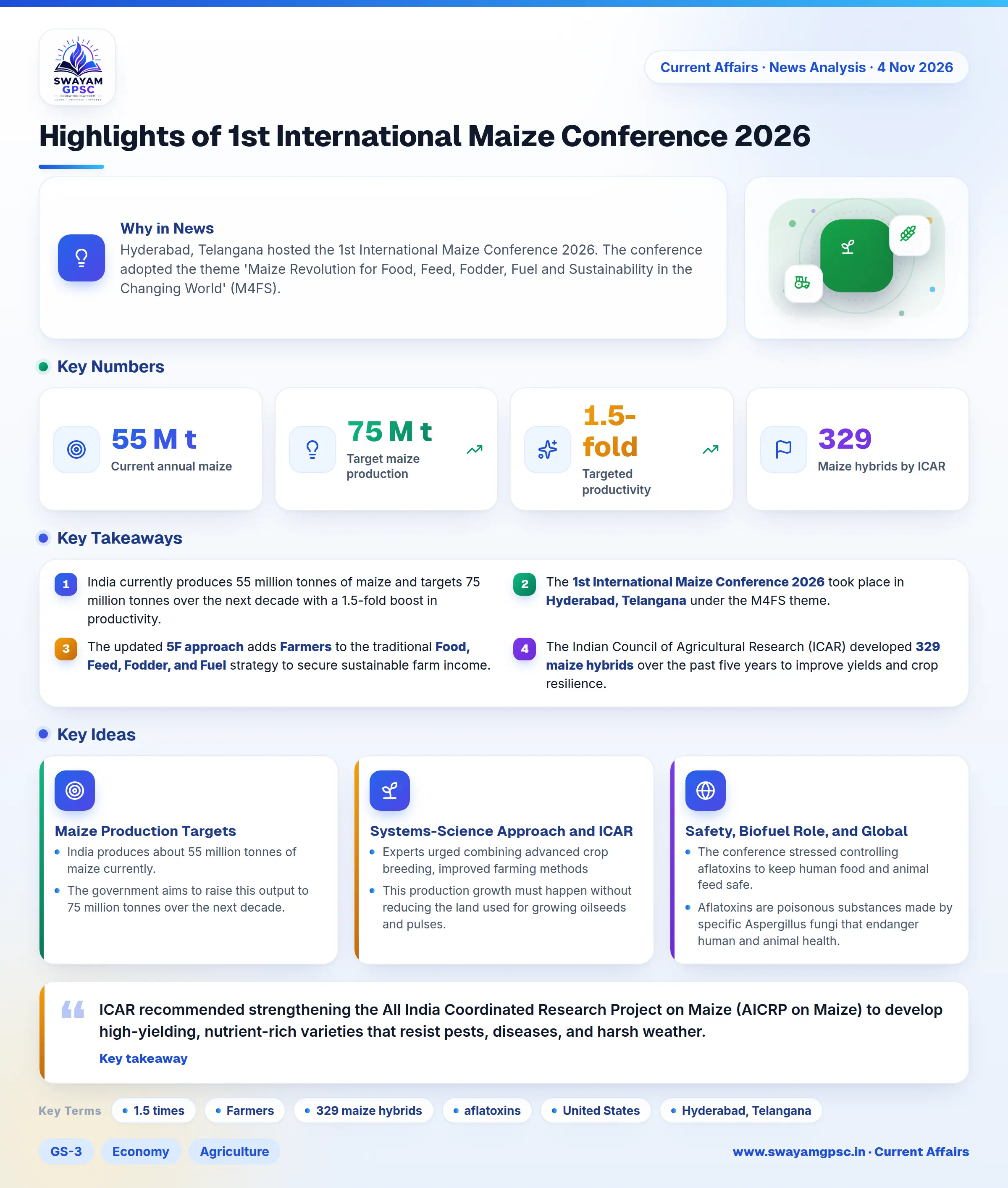
Highlights of 1st International Maize Conference 2026
#GS-3 #Economy #Agriculture #Science & Technology #Rapid Fire CA #Quick Facts For Prelims #Agricultural Marketing #Achievements of Indians in Science & Technology
Key takeaways
- India currently produces 55 million tonnes of maize and targets 75 million tonnes over the next decade with a 1.5-fold boost in productivity.
- The 1st International Maize Conference 2026 took place in Hyderabad, Telangana under the M4FS theme.
- The updated 5F approach adds Farmers to the traditional Food, Feed, Fodder, and Fuel strategy to secure sustainable farm income.
- The Indian Council of Agricultural Research (ICAR) developed 329 maize hybrids over the past five years to improve yields and crop resilience.
- Maize plays a growing role as a key feedstock for ethanol production to support India's national bioenergy goals.
Why in News
- Hyderabad, Telangana hosted the 1st International Maize Conference 2026.
- The conference adopted the theme 'Maize Revolution for Food, Feed, Fodder, Fuel and Sustainability in the Changing World' (M4FS).
- Scientists, policymakers, and industry experts gathered to boost maize productivity, research, and sustainable value-chain development.
Maize Production Targets and the Expanded 5F Approach
- India produces about 55 million tonnes of maize currently.
- The government aims to raise this output to 75 million tonnes over the next decade.
- Plans focus on boosting productivity by 1.5 times through modern technology, better farming techniques, and efficient resource management.
- The standard 4F framework (Food, Feed, Fodder, and Fuel) now adds a fifth F for Farmers.
- This expanded strategy keeps farmer profitability and sustainable income at the core of all maize development programs.
Systems-Science Approach and ICAR Research Efforts
- Experts urged combining advanced crop breeding, improved farming methods, and smart resource use to close yield gaps across different seasons and regions.
- This production growth must happen without reducing the land used for growing oilseeds and pulses.
- The Indian Council of Agricultural Research (ICAR) created 329 maize hybrids in the last five years.
- ICAR recommended strengthening the All India Coordinated Research Project on Maize (AICRP on Maize) to develop high-yielding, nutrient-rich varieties that resist pests, diseases, and harsh weather.
- The strategy highlights modern breeding, germplasm conservation, farm mechanization, and affordable quality seeds through public-sector hybrids.
Safety, Biofuel Role, and Global Collaboration
- The conference stressed controlling aflatoxins to keep human food and animal feed safe.
- Aflatoxins are poisonous substances made by specific Aspergillus fungi that endanger human and animal health.
- Maize is becoming vital as a raw material for ethanol production, helping India meet its clean energy and energy-security goals.
- Speakers called for stronger partnerships between research institutes, farm universities, industry, and global groups like CIMMYT (International Maize and Wheat Improvement Center).
- The top global maize producers for 2025-26 include the United States, China, Brazil, Argentina, the European Union, and India.