Khelo India Sports Goods Manufacturing Scheme Approved by Cabinet
#GS-2 #Governance & Social Justice #Government Policies & Interventions #Welfare Schemes #GS-3 #Economy #Infrastructure #Manufacturing #MSME
Key takeaways
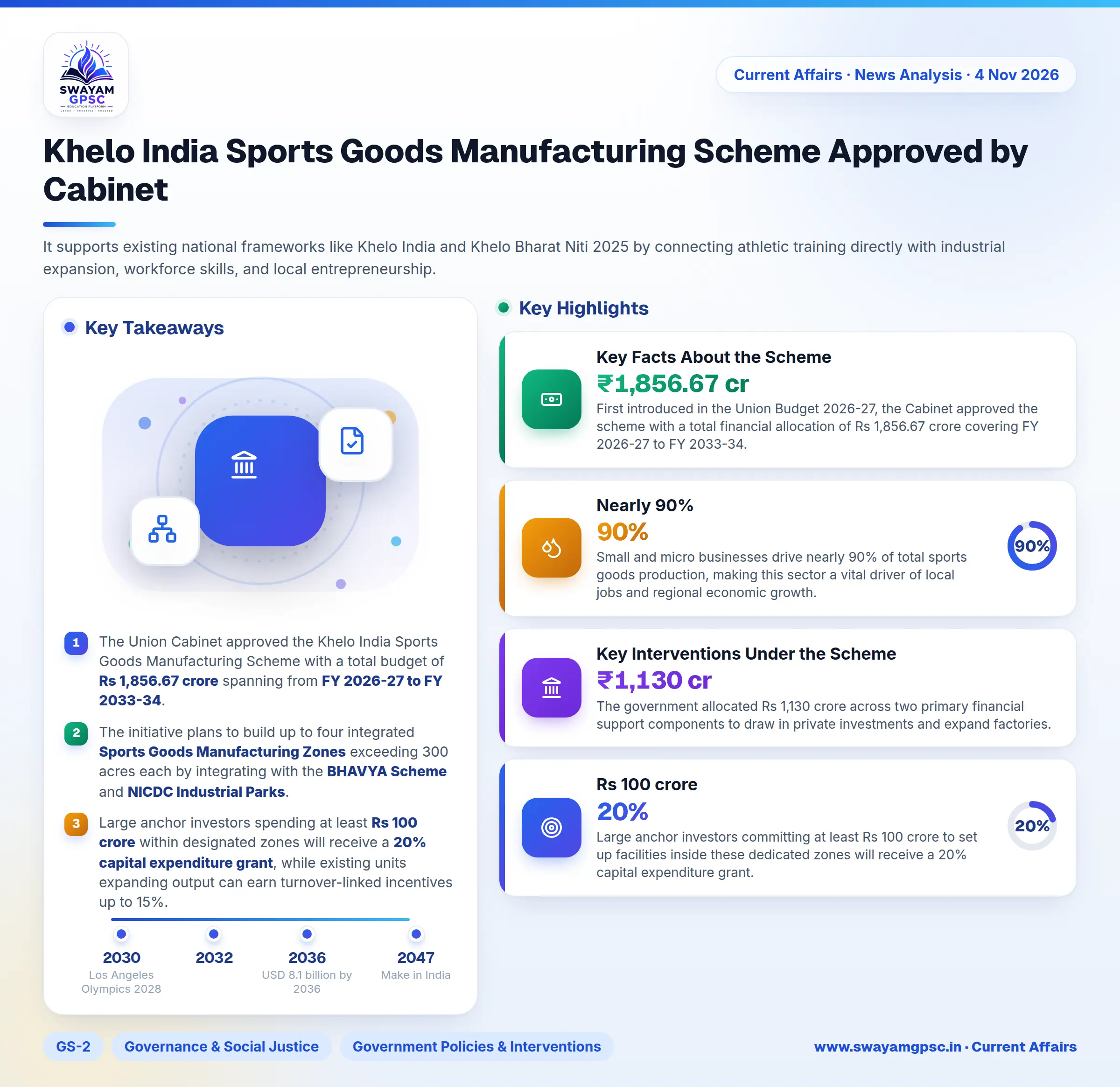
- The Union Cabinet approved the Khelo India Sports Goods Manufacturing Scheme with a total budget of Rs 1,856.67 crore spanning from FY 2026-27 to FY 2033-34.
- The initiative plans to build up to four integrated Sports Goods Manufacturing Zones exceeding 300 acres each by integrating with the BHAVYA Scheme and NICDC Industrial Parks.
- Large anchor investors spending at least Rs 100 crore within designated zones will receive a 20% capital expenditure grant, while existing units expanding output can earn turnover-linked incentives up to 15%.
- Small and micro enterprises manage nearly 90% of domestic production, centered largely around traditional manufacturing hubs in Jalandhar and Meerut.
- India aims to scale its athletic equipment exports from USD 275 million up to USD 8.1 billion by 2036, which could create 54 lakh direct and indirect jobs.
Why in News
- The Union Cabinet approved the Khelo India Sports Goods Manufacturing Scheme to transform India into a global hub for making athletic equipment.
- This scheme aims to attract private capital, boost domestic production capacity, foster modern innovation, and expand overall equipment exports.
- It supports existing national frameworks like Khelo India and Khelo Bharat Niti 2025 by connecting athletic training directly with industrial expansion, workforce skills, and local entrepreneurship.
Key Facts About the Scheme
- First introduced in the Union Budget 2026-27, the Cabinet approved the scheme with a total financial allocation of Rs 1,856.67 crore covering FY 2026-27 to FY 2033-34.
- The initiative integrates multiple support mechanisms including technology modernizations, startup grants, skill building programs, and international market expansion.
- It aims to build India into a competitive global manufacturing center for safe, high-quality, and cost-effective athletic goods that integrate easily into international supply chains.
- India's overall athletic framework is moving beyond simple game participation to focus heavily on industrial output, local employment, and export revenues.
- The country already possesses well-established production clusters in Jalandhar in Punjab and Meerut in Uttar Pradesh, which rely on skilled craftspeople and entrepreneurial networks.
- Small and micro businesses drive nearly 90% of total sports goods production, making this sector a vital driver of local jobs and regional economic growth.
Key Interventions Under the Scheme
- The government plans to establish up to four integrated Sports Goods Manufacturing Zones (SGMZs) spanning over 300 acres each by linking with the BHAVYA Scheme and NICDC Industrial Parks.
- These specialized zones will group together core equipment makers, raw material suppliers, testing labs, and product design centers to lower production overheads.
- The government allocated Rs 1,130 crore across two primary financial support components to draw in private investments and expand factories.
- Large anchor investors committing at least Rs 100 crore to set up facilities inside these dedicated zones will receive a 20% capital expenditure grant.
- Existing manufacturers spending Rs 10 crore or more on expansion will get turnover-linked financial incentives reaching up to 15%.
- Traditional regional clusters will receive state-shared funding to modernize their common testing facilities and shared workspace infrastructure, helping local MSMEs stay competitive.
- A dedicated sum of Rs 105 crore will assist manufacturers in getting safety and performance approvals from global sports bodies by funding 70% of initial certification costs and 50% of renewal fees.
- Leading academic institutions will host new Centres of Excellence to research advanced equipment materials, while DPIIT-registered sports startups can secure up to Rs 20 lakh in development grants alongside co-funding from the Anusandhan National Research Foundation.
- The government will run specialized workforce training initiatives alongside the Ministry of Skill Development and Entrepreneurship and factory leaders to train workers for modern production techniques.
- An upcoming India Sports Expo and a broad Brand India marketing campaign backed by the Export Promotion Mission will market domestic sports goods to international buyers.
Current Status of India's Sports Goods Industry
- The two major clusters in Jalandhar and Meerut operate more than 250 dedicated export units, 1,000 domestic factories, 4,000 micro units, and close to 20,000 home workshops, alongside bicycle hubs in Ludhiana and apparel centers in Delhi and Mumbai.
- Small and micro enterprises manage nearly 90% of all physical production, creating crucial employment opportunities across regional towns.
- India exports high-grade cricket bats, protective gear, athletic balls, and gym machinery, with the UK, US, and Australia buying over 50% of these exports.
- Indian manufacturers control roughly 75% to 80% of global cricket bat production and hold a 30% to 35% share of the world market for protective cricket helmets.
- Sports goods manufacturing relies on diverse raw material sectors like rubber, industrial polymers, modern composites, wood, and metal alloys.
- India's domestic sports market stands at USD 2.5 billion, including USD 0.5 billion in core equipment, leaving vast room for growth against the global export market of USD 52 billion recorded in 2024.
- With focused policy support, India's equipment exports could climb to USD 8.1 billion by 2036, potentially generating 54 lakh direct and indirect jobs.
- Upcoming events like the Los Angeles Olympics 2028, Ahmedabad Commonwealth Games 2030, Brisbane Olympics 2032, and India's potential 2036 Olympics hosting bid present large commercial opportunities for domestic makers.
Other Government Initiatives Supporting the Sports Ecosystem
- The Bharat Audyogik Vikas Yojna (BHAVYA) carries a budget of Rs 33,660 crore to set up 100 plug-and-play industrial parks with ready factories, labs, and warehouses that the new sports zones will use.
- The National Industrial Corridor Development Corporation (NICDC) manages 20 industrial smart cities across 13 States, providing modern logistics networks that directly benefit sports equipment manufacturing hubs.
- The Anusandhan National Research Foundation (ANRF) bridges academic research and real-world factory applications, driving R&D into protective gear and lightweight materials.
- The Startup India program, which backed over 2.23 lakh recognised startups creating 23.36 lakh direct jobs by March 31, 2026, offers up to Rs 20 lakh in targeted grants to sports tech innovators.
- The Export Promotion Mission, operating with Rs 25,060 crore from FY 2025-26 to FY 2030-31, uses its Niryat Protsahan and Niryat Disha sub-schemes to help MSMEs with international trade branding, testing, and buyer matching.
- Though sports goods are not directly listed under the Production Linked Incentive (PLI) program, which generated Rs 23.8 lakh crore in production and created 14.6 lakh jobs across 14 sectors by June 2026, the scheme applies similar financial incentive models.
- Launched in 2017, the core Khelo India program consolidated three legacy schemes to improve talent identification and local training, funding 349 infrastructure projects worth Rs 3,176 crore and setting up 1,067 Khelo India Centres by July 2026.
- The Khelo Bharat Niti 2025 framework views sports as a major driver of national economic growth and local jobs, promoting physical activity across schools under NEP 2020 while encouraging participation from women and marginalized groups.
Way Forward
- The success of the new scheme relies on quick zone construction, steady joint research between universities and factories, and targeted workforce skill training.
- Expanding international certifications and marketing high-value sports goods will help Indian manufacturers secure a larger share of global trade.
- Building reliable domestic supply chains will support the broader goals of Make in India and Viksit Bharat@2047.