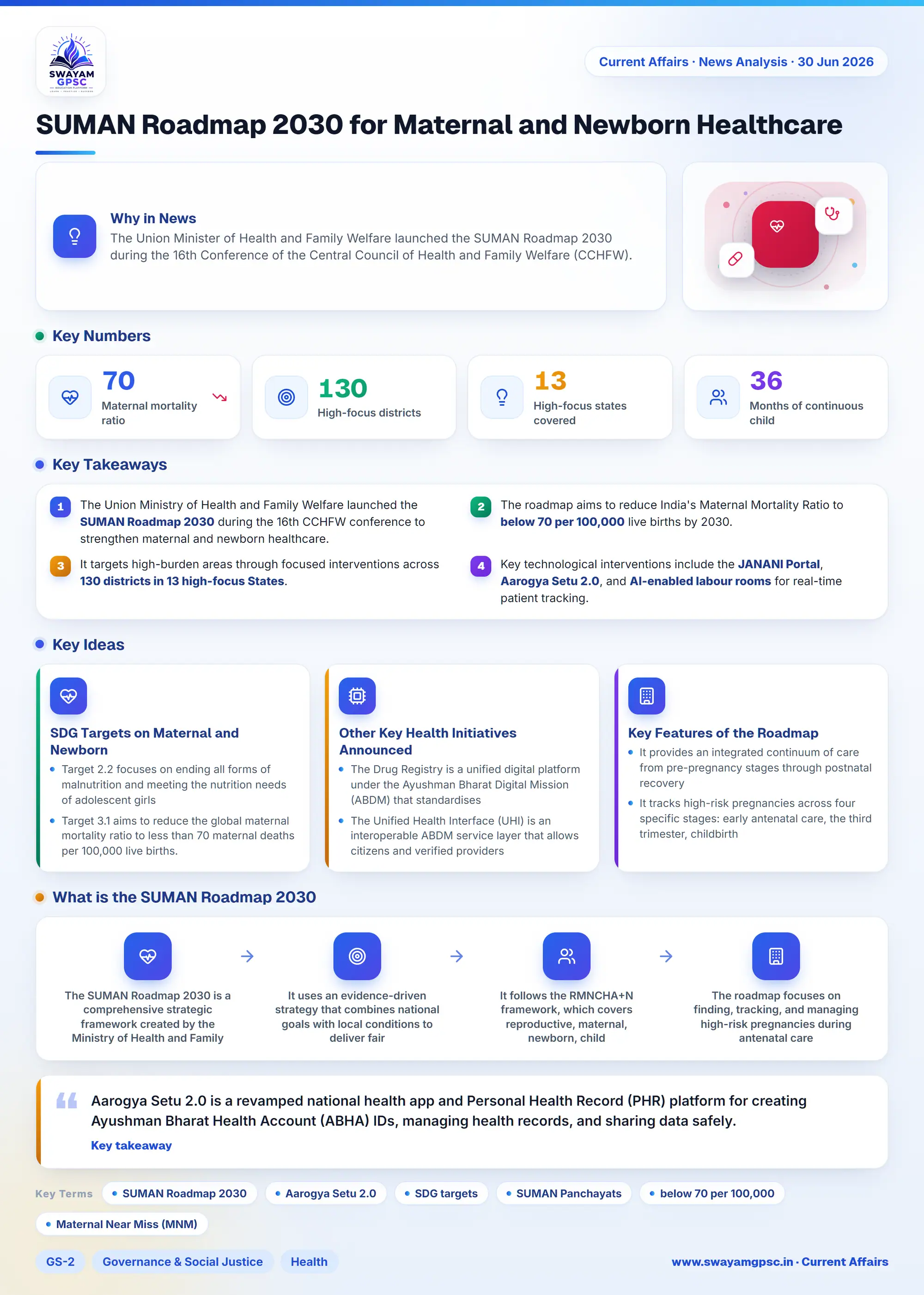
SUMAN Roadmap 2030 for Maternal and Newborn Healthcare
#GS-2 #Governance & Social Justice #Health #Quick Facts For Prelims #National #Welfare Schemes #Current Events
Key takeaways
- The Union Ministry of Health and Family Welfare launched the SUMAN Roadmap 2030 during the 16th CCHFW conference to strengthen maternal and newborn healthcare.
- The roadmap aims to reduce India's Maternal Mortality Ratio to below 70 per 100,000 live births by 2030.
- It targets high-burden areas through focused interventions across 130 districts in 13 high-focus States.
- Key technological interventions include the JANANI Portal, Aarogya Setu 2.0, and AI-enabled labour rooms for real-time patient tracking.
Why in News
- The Union Minister of Health and Family Welfare launched the SUMAN Roadmap 2030 during the 16th Conference of the Central Council of Health and Family Welfare (CCHFW).
- During the event, other health initiatives like Aarogya Setu 2.0, eSushrut@clinic, Ayushman Sarathi PM-JAY WhatsApp Chatbot, Drug Registry, and Unified Health Interface were also introduced.
What is the SUMAN Roadmap 2030
- The SUMAN Roadmap 2030 is a comprehensive strategic framework created by the Ministry of Health and Family Welfare to improve maternal and newborn healthcare across India.
- It uses an evidence-driven strategy that combines national goals with local conditions to deliver fair and high-quality care, helping India reach its SDG targets for mothers and babies by 2030.
- It follows the RMNCHA+N framework, which covers reproductive, maternal, newborn, child, adolescent health and nutrition through a complete life-cycle approach from pre-pregnancy to the postnatal period.
- The roadmap focuses on finding, tracking, and managing high-risk pregnancies during antenatal care, the third trimester, childbirth, and after birth.
- It addresses important issues like transport, tribal and hard-to-reach areas, emergency care for pregnant women, community involvement through SUMAN Panchayats, and climate risks for mothers and newborns.
- It introduces time-bound actions in 130 districts across 13 high-focus States, including Assam, Bihar, Chhattisgarh, Haryana, Jharkhand, Karnataka, Madhya Pradesh, Odisha, Punjab, Rajasthan, Uttar Pradesh, Uttarakhand, and West Bengal.
- The main goal is to reduce the Maternal Mortality Ratio to below 70 per 100,000 live births by 2030, lower neonatal and infant mortality, and achieve zero preventable deaths.
- It expands interventions to include pre-pregnancy folic acid, nutrition for maternal anaemia, high-risk surveillance, Maternal Death Surveillance and Response (MDSR), Maternal Near Miss (MNM) reviews, and Non-Pneumatic Anti-Shock Garments (NASG).
- It also brings in AI-enabled labour rooms, climate-smart planning, Caesarean section checks, and integration with the Samagra Shishu Bal Swasthya Karyakram (SSBSK).
- Implementation support includes Centres of Excellence, a central SUMAN Call Centre for complaints, better referral links, and digital monitoring via the JANANI Portal.
SDG Targets on Maternal and Newborn Health
- Target 2.2 focuses on ending all forms of malnutrition and meeting the nutrition needs of adolescent girls, pregnant and nursing women, and children under 5 years old.
- Target 3.1 aims to reduce the global maternal mortality ratio to less than 70 maternal deaths per 100,000 live births.
- Target 3.2 seeks to end preventable deaths for newborns and children under 5, reducing the Neonatal Mortality Rate (NMR) to at least 12 per 1,000 live births.
- Target 3.7 ensures universal access to sexual and reproductive healthcare services, family planning, and related education within national programmes.
- Target 5.6 ensures universal access to sexual and reproductive health and reproductive rights to support safe reproductive choices and maternal health.
Other Key Health Initiatives Announced
- The Drug Registry is a unified digital platform under the Ayushman Bharat Digital Mission (ABDM) that standardises medicine information to improve electronic prescriptions and clinical decisions.
- The Unified Health Interface (UHI) is an interoperable ABDM service layer that allows citizens and verified providers to find and book digital health services across different apps.
- The National Ambulance Services (NAS) Operational Guidelines 2026 create a national framework for emergency transport, ambulance deployment, Automotive Industry Standard-125 (AIS-125) compliance, and Global Positioning System (GPS) tracking.
- Aarogya Setu 2.0 is a revamped national health app and Personal Health Record (PHR) platform for creating Ayushman Bharat Health Account (ABHA) IDs, managing health records, and sharing data safely.
- Ayushman Sarathi is a Pradhan Mantri Jan Arogya Yojana (PM-JAY) WhatsApp chatbot offering round-the-clock access to eligibility checks, card downloads, and hospital searches.
- eSushrut@clinic is a lightweight ABDM-enabled Hospital Management Information System built by C-DAC for small clinics, Primary Health Centres, and Wellness Centres.
- The Samagra Shishu Bal Swasthya Karyakram (SSBSK) combines Home-Based Newborn Care (HBNC) and Home-Based Care for Young Child (HBYC) for seamless care from birth to 36 months.
Key Features of the Roadmap
- It provides an integrated continuum of care from pre-pregnancy stages through postnatal recovery, including regular health checks and safe deliveries.
- It tracks high-risk pregnancies across four specific stages: early antenatal care, the third trimester, childbirth, and postpartum recovery.
- It concentrates efforts on 130 high-burden districts by setting up Birth Waiting Homes, Maternal and Child Health Wings, and Obstetric HDUs or ICUs.
- Ground-level community participation is driven by SUMAN Panchayats, which give local village councils governance ownership to track health goals and ensure institutional deliveries.
- Frontline ASHA workers perform bi-weekly home health checks during the critical eighth and ninth months of pregnancy to spot warning signs early.
- The Mothers Picnic Platform encourages community engagement, health awareness, and positive newborn care practices among local mothers.
- Advanced digital technology like AI-enabled labour rooms automatically track maternal vitals and fetal distress during delivery.
- Climate-responsive frameworks introduce adaptive local protocols to protect pregnant women and newborns from extreme weather changes.