Sujalam Sufalam Jal Abhiyan: Gujarat Water Conservation
#GS-2 #GS-3 #Governance & Social Justice #Economy #Environment #Geography #Government Policies & Interventions #Welfare Schemes and Rural Development #Water Resources Management and Conservation of Natural Resources #Climate Change Adaptation and Sustainable Development #Gujarat
Key takeaways
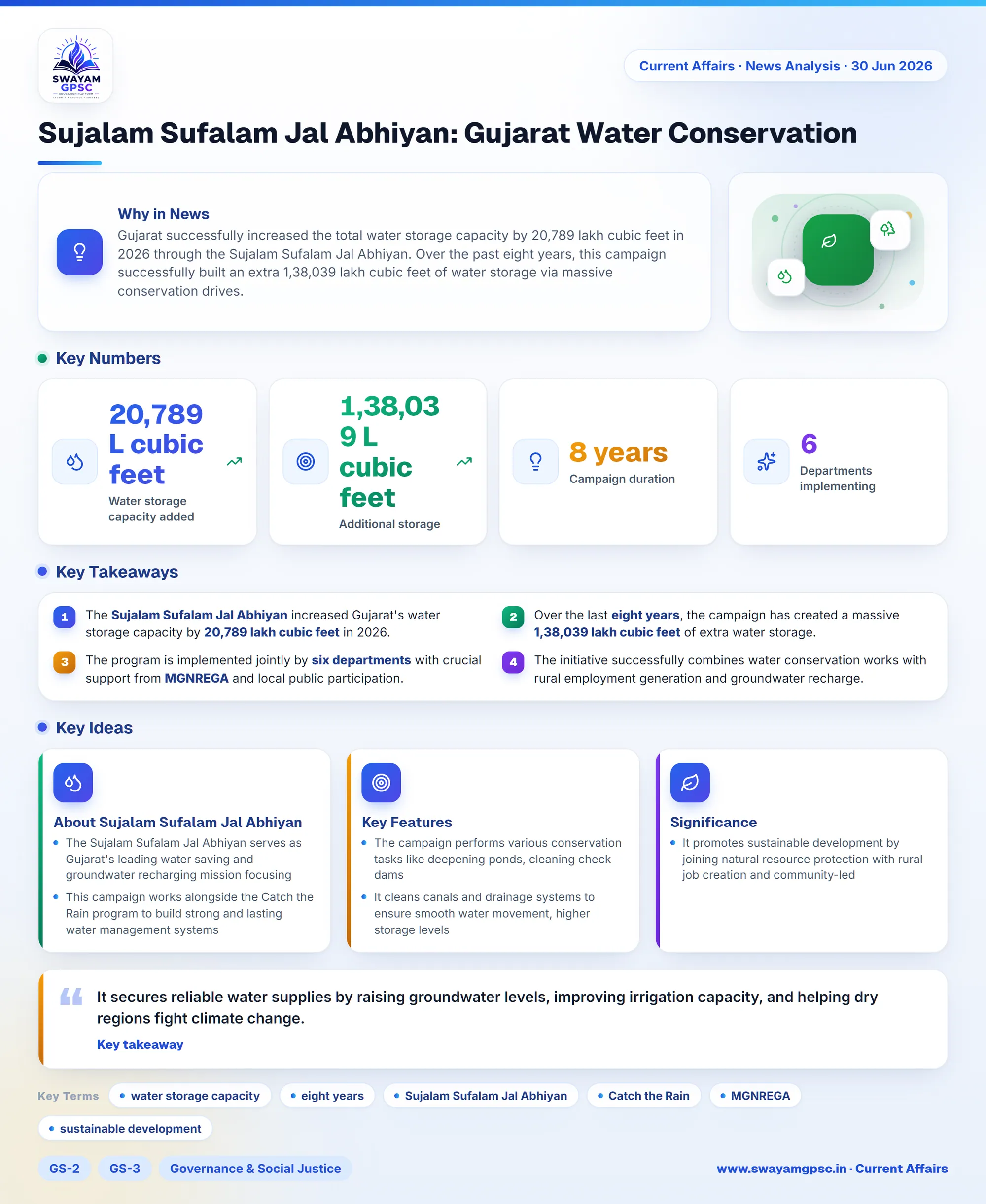
- The Sujalam Sufalam Jal Abhiyan increased Gujarat's water storage capacity by 20,789 lakh cubic feet in 2026.
- Over the last eight years, the campaign has created a massive 1,38,039 lakh cubic feet of extra water storage.
- The program is implemented jointly by six departments with crucial support from MGNREGA and local public participation.
- The initiative successfully combines water conservation works with rural employment generation and groundwater recharge.
Why in News
- Gujarat successfully increased the total water storage capacity by 20,789 lakh cubic feet in 2026 through the Sujalam Sufalam Jal Abhiyan.
- Over the past eight years, this campaign successfully built an extra 1,38,039 lakh cubic feet of water storage via massive conservation drives.
About Sujalam Sufalam Jal Abhiyan
- The Sujalam Sufalam Jal Abhiyan serves as Gujarat's leading water saving and groundwater recharging mission focusing on public involvement, cleaning silted lakes, and reviving old water sources.
- This campaign works alongside the Catch the Rain program to build strong and lasting water management systems throughout the state.
- The primary goal centers on boosting water storage capacity, raising the groundwater table, and building strong water structures using local community support.
Key Features
- The campaign performs various conservation tasks like deepening ponds, cleaning check dams, and bringing old water reservoirs back to life.
- It cleans canals and drainage systems to ensure smooth water movement, higher storage levels, and better irrigation results for farmers.
- Six different government departments work together on this mission with backing from MGNREGA, local agencies, and active citizen participation.
- This program generates many jobs in rural areas through big conservation projects while making the state secure against future water shortages.
Significance
- It secures reliable water supplies by raising groundwater levels, improving irrigation capacity, and helping dry regions fight climate change.
- It promotes sustainable development by joining natural resource protection with rural job creation and community-led care for the environment.