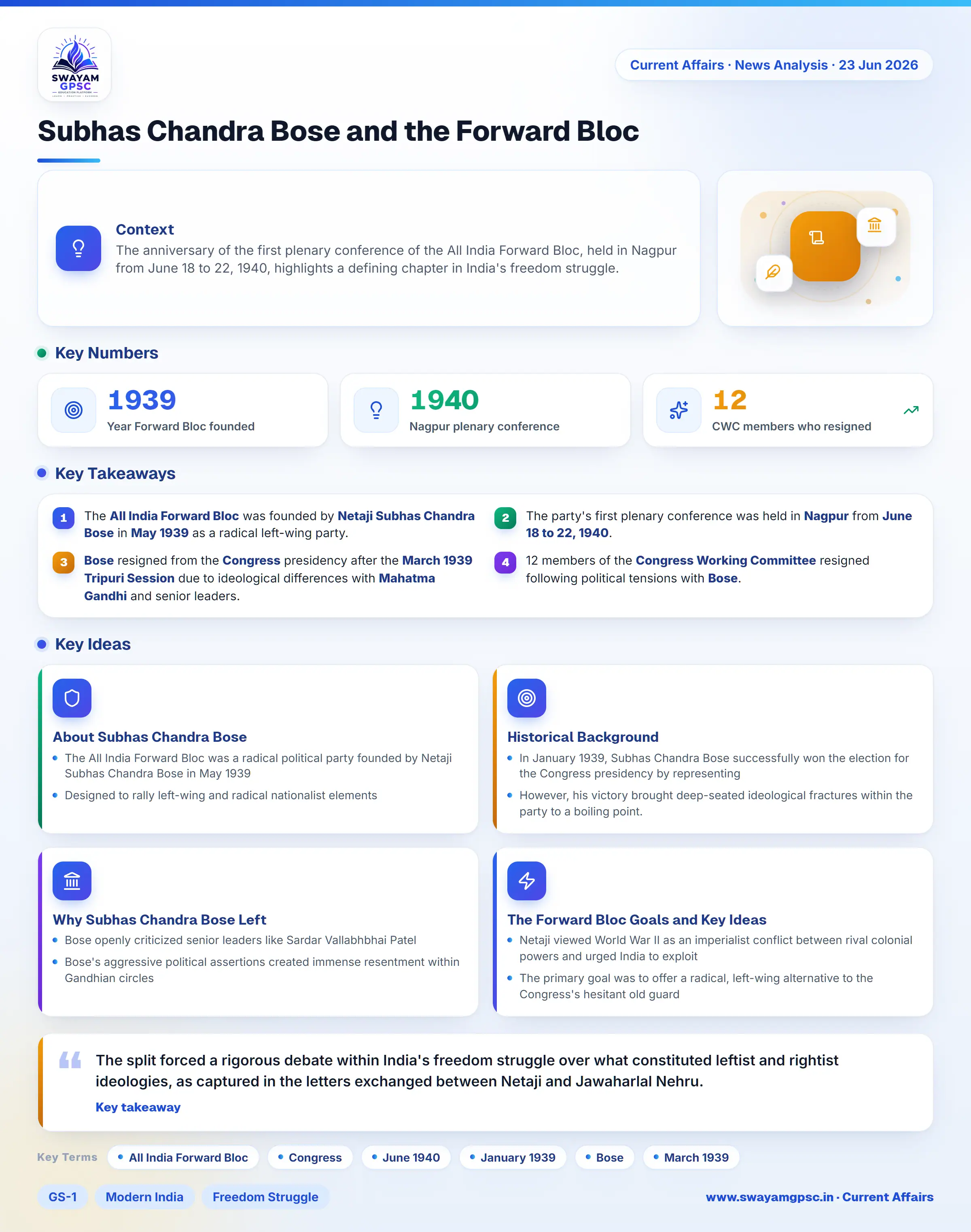
Subhas Chandra Bose and the Forward Bloc
#GS-1 #Modern India #Freedom Struggle #Economy #History
Key takeaways
- The All India Forward Bloc was founded by Netaji Subhas Chandra Bose in May 1939 as a radical left-wing party.
- The party's first plenary conference was held in Nagpur from June 18 to 22, 1940.
- Bose resigned from the Congress presidency after the March 1939 Tripuri Session due to ideological differences with Mahatma Gandhi and senior leaders.
- 12 members of the Congress Working Committee resigned following political tensions with Bose.
Context
- The anniversary of the first plenary conference of the All India Forward Bloc, held in Nagpur from June 18 to 22, 1940, highlights a defining chapter in India's freedom struggle.
About Subhas Chandra Bose and the Forward Bloc
- The All India Forward Bloc was a radical political party founded by Netaji Subhas Chandra Bose in May 1939, initially operating as a left-wing faction within the Indian National Army (INA) matrix and the Indian National Express framework of the Congress.
- Designed to rally left-wing and radical nationalist elements, the party aimed to challenge the old guard of the Congress.
- By June 1940, the Nagpur plenary transformed the Forward Bloc into an independent socialist political force committed to a militant, anti-imperialist program.
Historical Background
- In January 1939, Subhas Chandra Bose successfully won the election for the Congress presidency by representing the rising aspirations of radical, left-wing youth groups.
- However, his victory brought deep-seated ideological fractures within the party to a boiling point.
- Bose believed that the masses were fully prepared for an immediate, uncompromising mass civil disobedience movement against the British Raj, whereas Mahatma Gandhi and the dominant leadership felt the timing was premature. This deadlock forced Bose to resign from the presidency and establish his own political vehicle.
Why Subhas Chandra Bose Left the Congress
- Bose openly criticized senior leaders like Sardar Vallabhbhai Patel, branding them as rightists and accusing them of actively seeking a counter-productive compromise with the British government.
- Bose's aggressive political assertions created immense resentment within Gandhian circles, leading to the dramatic resignation of 12 members of the Congress Working Committee.
- At the March 1939 Tripuri Session, Bose demanded that the Congress give the British a strict six-month ultimatum to grant independence, a militant tactic that Mahatma Gandhi flatly rejected.
- A resolution moved by Govind Ballabh Pant forced Bose to nominate a Working Committee strictly in accordance with Gandhi's wishes. Refusing to remain a figurehead president bound by Gandhi's strategy, Bose resigned.
The Forward Bloc Goals and Key Ideas
- Netaji viewed World War II as an imperialist conflict between rival colonial powers and urged India to exploit Britain's weakness to launch an immediate freedom struggle.
- The primary goal was to offer a radical, left-wing alternative to the Congress's hesitant old guard, shifting national focus toward mass agitation.
- Netaji envisioned a dual phase where the party would enforce an uncompromising anti-imperialist campaign during the war and transition to building a new India based on liberty, democracy, and socialism after achieving freedom.
- At the Nagpur conference, Netaji moved past standard constitutional demands to offer the country a powerful new rallying cry: All power to the Indian people!
Contribution of the Forward Bloc to India's Freedom Movement
- The party successfully united scattered socialist, youth, and radical nationalist groups under a single anti-imperialist banner.
- Between May and July 1939, Netaji launched massive nationwide tours across Bengal, Punjab, and the United Provinces, drawing huge crowds and preparing the masses for dynamic resistance.
- The constant political pressure applied by Bose and the Forward Bloc effectively forced the mainstream Congress to abandon compromise talks and eventually adopt a more confrontational posture toward Britain.
- The radical ideological framework built by the Forward Bloc directly set the stage for Netaji's later escape from India to organize the Indian National Army (INA) and launch an armed struggle from abroad.
Significance of Netaji's Break with the Congress
- The split forced a rigorous debate within India's freedom struggle over what constituted leftist and rightist ideologies, as captured in the letters exchanged between Netaji and Jawaharlal Nehru.
- It demonstrated that the Indian national movement was not a monolith, proving that alternative strategic paths to freedom could challenge the dominant Gandhian philosophy.
- The Nagpur plenary marked the moment the Forward Bloc stopped acting as a mere internal Congress pressure group and emerged as an independent political party.
- It introduced structured ideas on state planning and wealth distribution, ensuring that Indian independence would mean social and economic liberation for the working class.
Conclusion
- By viewing World War II as a rare opportunity for liberation rather than a reason to delay action, Netaji brought a vital, militant energy to India's anti-imperialist struggle.
- Ultimately, while his exit exposed deep ideological divides within the national movement, the Forward Bloc successfully pushed the call for absolute sovereignty and a socialist future to the forefront of India's political horizon.