Sub-Mission on Agricultural Mechanization: Expanding Access to Modern Farming Tools
#GS-2 #GS-3 #Economy #Agriculture #Governance & Social Justice #Current Events #National
Why in News
- The Sub-Mission on Agricultural Mechanization (SMAM) has improved access to modern farm equipment for small landholders, women, and marginalized communities, especially in underserved regions and North-Eastern states.
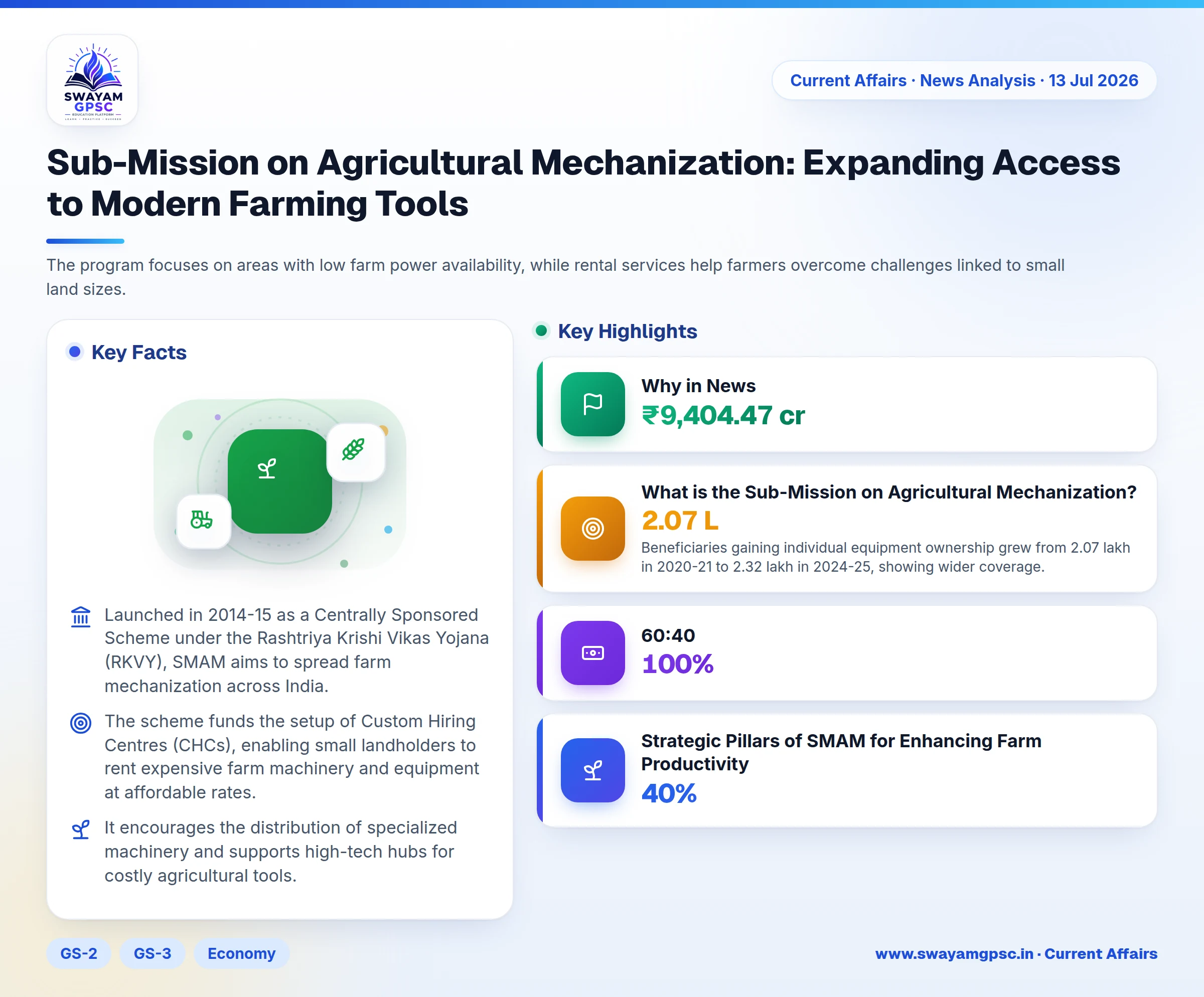
- Since its start, central assistance of ₹9,404.47 crore helped distribute 21.61 lakh machines, while ₹52.5 crore funded 40,928 drone demonstrations over 40,918 hectares to encourage precision farming.
What is the Sub-Mission on Agricultural Mechanization?
- Launched in 2014-15 as a Centrally Sponsored Scheme under the Rashtriya Krishi Vikas Yojana (RKVY), SMAM aims to spread farm mechanization across India.
- The initiative operates on the core guiding motto of 'reach the unreached' to deliver benefits to small farmers, women, SC/ST groups, Farmer-Producer Organizations (FPOs), and rural entrepreneurs.
- The scheme funds the setup of Custom Hiring Centres (CHCs), enabling small landholders to rent expensive farm machinery and equipment at affordable rates.
- It encourages the distribution of specialized machinery and supports high-tech hubs for costly agricultural tools.
- The program focuses on areas with low farm power availability, while rental services help farmers overcome challenges linked to small land sizes.
- Between 2014-15 and 2025-26, central aid of ₹9,404.47 crore funded 21.61 lakh individual machines, 27,554 CHCs, 646 Hi-tech Hubs, and 25,608 Farm Machinery Banks.
- Beneficiaries gaining individual equipment ownership grew from 2.07 lakh in 2020-21 to 2.32 lakh in 2024-25, showing wider coverage.
- The central and state governments split financial spending in a 60:40 ratio, which changes to 90:10 for Himalayan and North-Eastern States, while Union Territories get 100% central funding.
- Training programs, field demonstrations, and outreach campaigns build practical awareness and skill sets among farmers.
- The mission supports performance testing and machinery certification to verify standard quality, safety, and operational efficiency.
Rashtriya Krishi Vikas Yojana
- Launched in 2007, the Rashtriya Krishi Vikas Yojana (RKVY) acts as a key flagship initiative motivating states to boost public spending on agriculture.
- It offers administrative flexibility to state governments, allowing them to design local projects tailored to regional farming priorities.
- The scheme finances core agricultural areas, including crop cultivation, machinery, infrastructure setup, and post-harvest value addition.
- In 2017-18, RKVY was restructured as RKVY-RAFTAR to focus heavily on strengthening pre-harvest and post-harvest supply chain systems.
Strategic Pillars of SMAM for Enhancing Farm Productivity
- Training, testing, and field demonstrations improve overall productivity while boosting post-harvest infrastructure for processing, crop residue handling, and storage.
- Direct Benefit Transfer (DBT) subsidies cover 40% of equipment costs for general farmers and 50% for SC/ST, small, and North-Eastern farmers, alongside ₹2,000 per hectare support for mechanized services.
- Self-Help Groups and FPOs receive 80% to 90% aid to set up Farm Machinery Banks up to ₹30 lakh, while Custom Hiring Centres get 40% assistance for projects costing up to ₹250 lakh.
- Specialized equipment hubs provide high-capacity, crop-tailored machinery to streamline large-scale field activities and give farmers access to advanced technologies.
- The North-Eastern region receives priority financial assistance, including subsidies up to 100% for small tools and 95% support for setting up Farm Machinery Banks.
Role of Farm Mechanization and Drone Technology under SMAM
- Agricultural mechanization introduces modern tools across all cultivation stages, from land preparation and sowing to spraying, harvesting, and crop handling.
- It lowers reliance on manual labor, speeds up farm work, cuts down overall operational expenditure, and optimizes crop yields.
- SMAM actively encourages agricultural drones, giving ₹52.50 crore to the Indian Council of Agricultural Research (ICAR) to run extensive field demonstrations.
- Between 2023-24 and 2025-26, ICAR, state agricultural universities, and Krishi Vigyan Kendras (KVKs) conducted 40,928 Kisan Drone demonstrations spanning 40,918 hectares for chemical and nutrient spraying.
- Research bodies receive 100% grants up to ₹10 lakh per drone, FPOs receive up to 75% assistance, while service agencies get ₹6,000 per hectare as contingency aid.
- The sub-mission reserves 30% of its overall outlay specifically for women farmers to promote female participation in mechanized farming.
Way Forward
- While SMAM has widened equipment access for marginalized groups and women, long-term success requires making rentals affordable and providing hands-on training across all districts.
- Sustained growth will depend on region-specific technology deployment and promoting eco-friendly, climate-smart machinery to build sustainable farming systems.