Strengthening WASH Infrastructure for Disease Prevention
#GS-2 #Governance & Social Justice #Health #Water, Sanitation, and Hygiene (WASH) #Jal Jeevan Mission #Swachh Bharat Mission #AMRUT 2.0
Key takeaways
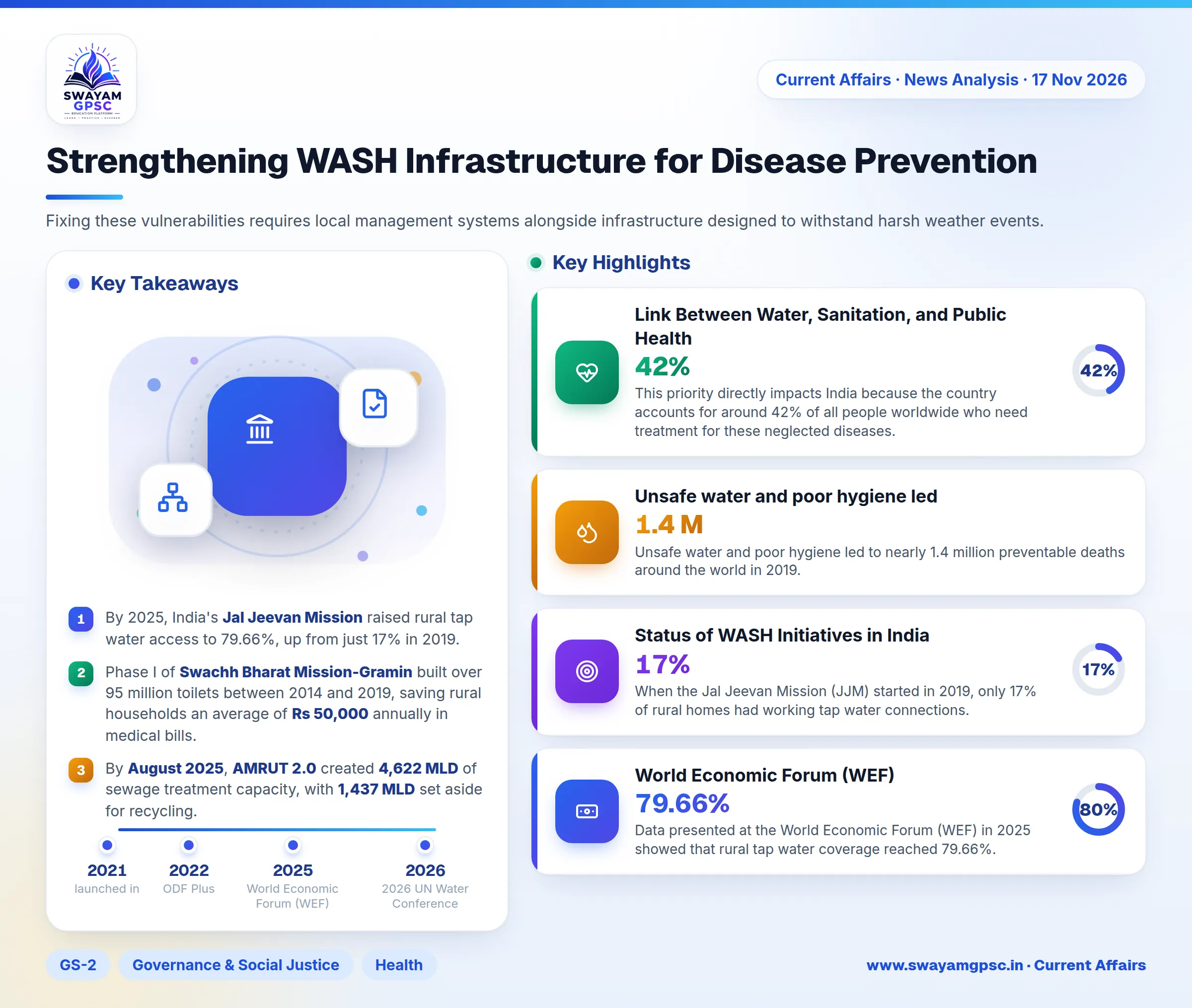
- By 2025, India's Jal Jeevan Mission raised rural tap water access to 79.66%, up from just 17% in 2019.
- Phase I of Swachh Bharat Mission-Gramin built over 95 million toilets between 2014 and 2019, saving rural households an average of Rs 50,000 annually in medical bills.
- By August 2025, AMRUT 2.0 created 4,622 MLD of sewage treatment capacity, with 1,437 MLD set aside for recycling.
- The WHO notes that every USD 1 invested in climate-resilient sanitation delivers USD 14 in lower healthcare spending and higher worker output.
Why in News
- Global health experts underlined the connection between water governance and public health during preparations for the 2026 UN Water Conference in the United Arab Emirates.
- Medical treatments and vaccines play an important role, but creating long-term public health security depends directly on safe Water, Sanitation, and Hygiene (WASH) systems.
Summary
- Access to clean drinking water and hygienic sanitation forms the foundation for stopping infectious diseases and cutting death rates across India.
- National programs like Jal Jeevan Mission (JJM), Swachh Bharat Mission (SBM), and AMRUT 2.0 have made big strides, yet issues like falling groundwater levels and maintenance gaps still remain.
- Fixing these vulnerabilities requires local management systems alongside infrastructure designed to withstand harsh weather events.
Link Between Water, Sanitation, and Public Health
- Clean water and safe waste disposal work together as a structural barrier that blocks the spread of harmful germs.
- Historical events like the 19th-century sanitary movement in the United Kingdom helped end cholera, showing how water safety prevents large disease outbreaks.
- The World Health Organization (WHO) identifies proper sanitation as a primary requirement to eliminate 21 Neglected Tropical Diseases (NTDs).
- This priority directly impacts India because the country accounts for around 42% of all people worldwide who need treatment for these neglected diseases.
- Unsafe water and poor hygiene led to nearly 1.4 million preventable deaths around the world in 2019.
- Health drives often stall when basic civic needs remain unmet, as seen when the Global Polio Eradication Initiative (GPEI) faced public hesitation caused by missing clean water facilities.
- Investing in sanitation yields strong financial gains, with WHO reporting in 2026 that every USD 1 spent on climate-resilient systems returns USD 14 by cutting medical costs and raising worker productivity.
- Closing the sanitation gap remains urgent because unsafe drinking water continues to cause more than 500,000 diarrhoeal deaths every year across the globe.
Status of WASH Initiatives in India
- When the Jal Jeevan Mission (JJM) started in 2019, only 17% of rural homes had working tap water connections.
- Data presented at the World Economic Forum (WEF) in 2025 showed that rural tap water coverage reached 79.66%.
- By bringing water straight to homes, the mission saves rural families about 55 million hours per day, allowing more women to work and study safely.
- Between 2014 and October 2019, Phase I of Swachh Bharat Mission-Gramin (SBM-G) built over 95 million toilets to reduce open defecation.
- Under Phase II launched in 2020, over 95% of villages achieved ODF Plus status, growing by 467% between December 2022 and November 2025 to total 5,67,708 villages.
- By late 2025, a total of 4,85,818 villages reached the ODF Plus Model standard by keeping up zero open defecation while handling solid and liquid waste.
- Families living in verified open defecation free villages saved around Rs 50,000 every year on health expenses.
- In urban locations, local bodies achieved near 100% open defecation free status by November 2025.
- Household toilet construction reached 108.62% of its original target with over 63.7 lakh units built, while public facilities hit 125.46% of their goal.
- Under the Atal Mission for Rejuvenation and Urban Transformation (AMRUT 2.0) launched in 2021, cities added 4,622 MLD of sewage treatment capacity by August 2025.
- Out of that total capacity, 1,437 MLD was directed toward recycling and reusing water to support SDG 6 and SDG 13 targets.
Key Challenges in India's WASH Sector
- Maintaining built facilities remains difficult because weak institutional setup at the Panchayat level leads to broken taps and abandoned toilets.
- Piped water networks rely heavily on underground reserves, making rapid aquifer depletion a threat to long-term supply.
- Heavy rains and storms can destroy sanitation setups overnight, mixing human waste into drinking supplies during natural disasters.
- Natural contaminants like arsenic, fluoride, uranium, and heavy metals continue to pollute water sources in several regions.
- Only about 42% of cities have earned ODF++ status, leaving untreated sewage to flow into rivers and drains.
- Ending manual cleaning completely while securing health insurance, protective gear, and fair conditions for sanitation workers remains an ongoing challenge.
- Discharging untreated waste drives Antimicrobial Resistance (AMR) by spreading resistant microbes into public waterways.
Way Forward
- Treat clean water access as a core constitutional duty linked to the right to life under Article 21 and public health duties under Article 47.
- Link Jal Jeevan Mission (JJM) efforts with Atal Bhujal Yojana to prioritize rainwater harvesting and groundwater recharge over extraction.
- Empower local Panchayats and Paani Samitis to collect basic user fees so they can fund regular pipeline repairs.
- Set up artificial intelligence tools to test wastewater samples early for signs of spreading pathogens like Polio or Cholera.
- Enforce waste management policies under AMRUT 2.0 that recycle treated water and cut down fresh water extraction.
- Build flood-resistant structures, such as raised toilets and sealed drains, to keep drinking water clean during heavy storms.
- Expand the NAMASTE Scheme to ensure total machine-based sewer cleaning and safeguard worker health.
Conclusion
- Medical treatments alone cannot eliminate infectious diseases without reliable public sanitation systems.
- Developing strong water management systems builds public health defenses while helping India meet the targets of SDG 3 and SDG 6.