Strengthening Rural Credit for Inclusive Growth in India
#GS-2 #Governance & Social Justice #Good Governance #GS-3 #Economy #Banking #Agriculture #Inclusive Growth #Government Policies & Interventions #Current Events #National
Why in News?
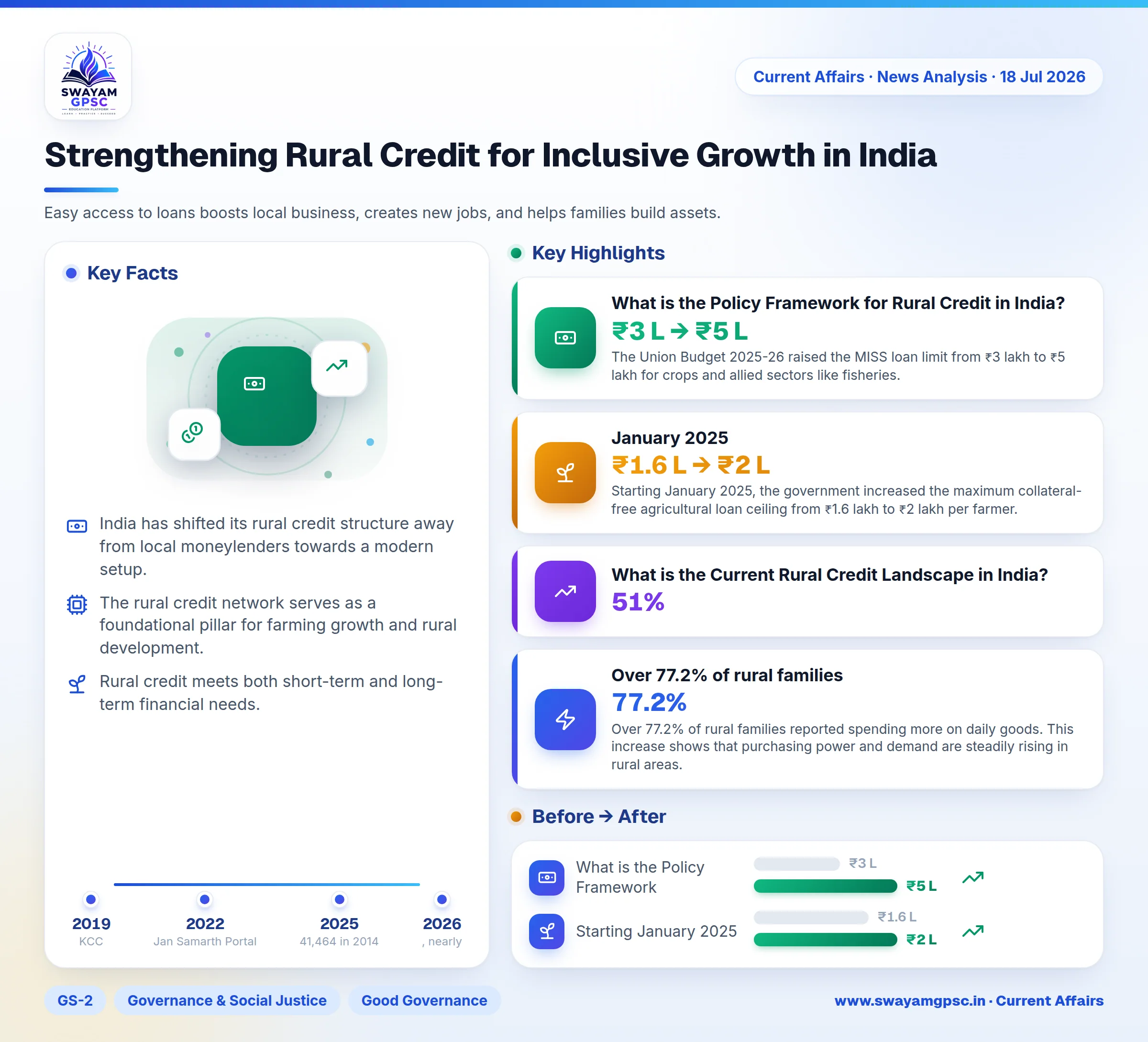
- India has shifted its rural credit structure away from local moneylenders towards a modern setup. Banks, NABARD, cooperatives, self-help groups, and digital channels now support farmers, rural businesses, and households across the country.
What is the Current Rural Credit Landscape in India?
- The rural credit network serves as a foundational pillar for farming growth and rural development. It has built a technology-backed network that offers reliable financial support across villages.
- Rural credit meets both short-term and long-term financial needs. It funds agricultural activities, rural companies, and basic household requirements for production or personal use.
- Easy access to loans boosts local business, creates new jobs, and helps families build assets. This financial support makes rural households far more resilient against unexpected economic shocks.
- A wide group of institutions delivers credit in villages, including Scheduled Commercial Banks, Regional Rural Banks, Cooperative Banks, Small Finance Banks, and NABARD.
- NABARD works as the top development bank for Indian agriculture. It offers refinance facilities, builds rural infrastructure, and monitors cooperative and regional banks.
- According to NABARD's Rural Economic Conditions and Sentiments Survey of May 2026, nearly 51% of rural families depend only on formal banks, while over 27% use both formal and informal sources.
- Over 77.2% of rural families reported spending more on daily goods. This increase shows that purchasing power and demand are steadily rising in rural areas.
- Policies like Priority Sector Lending, annual ground-level credit targets, and the Modified Interest Subvention Scheme keep bank loans affordable and timely for farmers.
- Modern tech platforms and financial inclusion programs have made loan delivery much faster. These tools reduce reliance on high-interest private moneylenders.
How has the Rural Credit System Evolved?
- In 1955, the government set up the National Agricultural Credit (Long-term Operations) Fund and established the State Bank of India to widen rural banking.
- The nationalization of 14 major commercial banks in 1969 forced financial institutions to lend more money to small farmers and rural businesses.
- The government established NABARD in 1982 to manage agricultural credit, oversee rural development, and direct financial inclusion programs.
- The Self-Help Group-Bank Linkage Programme started in 1992, bringing formal bank credit to low-income families and rural women.
- Launched in 1998, the Kisan Credit Card (KCC) scheme gave farmers an easy and flexible way to borrow working capital for crops.
- The Pradhan Mantri Jan Dhan Yojana (PMJDY) launched in 2014 provided zero-balance accounts to millions, strengthening the JAM Trinity for direct welfare benefit delivery.
- The Pradhan Mantri MUDRA Yojana (PMMY) came in 2015 to offer collateral-free loans to micro-enterprises, boosting self-employment in rural regions.
- Digital credit systems like the Jan Samarth Portal and e-KCC were launched from 2022 onwards, making loan approvals faster and transparent.
What is the Institutional Architecture of Rural Credit in India?
- India relies on a multi-tiered architecture that includes commercial banks, regional rural banks, cooperatives, small finance institutions, and NABARD.
- Scheduled Commercial Banks (SCBs) are listed under the Second Schedule of the RBI Act, 1934, and deliver rural banking via physical branches, business correspondents, and digital channels.
- The count of rural branches of commercial banks grew from 41,464 in 2014 to 56,193 by July 2025, greatly increasing formal financial coverage.
- Formed under the RRB Act, 1976, Regional Rural Banks (RRBs) focus specifically on meeting the credit requirements of small farmers, artisans, and rural workers.
- Currently, 28 RRBs operate across the country through more than 22,000 branches spread across approximately 700 districts.
- Cooperative banks serve remote populations through a network comprising 1,458 Urban Cooperative Banks, 34 State Co-operative Banks, and 352 District Central Co-operative Banks.
- Introduced after the Union Budget 2014-15 and licensed by the RBI, Small Finance Banks extend low-cost savings and credit services to small businesses and unorganized workers.
- Right now, 11 Small Finance Banks operate in India, playing a vital role in strengthening financial access for underserved rural groups.
What is the Policy Framework for Rural Credit in India?
- Under Priority Sector Lending (PSL) rules, the RBI mandates that commercial banks reserve a specific percentage of their loans for essential but underserved sectors like agriculture.
- Banks must direct at least 18% of their Adjusted Net Bank Credit or off-balance sheet credit equivalent to agricultural activities.
- Within the agricultural quota, banks must ensure that 14% goes to individual farmers and 10% specifically targets small and marginal landholders.
- Every year, the central government establishes ground-level credit targets for crop loans and term loans across different regions and lending institutions.
- Farm credit disbursement grew over 13% annually between FY15 and FY24, while the ground-level credit target for FY 2025-26 stands at ₹32.50 lakh crore.
- To support activities beyond traditional crop farming, the government earmarked a sub-target of ₹5 lakh crore for animal husbandry, dairying, and fisheries.
- NABARD launched the SHG-Bank Linkage Programme to connect self-help groups directly with formal banking branches, boosting credit access for rural women.
- First launched in 2010 as part of restructuring Swarnajayanti Gram Swarozgar Yojana, the scheme was renamed Deendayal Antyodaya Yojana-National Rural Livelihoods Mission (DAY-NRLM) on March 29, 2016.
- DAY-NRLM energized the self-help movement by building, training, and backing thousands of women-led community groups nationwide.
- By July 2025, the government successfully organized over 10.05 crore rural women into more than 90.90 lakh self-help groups.
- Approximately 50,548 Bank Sakhis assist self-help groups with bank paperwork, loan forms, and timely repayments, effectively bringing down loan default rates.
- Primary Agricultural Credit Societies (PACS) operate at the village level to provide short-term credit and facilitate the buying of seeds and fertilizers.
- The government approved a plan to set up 2 lakh new multipurpose PACS, dairy, and fishery cooperatives across every village panchayat within five years.
- By March 2026, out of 79,630 approved societies, 61,842 PACS successfully transitioned to a unified ERP-based national software system.
- The Modified Interest Subvention Scheme (MISS) provides short-term crop loans via KCC at a subsidized 7% rate, dropping to 4% with prompt repayment.
- The Union Budget 2025-26 raised the MISS loan limit from ₹3 lakh to ₹5 lakh for crops and allied sectors like fisheries.
- Starting January 2025, the government increased the maximum collateral-free agricultural loan ceiling from ₹1.6 lakh to ₹2 lakh per farmer.
- Approved in July 2025, PM Dhan Dhanya Krishi Yojana (PM-DDKY) integrates 36 Central schemes across 11 Ministries to develop 100 low-performing agricultural districts.
- The PM-DDKY scheme focuses on boosting crop productivity, encouraging sustainable farming, expanding irrigation facilities, and enhancing farm credit availability.
How is India Strengthening Rural Financial Inclusion?
- The Kisan Credit Card (KCC) offers flexible borrowing through ATM-enabled debit cards, simplified documentation, and revolving credit facilities for farmers.
- KCC credit covers crop cultivation costs, post-harvest expenditures, household needs, farm machinery maintenance, and investment in non-farm activities.
- As of 8th July 2026, total KCC applications reached 739 lakh in commercial banks, 365 lakh in RRBs, and 1178 lakh in cooperative banks.
- The KCC scheme covers landowning farmers, tenant cultivators, and self-help groups, having expanded in 2019 to include dairy, fisheries, and animal husbandry.
- Developed by NABARD, the e-KCC portal fully digitizes loan processing for RRBs and cooperative banks, eliminating physical branch visits for farmers.
- Farmers can apply for crop loans at local Common Service Centres (CSCs), receiving loan sanction within approximately 2 days.
- The RBI, NABARD, and financial institutions promote credit awareness through Centres for Financial Literacy, local camps, and the annual Financial Literacy Week.
- Under Pradhan Mantri Jan Dhan Yojana (PMJDY), every household receives access to a basic bank account alongside insurance, pension benefits, and a RuPay debit card.
- PMJDY enables Direct Benefit Transfer (DBT) by crediting government subsidies directly into beneficiaries' accounts, forming the core of the JAM Trinity.
- By 24th June 2026, total Jan Dhan accounts exceeded 58.63 crore, accumulating total deposits of more than ₹3 lakh crore.
- Women hold 32.68 crore of all Jan Dhan accounts, while 45.62 crore accounts operate in rural and semi-urban localities.
- Launched in June 2022, the Jan Samarth Portal serves as a unified digital platform connecting government credit schemes directly with citizens and lenders.
- The Jan Samarth Portal simplifies credit delivery by matching applicants to appropriate government schemes and digitizing loan approvals end-to-end.
- Citizens can use the Jan Dhan Darshak App to locate nearest bank branches, ATMs, Bank Mitras, and Common Service Centres.
- Government officials use the Jan Dhan Darshak App to track banking infrastructure across rural areas and identify unserved locations.
- By 6th March 2025, about 99.92% of Indian villages had a banking touchpoint within a 5 km radius, with Dadra and Nagar Haveli achieving complete coverage.
Conclusion
- India's rural credit system has matured into a digitally integrated, institution-led network. Continued expansion of NABARD, KCC, PMJDY, and digitized PACS will ensure sustainable agricultural growth and financial inclusion for all rural households.