Strengthening India's Toy Ecosystem: Growth, Policy, and Global Reach
#GS-2 #Governance & Social Justice #Government Policies & Interventions #GS-3 #Economy #Growth #Employment #GS-1 #Culture #Heritage #Current Events #National
Key takeaways
- India achieved a trade surplus of US$152 million in key toy categories in 2025-26, reversing a US$213.01 million deficit recorded in 2017-18.
- Overall toy exports grew by 151.9% from US$152.7 million in 2017-18 to US$384.7 million in 2025-26, with the United States as the top market receiving US$111.9 million.
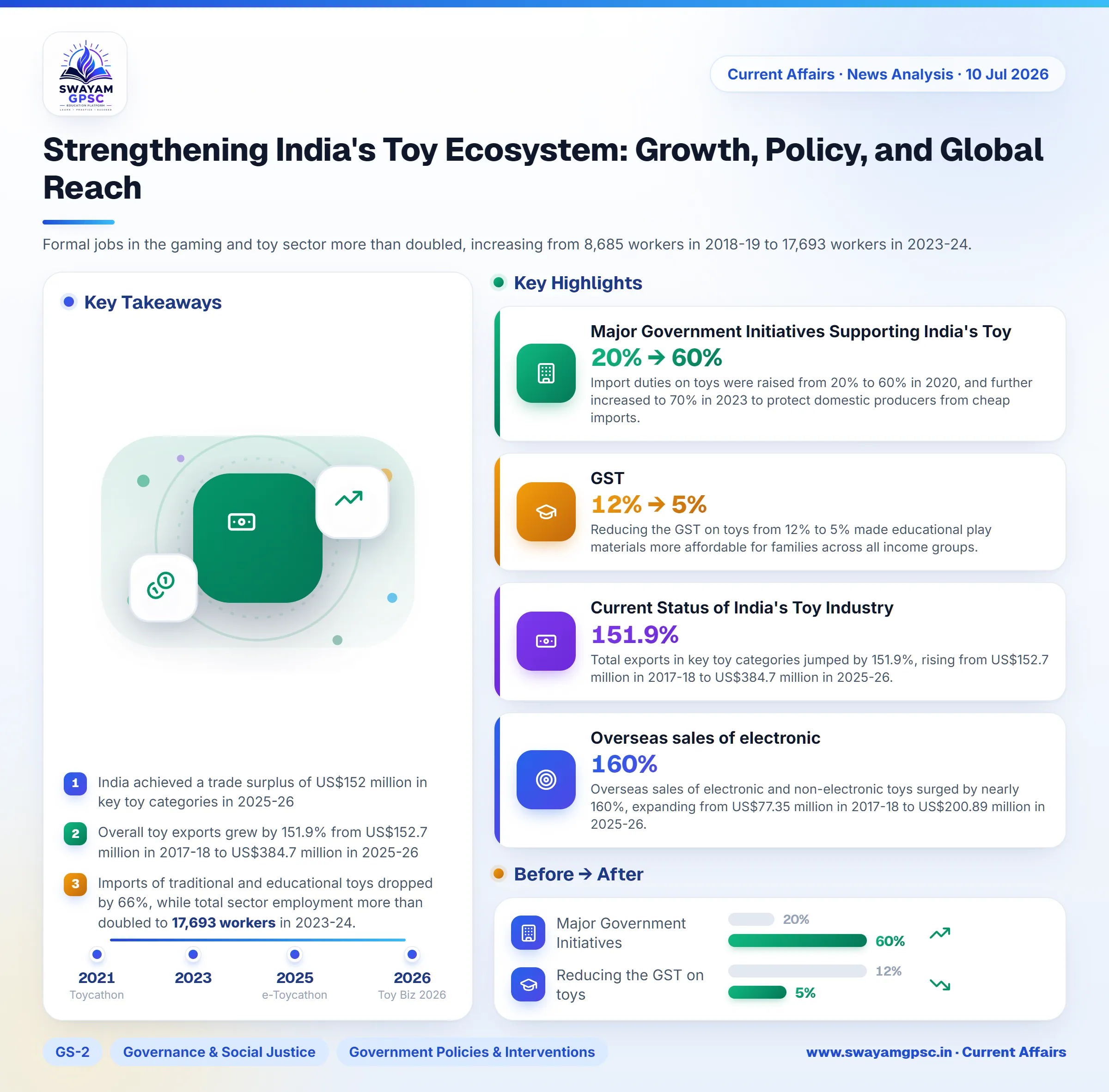
- Imports of traditional and educational toys dropped by 66%, while total sector employment more than doubled to 17,693 workers in 2023-24.
- Government policy measures included raising basic customs duties up to 70% in 2023 and lowering GST on toys from 12% to 5% to support local MSMEs.
Why in News
- India's toy sector is growing rapidly across manufacturing, exports, and job creation because of strong government support and growing demand for local, educational, and eco-friendly toys.
- Experts view this industry as an emerging sunrise sector that successfully blends ancient cultural heritage, local production, modern innovation, and international trade strength.
Current Status of India's Toy Industry
- Total exports in key toy categories jumped by 151.9%, rising from US$152.7 million in 2017-18 to US$384.7 million in 2025-26.
- Overseas sales of electronic and non-electronic toys surged by nearly 160%, expanding from US$77.35 million in 2017-18 to US$200.89 million in 2025-26.
- The United States became the largest buyer of Indian toys as shipments reached US$111.9 million from US$26.7 million, followed by the United Kingdom, Poland, the Netherlands, and Germany.
- Video game console and gaming exports nearly tripled from US$15.68 million in 2017-18 to US$46.75 million in 2025-26, led by the United States, UAE, Russia, France, and the United Kingdom.
- Shipments of festive and carnival entertainment items expanded by nearly 130%, moving from US$59.69 million in 2017-18 to US$137.03 million in 2025-26, targeting markets like the United States, Germany, the United Kingdom, the Netherlands, and Sweden.
- Inbound shipments of traditional and learning toys fell by 66%, which helped cut import reliance and boosted local factory output.
- Strong export performance helped India achieve a trade surplus of US$152 million in primary toy categories during 2025-26.
- This surplus marks a major turnaround from 2017-18, when India suffered a trade deficit of US$213.01 million due to heavy foreign toy imports.
- Formal jobs in the gaming and toy sector more than doubled, increasing from 8,685 workers in 2018-19 to 17,693 workers in 2023-24.
Significance of India's Toy Industry
- Toy manufacturing in India carries a 5,000-year history, stretching from terracotta carts of the Indus Valley Civilisation to wooden dolls inspired by the Ramayana, Mahabharata, and regional folklore.
- The sector powers rural and urban livelihoods by generating business for traditional artisans, small enterprises, trading units, and innovative startups.
- Toy production, packaging, and design create accessible employment opportunities for women and diverse socio-economic groups across rural hubs.
- Growing interest in STEM toys and skill-based puzzles helps boost cognitive thinking and practical learning among young children.
- Expanding domestic supply chains supports the Make in India initiative, cutting down reliance on foreign goods while expanding global market footprint.
- Promoting toys linked to Indian legends, local heroes, and ancient value systems helps preserve and transmit the Indian Knowledge Systems to younger generations.
- Programs like One District, One Product and GI-tagged toys preserve inherited crafting skills while enhancing product branding and market reach for rural creators.
Major Government Initiatives Supporting India's Toy Ecosystem
- The National Action Plan for Toys, 2020 encourages toy design rooted in Indian culture, while building local manufacturing clusters and promoting innovation.
- The Quality Control Order for Toys, 2020 made BIS certification mandatory for local and foreign producers to ensure strict chemical, physical, and electrical safety.
- Import duties on toys were raised from 20% to 60% in 2020, and further increased to 70% in 2023 to protect domestic producers from cheap imports.
- The Toy Biz 2026 trade show was organized in July 2026 in New Delhi to connect Indian toy makers with global and domestic wholesale buyers.
- Launched in 2021, Toycathon crowdsources ideas for innovative toys inspired by Indian history, regional folklore, and traditional ethical values.
- The government held the first e-Toycathon in 2025 to spur technical innovations in electronic toys that promote creative learning and child development.
- The Ministry of Electronics and Information Technology created the e-Toys Lab at C-DAC, Noida to train developers in electronic toy design, testing, and prototyping.
- BIS conducted Manak Manthan in April 2026 to build awareness among producers about essential mechanical and physical safety standards for toys.
- Under One District, One Product, selected traditional toy varieties receive targeted assistance in branding, technology adoption, packaging, and export marketing.
- Awarding Geographical Indication tags to traditional crafts like Channapatna toys of Karnataka, Leather Toys of Indore, and Thanjavur dolls of Tamil Nadu protects artisan heritage.
- Reducing the GST on toys from 12% to 5% made educational play materials more affordable for families across all income groups.
- Comprehensive trade deals signed with partners like the UAE, Australia, EFTA, Oman, New Zealand, and the United Kingdom offer lower import tariffs for Indian toys.
- The Districts as Export Hubs initiative has identified over 10 districts with high toy manufacturing potential to build export linkages and generate local jobs.
Conclusion
- India's toy industry effectively integrates ancient craftsmanship, modern quality standards, digital features, and policy incentives to transform from an importer to a global supplier.
- Strengthening this domestic ecosystem supports Atmanirbhar Bharat, boosts MSME development, increases female workplace participation, and expands manufacturing exports.