Strengthening Food Safety Infrastructure in India
#GS-2 #GS-3 #Governance & Social Justice #Health #Economy #Food Security #National #Food Processing #Government Policies & Interventions
Why in News
- Recent widespread incidents of food poisoning across India have raised serious concerns about the nation's food safety infrastructure. These events reveal major gaps in enforcing the Food Safety and Standards (FSS) Act, 2006 amidst a rise in foodborne deaths.
Challenges in India's Food Safety System
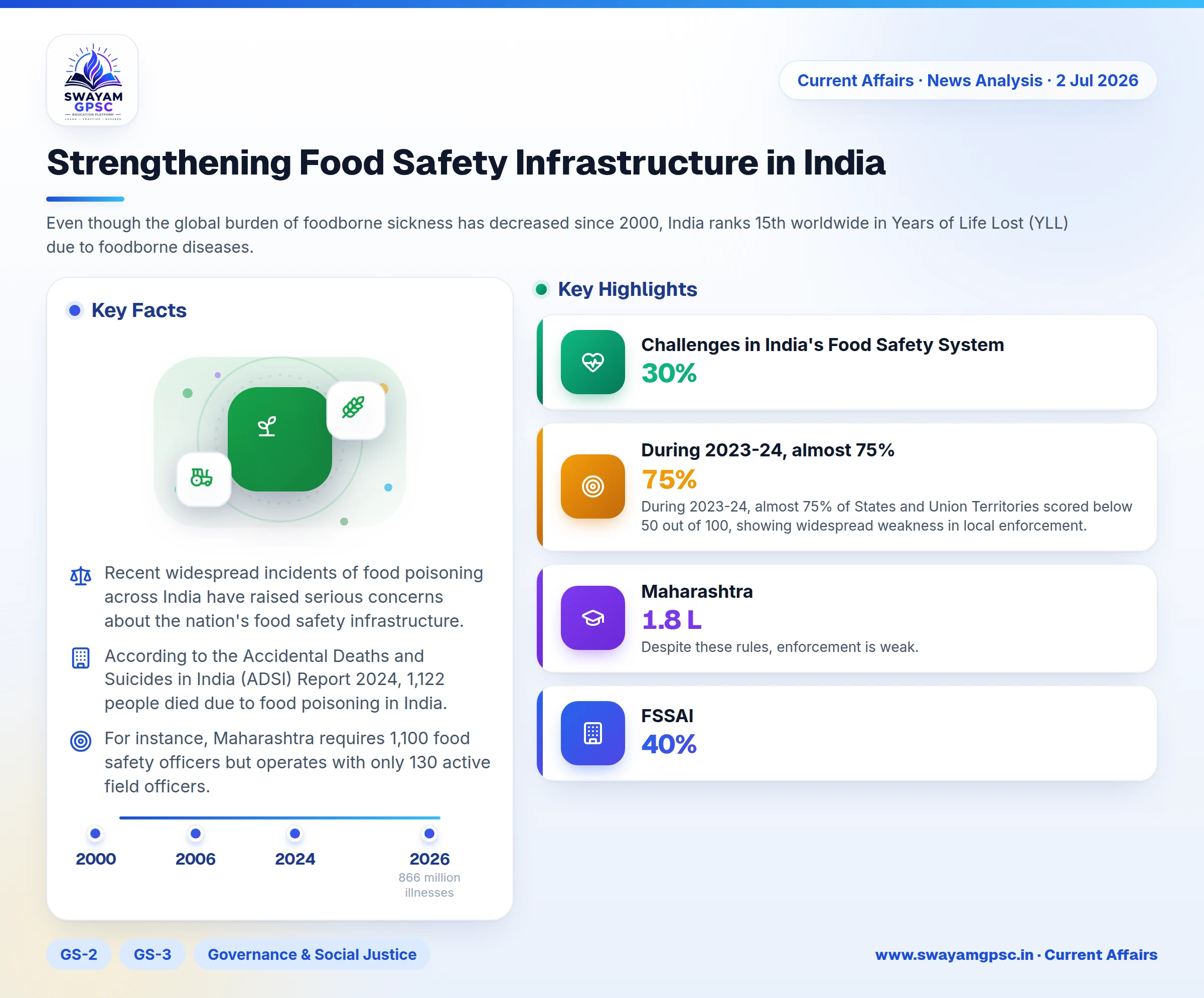
- According to the Accidental Deaths and Suicides in India (ADSI) Report 2024, 1,122 people died due to food poisoning in India.
- On a global scale, the WHO Foodborne Disease Estimates 2026 shows that contaminated food causes 866 million illnesses and 1.5 million deaths, with children under five bearing nearly 30% of the disease burden.
- Even though the global burden of foodborne sickness has decreased since 2000, India ranks 15th worldwide in Years of Life Lost (YLL) due to foodborne diseases.
- The Food Safety and Standards Authority of India (FSSAI) measures state performance through the State Food Safety Index, evaluating metrics like human resources, testing infrastructure, regulatory compliance, training, and consumer awareness.
- During 2023-24, almost 75% of States and Union Territories scored below 50 out of 100, showing widespread weakness in local enforcement.
- Among the lowest performing states, Jharkhand scored 26.5 and Uttar Pradesh scored 44.25, with both regions reporting severe cases of food poisoning deaths in 2024.
- Although the FSS Act, 2006 requires mandatory licensing, regular inspections, and laboratory testing for Food Business Operators (FBOs), actual ground implementation remains poor.
- The Food Safety and Standards (Licensing and Registration of Food Businesses) Amendment Regulations, 2026, set up a risk-based inspection framework to inspect high-risk businesses more frequently based on past compliance.
- Despite these rules, enforcement is weak. For example, in Maharashtra, inspectors collected only about 21,000 food samples during 2024-25, even though the state has over 1.8 lakh registered FBOs.
- Severe staff shortages affect the system, with FSSAI leaving nearly 40% of its central positions vacant, while states reported over 1,200 sanctioned Food Safety Officer (FSO) positions unfilled in early 2026.
- For instance, Maharashtra requires 1,100 food safety officers but operates with only 130 active field officers.
- Chemical contamination is a rising danger. The World Health Organization (WHO) warned about heavy metal contamination, such as inorganic arsenic in rice and groundwater and lead in spices, grains, and cookware, which cause chronic diseases and cognitive impairment in children.
- Unregulated antibiotic usage in livestock and dairy farming contributes to Antimicrobial Resistance (AMR), creating a major public health hazard.
- Long-term exposure to illegal pesticide residues in fresh farm produce increases the risk of cancer and severe endocrine disorders.
- Food adulteration has expanded into a parallel economy, particularly inside the dairy and edible oil sectors.
- Dangerous adulterants like ethylene glycol-contaminated milk and fake items like synthetic milk and fake paneer present severe hazards to consumer health.
- Deceptive marketing practices, known as health-washing, mislead consumers through exaggerated health claims and falsified nutritional details on packaged goods.
- During 2025-26, FSSAI penalised multiple brands for illegal health claims, including deceptive uses of 100% Natural labels and unproven medical cure promises.
- Rising global temperatures and heatwaves cause rapid food spoilage and bacterial growth, especially in areas lacking proper cold-chain infrastructure.
- Street food vendors often lack clean water, waste handling facilities, and hygiene training, spreading dangerous pathogens like Salmonella and E. coli.
Food Safety Overview
- Food safety refers to the scientific methods of handling, preparing, and storing food to prevent contamination and foodborne diseases.
- While food safety prevents accidental physical, biological, or chemical contamination, it links closely with food defense, which protects food supplies from intentional harm or tampering.
- The Food Safety and Standards Authority of India (FSSAI) is an apex statutory authority established under the Food Safety and Standards Act, 2006, operating under the Ministry of Health & Family Welfare (MoHFW) to regulate food standards and conduct risk assessments.
- Key programs launched by FSSAI include Eat Right India, the State Food Safety Index, RUCO (Repurpose Used Cooking Oil), and the Food Safety Mitra Scheme.
- State governments enforce the FSS Act, 2006 locally through Food Safety Commissioners, Designated Officers, and field Food Safety Officers (FSOs).
Way Forward
- Instead of fixed monetary fines, laws should mandate turnover-linked penalties so that large businesses cannot treat penalties merely as an ordinary operational expense.
- Establishing dedicated district-level Food Safety Tribunals will accelerate legal proceedings and relieve pressure on ordinary courts.
- Installing IoT temperature and humidity sensors in commercial cold chain vehicles and warehouses will prevent silent bacterial spoilage during transit.
- Connecting hygiene compliance directly to micro-credit initiatives like PM SVANidhi will encourage street vendors to maintain high safety standards in exchange for lower interest rates.
- Building an integrated Farm to Fork digital portal between FSSAI and the Ministry of Agriculture will track pesticide and antibiotic use at the farm level before produce enters factories.
- Following directions from the Supreme Court, FSSAI must introduce high-visibility Front-of-Pack (FOP) red, amber, and green color-coded labels to stop health-washing on packaged goods.
- Launching a public Food Watch app will allow citizens to report violations with location tags, automatically sending inspectors to businesses facing repeated complaints.
Conclusion
- India needs an end-to-end Farm to Fork governance framework, modern testing facilities, and strict turnover-linked penalties to curb food poisoning cases effectively.
- Maintaining high food safety standards is directly linked to reaching international goals under the UN Sustainable Development Goals (SDGs), specifically SDG 2 (Zero Hunger), SDG 3 (Good Health and Well-being), and SDG 12 (Responsible Consumption and Production).