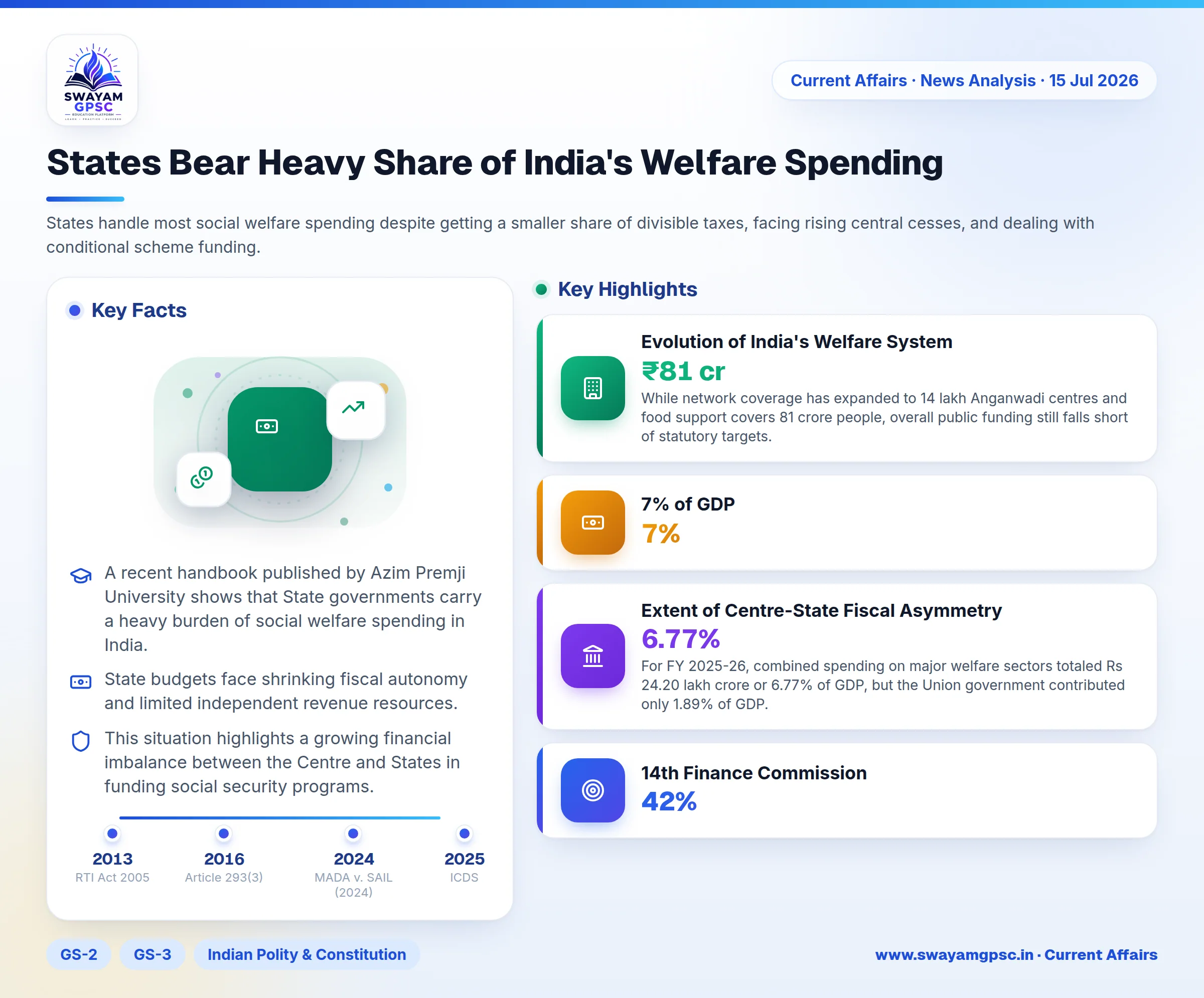
States Bear Heavy Share of India's Welfare Spending
#GS-2 #GS-3 #Indian Polity & Constitution #Federalism #Governance & Social Justice #Economy #Taxation #Budget #Fiscal Federalism
Why in News
- A recent handbook published by Azim Premji University shows that State governments carry a heavy burden of social welfare spending in India.
- State budgets face shrinking fiscal autonomy and limited independent revenue resources.
- This situation highlights a growing financial imbalance between the Centre and States in funding social security programs.
Summary of Key Issues
- States handle most social welfare spending despite getting a smaller share of divisible taxes, facing rising central cesses, and dealing with conditional scheme funding.
- Fixing cooperative federalism requires giving States more untied funds, simplifying central schemes, protecting State tax powers, and applying the funds follow functions rule.
Evolution of India's Welfare System
- In the early post-independence decades, welfare focused on planned economic growth through initiatives like the Community Development Programme (1952), Integrated Child Development Services (ICDS) (1975), and Minimum Needs Programme (1975).
- After the 1991 economic reforms, the government moved from general subsidies to focused assistance, introducing programs such as Targeted PDS (1997) for specific income groups.
- During the 2000s, welfare became a legal entitlement through key laws including the RTI Act 2005, MGNREGA, RTE Act 2009, and National Food Security Act (NFSA), 2013.
- Today, technology drives welfare through the JAM Trinity and Direct Benefit Transfer, shifting the model toward direct individual support under programs like PM-KISAN.
- While network coverage has expanded to 14 lakh Anganwadi centres and food support covers 81 crore people, overall public funding still falls short of statutory targets.
- Total welfare spending by the Union and States stands at roughly 7% of GDP and 21% of total public expenditure, leaving India behind comparable nations in social spending relative to economic size.
Extent of Centre-State Fiscal Asymmetry
- For FY 2025-26, combined spending on major welfare sectors totaled Rs 24.20 lakh crore or 6.77% of GDP, but the Union government contributed only 1.89% of GDP.
- Although the 14th Finance Commission and 15th Finance Commission recommended tax shares of 42% and 41% respectively, actual devolutions stayed around 29-32% because central cesses rose from 10.4% in 2011-12 to over 20% in 2021-22.
- While overall expenditure on social services grew across the country, the Central share remained flat while State budgets absorbed most of the increase.
- States fund nearly 75.2% of all school education costs, making them the main source of financial support for public schooling.
- States also pay the majority of costs for public hospitals, community health centers, and regional food subsidy systems.
- According to the 16th Finance Commission, States spent Rs 4.14 lakh crore on direct cash transfer schemes, adding a substantial burden to their local budgets.
- Many successful national schemes started in States: Rythu Bandhu in Telangana and KALIA in Odisha inspired PM-KISAN, while Tamil Nadu's Mid-Day Meal Scheme became PM POSHAN.
- Centrally Sponsored Schemes like ICDS require a 60:40 contribution ratio, and new rules under the VB-G RAM G Act, 2025 will increase State funding shares beyond older schemes like MGNREGA which used a 90:10 ratio.
- The Union government frequently ties scheme funds to strict conditions, as seen in the PM SHRI Scheme where States had to sign formal agreements to access funds.
- After GST came into effect, States lost individual authority over major local taxes, creating a gap between their constitutional duties and available revenue tools.
- This combination of reduced tax sharing, conditional grants, and restricted borrowing risks turning cooperative federalism into a system of central financial dominance.
Way Forward
- The central government should cap cesses and surcharges so that more tax collections return to the shared pool for States.
- Central schemes should be rationalized, and as suggested by the Punchhi Commission (2010), centrally sponsored programs should focus only on top national priorities while transferring untied grants to States.
- To ensure stable debt management, borrowing controls under Article 293(3) should follow clear rules, backed by a Fiscal Council as proposed by the N.K. Singh FRBM Review Committee (2016).
- Court rulings like MADA v. SAIL (2024) on mineral taxation and State of UP v. Lalta Prasad Vaish (2024) on industrial alcohol must be respected to preserve State revenue rights.
- Central funding formulas should better support financially weaker States facing heavy demographic demands and lower tax revenue capacity.
- State Finance Commissions need regular establishment and full power so local panchayats and cities receive reliable funding.
- Local self-governments should gain broader powers to collect property taxes and service fees directly.
- Federal bodies like the Inter-State Council and the Finance Commission should handle fiscal disputes through dialogue rather than court cases.
- Revenue distribution must match actual spending responsibilities across all levels of government to ensure long-term public welfare.
Conclusion
- India's welfare system faces a significant financial gap between central revenue collection and State expenditure obligations.
- True cooperative federalism requires adequate financial devolution, giving States the money needed to meet constitutional social goals.