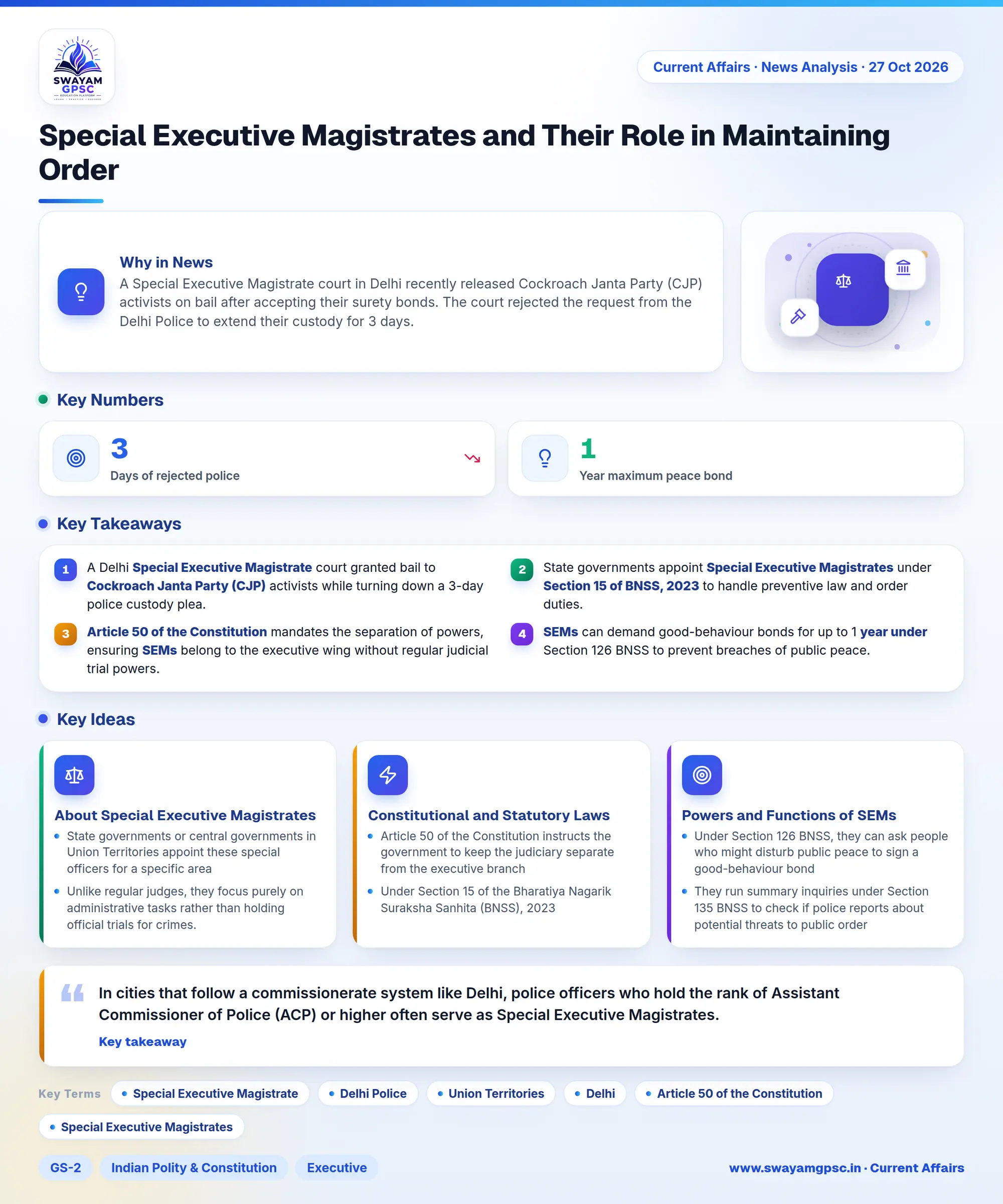
Special Executive Magistrates and Their Role in Maintaining Order
#GS-2 #Indian Polity & Constitution #Executive #Judiciary #Governance & Social Justice #Good Governance #Current Events #National #Law and Order
Key takeaways
- A Delhi Special Executive Magistrate court granted bail to Cockroach Janta Party (CJP) activists while turning down a 3-day police custody plea.
- State governments appoint Special Executive Magistrates under Section 15 of BNSS, 2023 to handle preventive law and order duties.
- Article 50 of the Constitution mandates the separation of powers, ensuring SEMs belong to the executive wing without regular judicial trial powers.
- SEMs can demand good-behaviour bonds for up to 1 year under Section 126 BNSS to prevent breaches of public peace.
Why in News
- A Special Executive Magistrate court in Delhi recently released Cockroach Janta Party (CJP) activists on bail after accepting their surety bonds.
- The court rejected the request from the Delhi Police to extend their custody for 3 days.
About Special Executive Magistrates
- State governments or central governments in Union Territories appoint these special officers for a specific area, time period, or situation to handle preventive law and order duties.
- Unlike regular judges, they focus purely on administrative tasks rather than holding official trials for crimes.
- In cities that follow a commissionerate system like Delhi, police officers who hold the rank of Assistant Commissioner of Police (ACP) or higher often serve as Special Executive Magistrates.
Constitutional and Statutory Laws Governing SEMs
- Article 50 of the Constitution instructs the government to keep the judiciary separate from the executive branch, meaning SEMs belong strictly to the executive wing and do not hold real judicial powers.
- Under Section 15 of the Bharatiya Nagarik Suraksha Sanhita (BNSS), 2023, the state government can appoint executive magistrates or senior police officers as Special Executive Magistrates for specific jurisdictions.
- Section 163 of BNSS gives these executive magistrates the power to issue urgent orders to stop public nuisances or prevent approaching dangers.
Powers and Functions of SEMs
- Under Section 126 BNSS, they can ask people who might disturb public peace to sign a good-behaviour bond with or without sureties for up to 1 year.
- They run summary inquiries under Section 135 BNSS to check if police reports about potential threats to public order are genuine before enforcing bonds.
- They use emergency powers under Section 163 BNSS to ban unlawful gatherings, stop processions, and prevent threats to public safety.
- They can send a person to custody under Section 135(3) or Section 141 BNSS if that person fails to provide the required sureties during an inquiry.
- Unlike regular Judicial Magistrates, an SEM cannot hear criminal cases, run formal trials, frame charges, or sentence anyone to prison.
- All decisions and detentions made by SEMs are quasi-judicial actions, meaning they can be reviewed by Sessions Courts and challenged in High Courts under Articles 226 and 227.