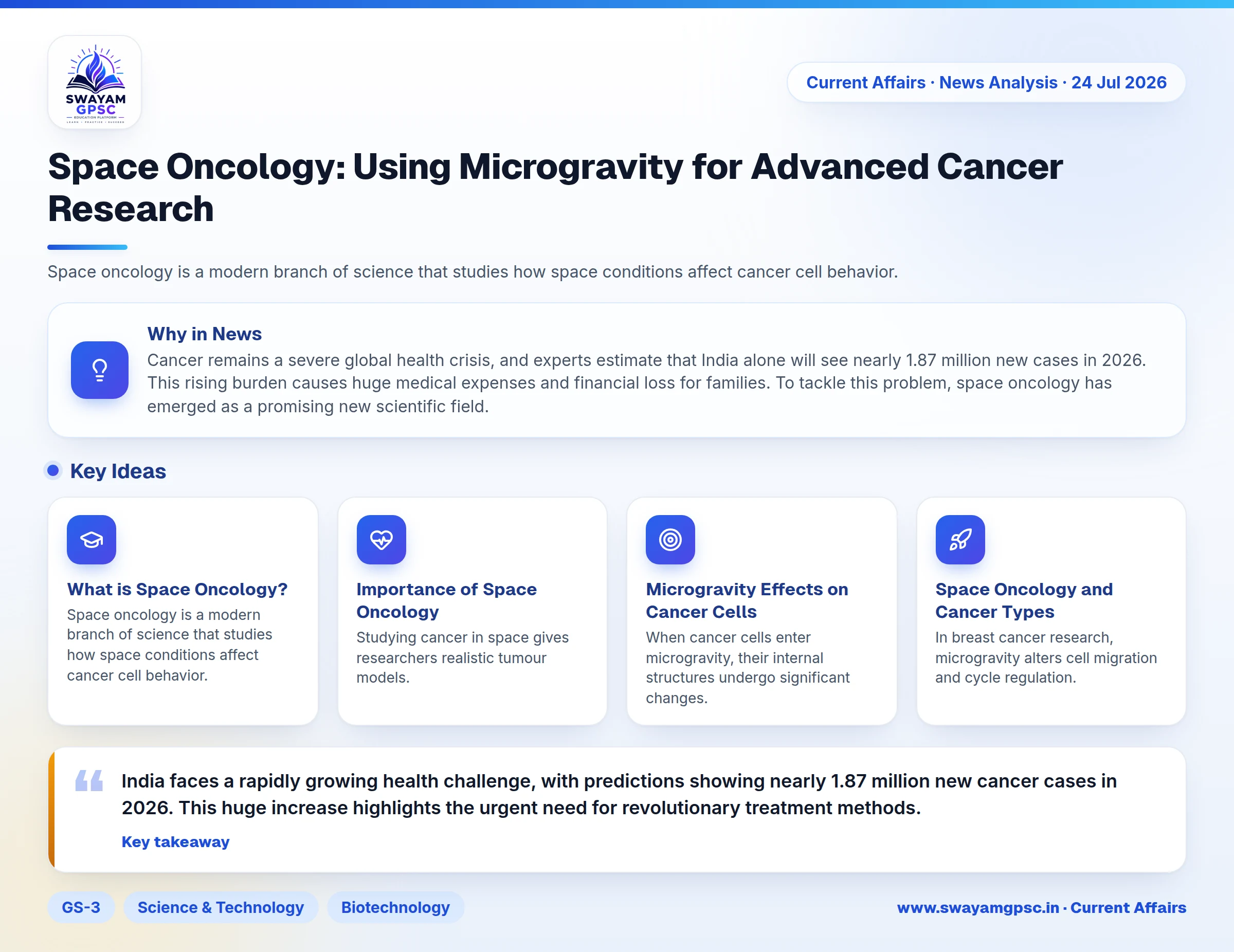
Space Oncology: Using Microgravity for Advanced Cancer Research
#GS-3 #Science & Technology #Biotechnology #Space #Health #Current Events #National
Why in News
- Cancer remains a severe global health crisis, and experts estimate that India alone will see nearly 1.87 million new cases in 2026. This rising burden causes huge medical expenses and financial loss for families.
- To tackle this problem, space oncology has emerged as a promising new scientific field. Researchers use microgravity in space to study how tumours grow and to design better cancer medicines.
What is Space Oncology?
- Space oncology is a modern branch of science that studies how space conditions affect cancer cell behavior. It examines the impact of microgravity and cosmic radiation on tumour growth and treatment response.
- Outer space acts as an ideal natural laboratory for medical researchers. It helps scientists observe how cancer spreads, resists drugs, and responds to radiation treatments.
- This research helps scientists develop advanced 3D cell cultures and tumour spheroids. It also improves protein crystallization and accelerates the creation of effective new drugs.
Importance of Space Oncology
- India faces a rapidly growing health challenge, with predictions showing nearly 1.87 million new cancer cases in 2026. This huge increase highlights the urgent need for revolutionary treatment methods.
- Cancer causes severe financial damage to families through expensive treatment costs and loss of earning capability. It also creates long-term mental and financial stress for caregivers.
- Studying cancer in space gives researchers realistic tumour models. These advanced models help scientists understand basic disease mechanisms much faster than traditional laboratory tools.
- Microgravity testing improves drug formulations and makes drug delivery systems more precise. This approach can also reduce our reliance on testing medicines on animals.
Microgravity Effects on Cancer Cells
- When cancer cells enter microgravity, their internal structures undergo significant changes. Their cytoskeleton reorganizes and changes how cells attach to their surrounding tissue.
- These gravity changes directly alter how cancer cells grow, divide, and move. They also change gene expression patterns inside the malignant cells.
- Microgravity allows cancer cells to cluster into realistic three-dimensional structures called tumour spheroids. These structures closely mimic how actual tumours behave inside the human body.
- Structural shifts in cells change how easily cancer medicine can enter them. This helps researchers discover why certain drug therapies succeed or fail.
Space Oncology and Cancer Types
- In breast cancer research, microgravity alters cell migration and cycle regulation. This makes breast cancer spheroids more vulnerable to specialized therapy drugs.
- Certain gastrointestinal cancer cells change their growth behavior in space. They show reduced drug resistance, allowing medicines to target and destroy them more effectively.
Role India Can Play in Space Oncology
- India can combine ISRO space expertise with its growing commercial space industry to create modern space-based biomedical research facilities.
- The government can encourage pharmaceutical companies to conduct space-based research for novel drug formulations and microgravity manufacturing.
- Strong partnerships between ISRO, medical hospitals, pharmaceutical firms, and space startups can speed up practical discoveries in cancer research.
- India can focus on transforming space research into affordable cancer diagnostic tools and treatments to reduce expenses for local patients.
- With declining rocket launch costs and expanding space access, India can position itself as a global leader in space biotechnology.