South China Sea Territorial Disputes and PCA Ruling
#GS-1 #Geography #Resources #GS-3 #Current Events #International #Mapping #South China Sea #Permanent Court of Arbitration #Nine-Dash Line
Why in News
- China recently reiterated its strong rejection of the 2016 Permanent Court of Arbitration ruling regarding South China Sea territorial claims, declaring the legal decision illegal and invalid.
About South China Sea
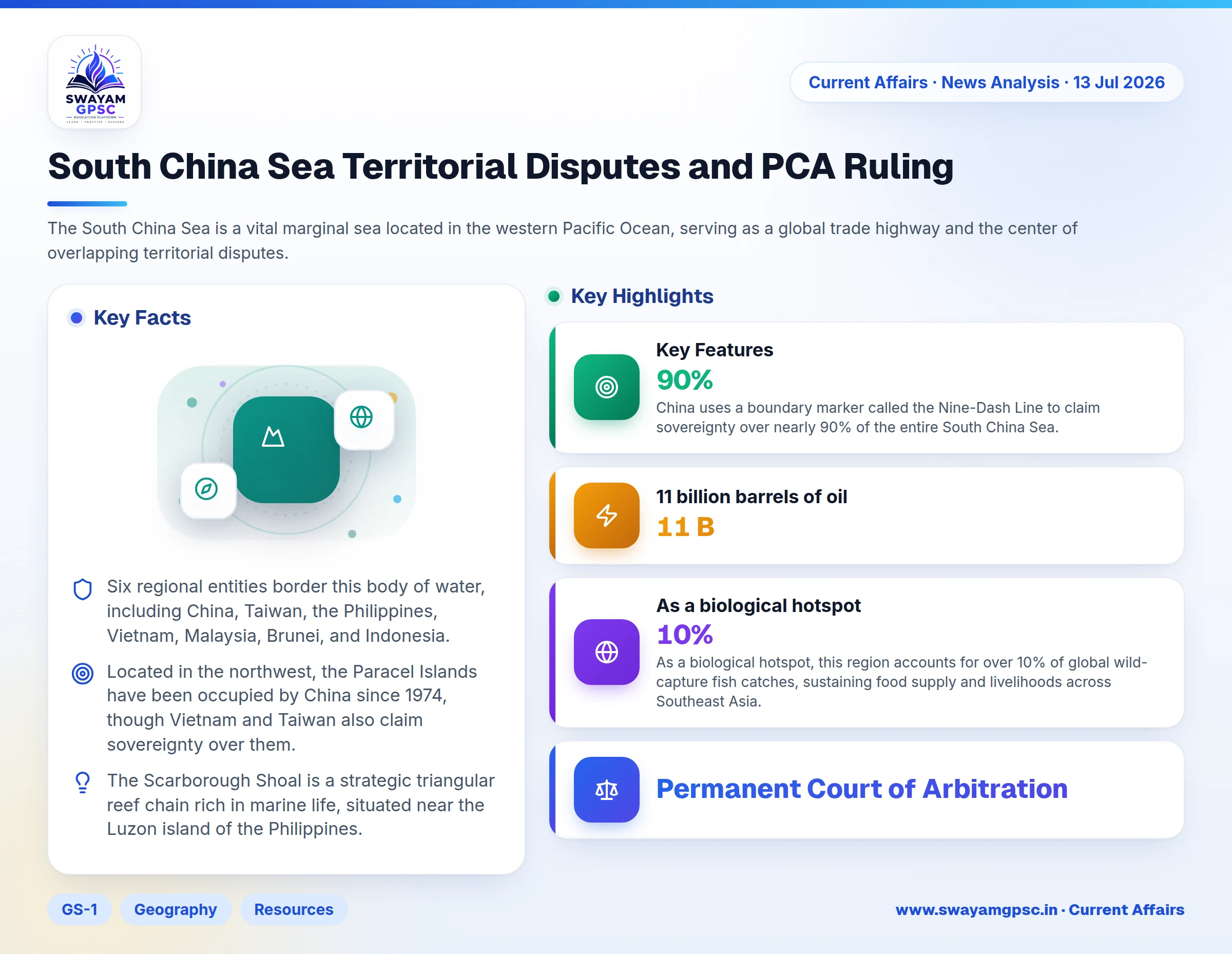
- The South China Sea is a vital marginal sea located in the western Pacific Ocean, serving as a global trade highway and the center of overlapping territorial disputes.
Location
- Geographically, this sea lies in Southeast Asia, situated south of mainland China, east of Vietnam, west of the Philippines, and north of Borneo and Sumatra islands.
Connecting Choke Points
- Key maritime channels connect this sea: the Taiwan Strait links it to the East China Sea, the Luzon Strait connects to the Philippine Sea, and the Strait of Malacca provides access to the Indian Ocean.
Nations Bordering the Sea
- Six regional entities border this body of water, including China, Taiwan, the Philippines, Vietnam, Malaysia, Brunei, and Indonesia.
Key Features
- China uses a boundary marker called the Nine-Dash Line to claim sovereignty over nearly 90% of the entire South China Sea.
- The Spratly Islands consist of over 100 small islands, reefs, and atolls in the south, claimed fully or partially by China, Vietnam, the Philippines, Malaysia, and Taiwan.
- Located in the northwest, the Paracel Islands have been occupied by China since 1974, though Vietnam and Taiwan also claim sovereignty over them.
- The Scarborough Shoal is a strategic triangular reef chain rich in marine life, situated near the Luzon island of the Philippines.
- According to the U.S. Energy Information Administration (EIA), the seabed holds immense resources, including about 11 billion barrels of oil and 190 trillion cubic feet of natural gas.
- As a biological hotspot, this region accounts for over 10% of global wild-capture fish catches, sustaining food supply and livelihoods across Southeast Asia.
Significance
- More than one-third of total global maritime shipping passes through these waters, meaning any conflict here could derail worldwide energy supplies and industrial supply chains.
- China has converted several natural reefs into fortified military outposts equipped with airstrips, radar stations, and missile platforms, heightening regional security risks.