SOLAR-1: 1st U.S. Dedicated Space Weather Monitoring Satellite
#GS-3 #Science & Technology #Space Technology #Current Events #National
Key takeaways
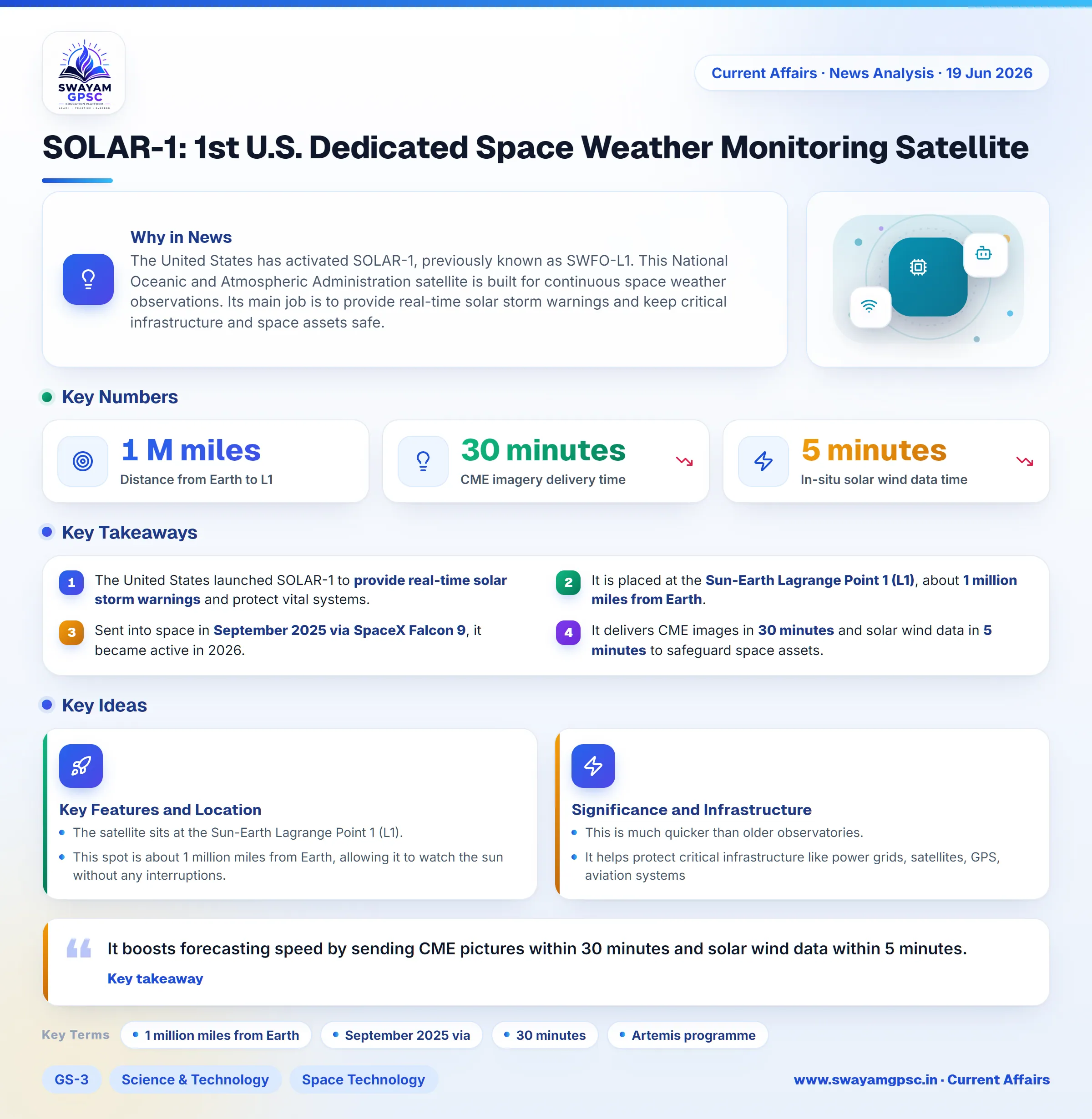
- The United States launched SOLAR-1 to provide real-time solar storm warnings and protect vital systems.
- It is placed at the Sun-Earth Lagrange Point 1 (L1), about 1 million miles from Earth.
- Sent into space in September 2025 via SpaceX Falcon 9, it became active in 2026.
- It delivers CME images in 30 minutes and solar wind data in 5 minutes to safeguard space assets.
Why in News
- The United States has activated SOLAR-1, previously known as SWFO-L1.
- This National Oceanic and Atmospheric Administration satellite is built for continuous space weather observations.
- Its main job is to provide real-time solar storm warnings and keep critical infrastructure and space assets safe.
Key Features and Location
- The satellite sits at the Sun-Earth Lagrange Point 1 (L1).
- This spot is about 1 million miles from Earth, allowing it to watch the sun without any interruptions.
- It was sent into space in September 2025 via a SpaceX Falcon 9 rocket.
- After traveling to its location and going through testing, it became fully operational in 2026.
- Its primary task is watching solar wind and coronal mass ejections closely to spot and track solar storms as they happen.
- It is packed with a coronagraph and in-situ sensors to take pictures of solar explosions and measure space weather instantly.
Significance and Infrastructure Protection
- It boosts forecasting speed by sending CME pictures within 30 minutes and solar wind data within 5 minutes.
- This is much quicker than older observatories.
- It helps protect critical infrastructure like power grids, satellites, GPS, aviation systems, and communication networks.
- It also supports human spaceflight missions such as NASA’s Artemis programme.
- Overall, SOLAR-1 strengthens early warning systems, lowers operational risks, and aids national security along with deep-space exploration.