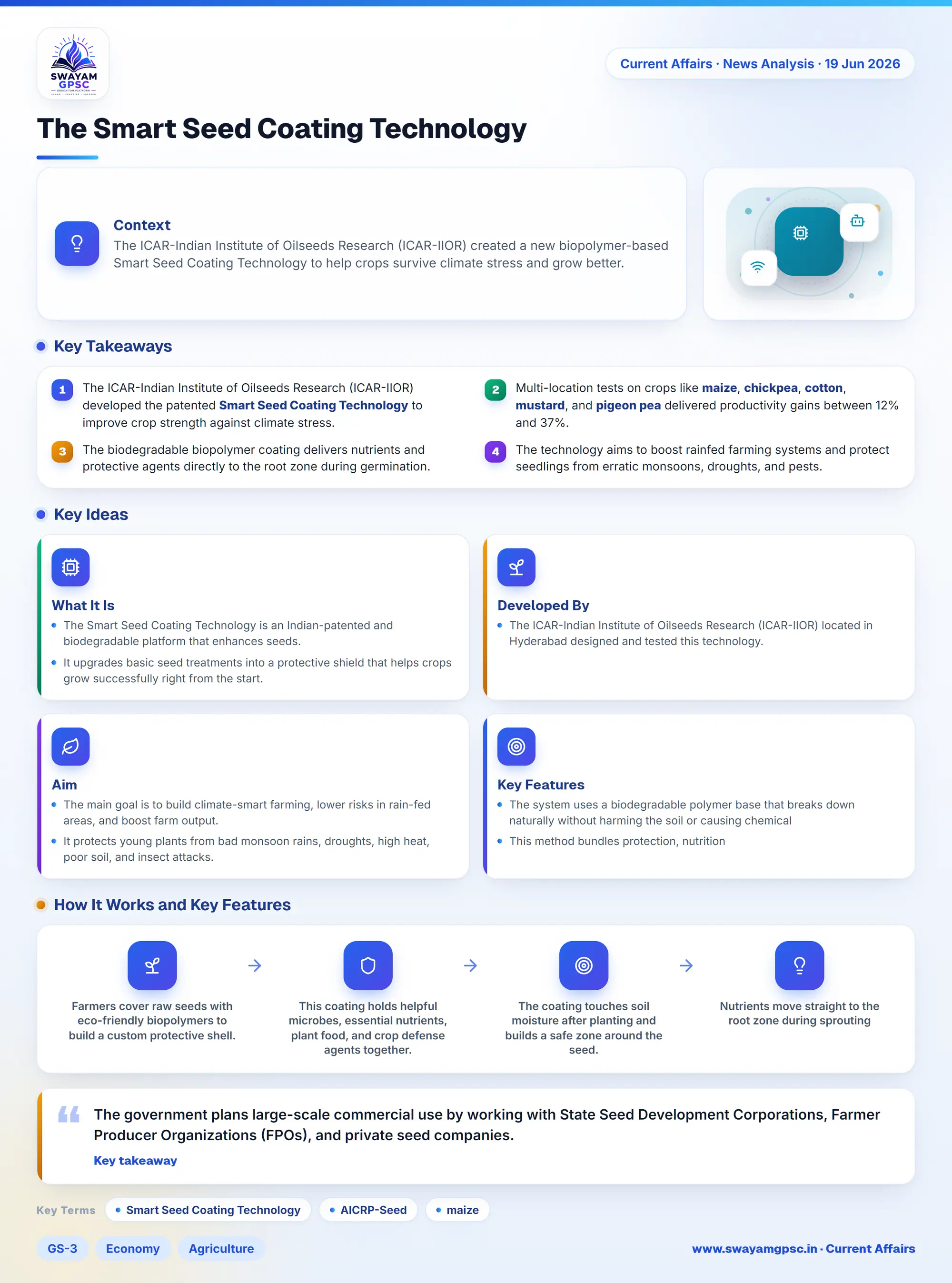
The Smart Seed Coating Technology
#GS-3 #Economy #Agriculture #Science & Technology #Environment
Key takeaways
- The ICAR-Indian Institute of Oilseeds Research (ICAR-IIOR) developed the patented Smart Seed Coating Technology to improve crop strength against climate stress.
- Multi-location tests on crops like maize, chickpea, cotton, mustard, and pigeon pea delivered productivity gains between 12% and 37%.
- The biodegradable biopolymer coating delivers nutrients and protective agents directly to the root zone during germination.
- The technology aims to boost rainfed farming systems and protect seedlings from erratic monsoons, droughts, and pests.
Context
- The ICAR-Indian Institute of Oilseeds Research (ICAR-IIOR) created a new biopolymer-based Smart Seed Coating Technology to help crops survive climate stress and grow better.
What It Is
- The Smart Seed Coating Technology is an Indian-patented and biodegradable platform that enhances seeds.
- It upgrades basic seed treatments into a protective shield that helps crops grow successfully right from the start.
Developed By
- The ICAR-Indian Institute of Oilseeds Research (ICAR-IIOR) located in Hyderabad designed and tested this technology.
Aim
- The main goal is to build climate-smart farming, lower risks in rain-fed areas, and boost farm output.
- It protects young plants from bad monsoon rains, droughts, high heat, poor soil, and insect attacks.
How It Works and Key Features
- Farmers cover raw seeds with eco-friendly biopolymers to build a custom protective shell.
- This coating holds helpful microbes, essential nutrients, plant food, and crop defense agents together.
- The coating touches soil moisture after planting and builds a safe zone around the seed.
- Nutrients move straight to the root zone during sprouting, helping roots grow fast and feeding the young plant right away.
Key Features
- The system uses a biodegradable polymer base that breaks down naturally without harming the soil or causing chemical pollution.
- This method bundles protection, nutrition, and biological support into one single step instead of using traditional single-use treatments.
- Farmers can adjust the formula to match the specific needs of grains, millets, pulses, oilseeds, fiber crops, fodder, vegetables, and spices.
- Field trials through AICRP-Seed on crops like maize, chickpea, cotton, mustard, and pigeon pea proved yield jumps between 12% and 37% compared to untreated seeds.
- The government plans large-scale commercial use by working with State Seed Development Corporations, Farmer Producer Organizations (FPOs), and private seed companies.