Small Hydro Power Development in India
#GS-2 #GS-3 #Government Policies & Interventions #Infrastructure #Economy #Energy #Environment #Sustainable Development
Key takeaways
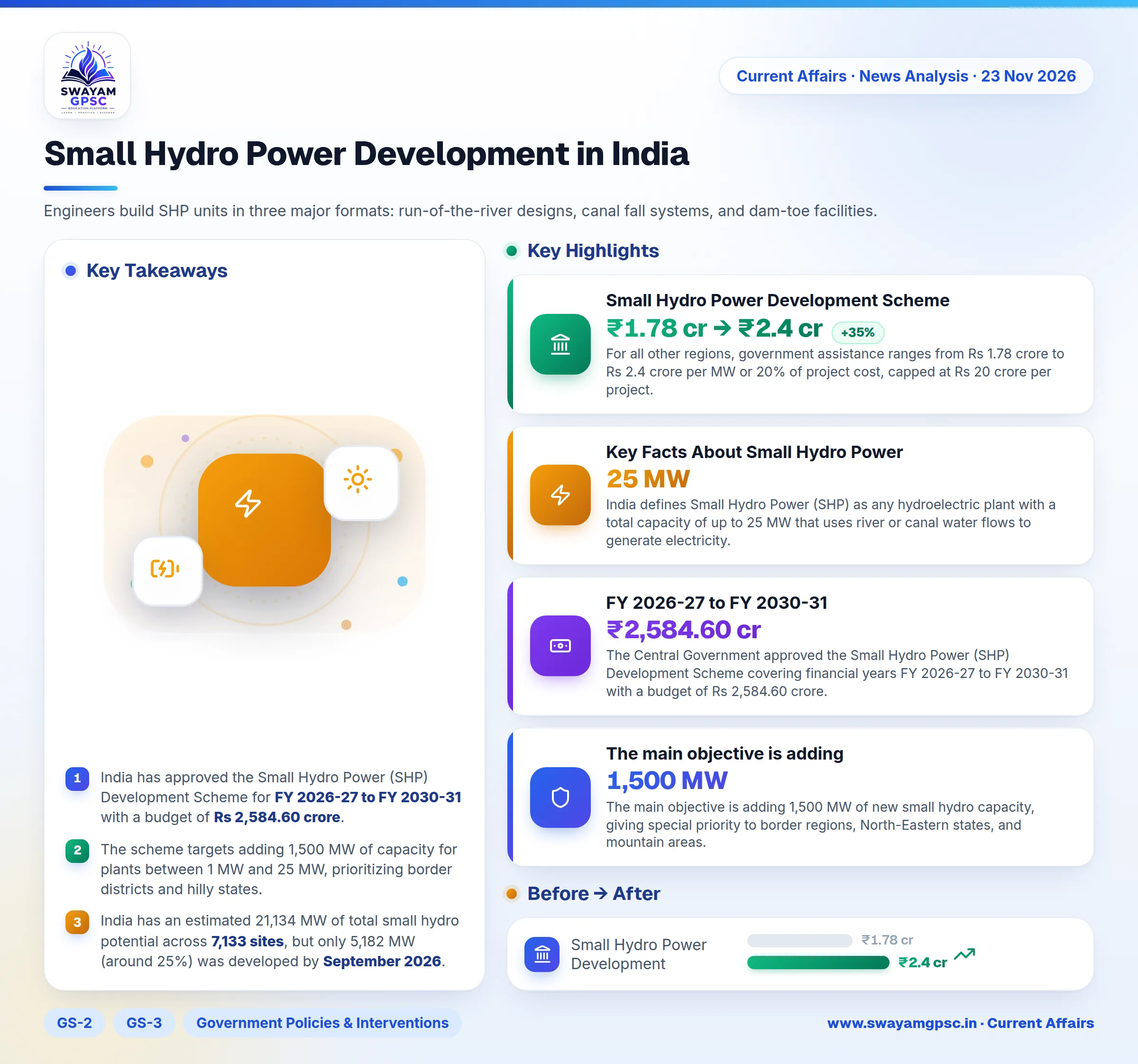
- India has approved the Small Hydro Power (SHP) Development Scheme for FY 2026-27 to FY 2030-31 with a budget of Rs 2,584.60 crore.
- The scheme targets adding 1,500 MW of capacity for plants between 1 MW and 25 MW, prioritizing border districts and hilly states.
- India has an estimated 21,134 MW of total small hydro potential across 7,133 sites, but only 5,182 MW (around 25%) was developed by September 2026.
- The Northern Region holds India's highest small hydro capacity at 8,030 MW, with Himachal Pradesh accounting for 3,460 MW.
- The program is projected to attract Rs 15,000 crore in total investments and create 51 lakh person-days of employment during construction.
Why in News
- The Ministry of New and Renewable Energy (MNRE) recently showcased India's renewed efforts to speed up Small Hydro Power (SHP) projects.
- The initiative aims to boost decentralized clean energy generation, improve national energy security, and support sustainable growth in remote and hilly areas.
Key Facts About Small Hydro Power
- India defines Small Hydro Power (SHP) as any hydroelectric plant with a total capacity of up to 25 MW that uses river or canal water flows to generate electricity.
- Projects under 25 MW are managed by the Ministry of New and Renewable Energy (MNRE), whereas larger hydropower projects above 25 MW fall under the Ministry of Power.
- Engineers build SHP units in three major formats: run-of-the-river designs, canal fall systems, and dam-toe facilities.
- Run-of-the-river setups divert natural river water directly into power turbines before returning it to the river stream without building massive water storage reservoirs.
- Canal-based and dam-toe plants use existing drop levels in irrigation canals, barrages, or existing dams to produce electricity efficiently.
- SHP delivers reliable and flexible green power based on seasonal water flow, which helps balance fluctuating solar and wind power output on the electrical grid.
- These plants work best in hilly regions, border districts, and North-Eastern states because localized power generation cuts down the need for long-distance power lines.
- Compared to mega-dams, SHP plants require far less land area and cause minimal displacement of local communities.
- Building local plants creates jobs, expands rural infrastructure, attracts investments, and improves livelihoods across isolated rural communities.
Significance of Small Hydro Power
- Generating power near consumer centers cuts down transmission losses and makes local power supply far more reliable.
- The continuous and adaptable electricity supply from water flows stabilizes the power grid alongside solar and wind installations.
- Smaller footprints mean minimal land acquisition and low community relocation risks compared to large dam projects.
- Constructing and maintaining these power stations brings new economic investments and steady jobs to underdeveloped rural areas.
- These plants produce electricity cleanly without burning fuel and operate reliably for decades, helping India phase out fossil fuels.
Small Hydro Power Development Scheme
- The Central Government approved the Small Hydro Power (SHP) Development Scheme covering financial years FY 2026-27 to FY 2030-31 with a budget of Rs 2,584.60 crore.
- The main objective is adding 1,500 MW of new small hydro capacity, giving special priority to border regions, North-Eastern states, and mountain areas.
- This government initiative offers direct financial assistance for setting up new plants with capacities between 1 MW and 25 MW.
- For North-Eastern states and border districts, financial support covers Rs 3.6 crore per MW or 30% of project cost, capped at Rs 30 crore per project.
- For all other regions, government assistance ranges from Rs 1.78 crore to Rs 2.4 crore per MW or 20% of project cost, capped at Rs 20 crore per project.
- The government expects the scheme to mobilize around Rs 15,000 crore in total investments while encouraging equipment production under the Atmanirbhar Bharat mission.
- The scheme sets aside Rs 30 crore to fund Detailed Project Reports for over 200 SHP projects to build a solid pipeline of future power plants.
- Construction activities under this scheme will generate nearly 51 lakh person-days of employment, along with permanent maintenance jobs in rural areas.
Small Hydro Power Potential in India
- National assessments identify 21,134 MW of total small hydro potential spread across 7,133 identified sites throughout India.
- By 30 September 2026, India had tapped 5,182 MW or about 25% of this potential, leaving 15,952 MW of clean energy capacity completely unharnessed.
- The Northern Region holds the largest share at 8,030 MW, with Himachal Pradesh leading at 3,460 MW, followed by Uttarakhand with 1,664 MW and Jammu & Kashmir with 1,312 MW.
- The Southern Region features 5,490 MW of potential, led by Karnataka at 3,726 MW, Kerala at 647 MW, and Tamil Nadu at 604 MW.
- The North-Eastern Region accounts for 2,995 MW, where Arunachal Pradesh dominates with 2,065 MW of clean potential.
- The Western Region offers 2,912 MW of potential, led by Chhattisgarh with 1,098 MW, Madhya Pradesh with 820 MW, and Maharashtra with 786 MW.
- The Eastern Region contains 1,707 MW of potential, led by Bihar at 527 MW, West Bengal at 392 MW, and Odisha at 286 MW.
- Harnessing these untapped resources requires public-private partnerships, smart targeted incentives, and stronger power transmission grids.
Way Forward
- India must balance its clean energy expansion with strong ecological safeguards and climate-resilient engineering to ensure long-term environmental sustainability.
- Involving local communities in project planning and operation will guarantee financial viability and smooth regional development.