SIPRI Yearbook 2026
#GS-2 #GS-3 #International Relations #National Security #Nuclear Technology #Government Policies & Interventions #Economy #Science & Technology
Key takeaways
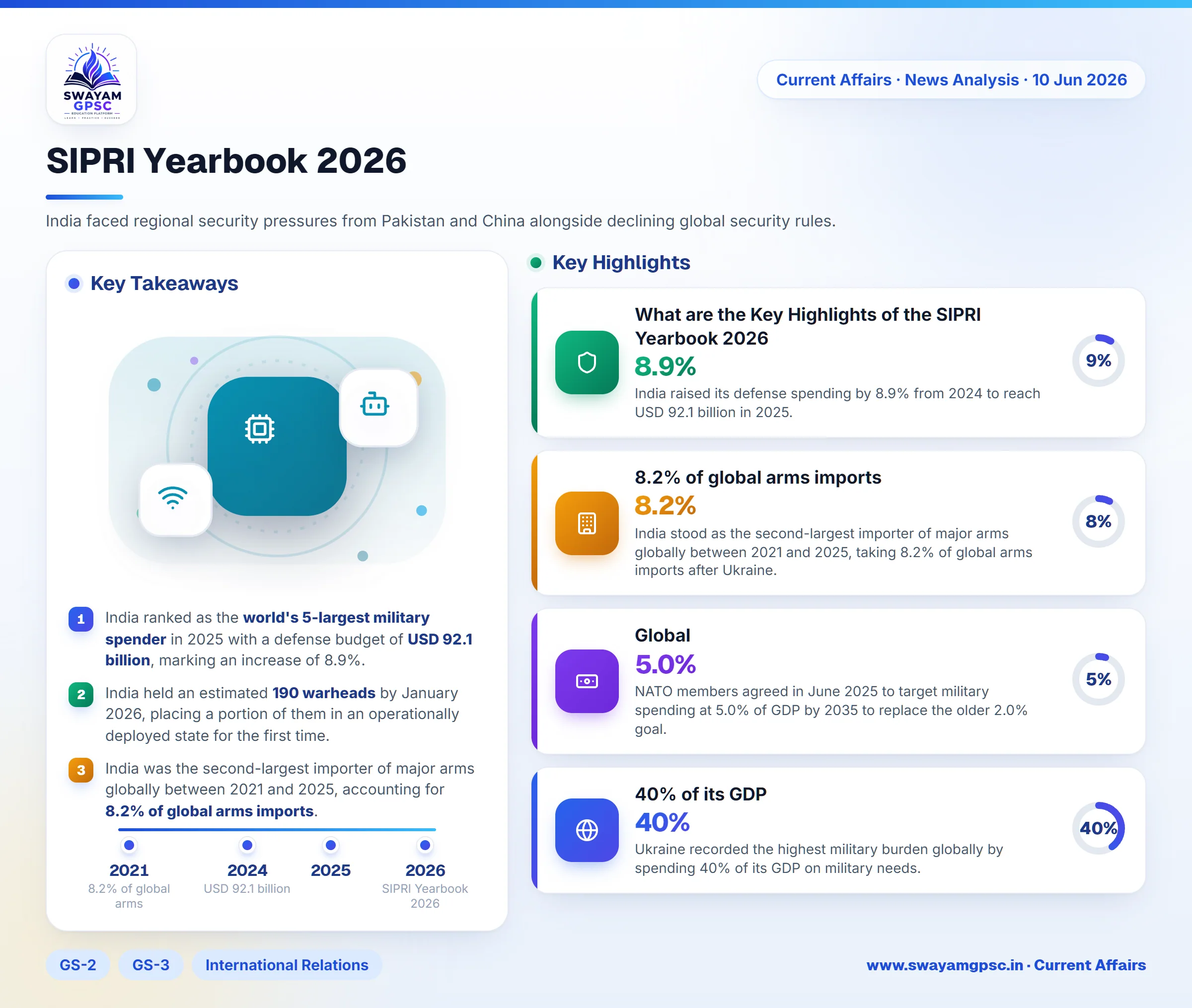
- India ranked as the world's 5-largest military spender in 2025 with a defense budget of USD 92.1 billion, marking an increase of 8.9%.
- India held an estimated 190 warheads by January 2026, placing a portion of them in an operationally deployed state for the first time.
- India was the second-largest importer of major arms globally between 2021 and 2025, accounting for 8.2% of global arms imports.
- The New START treaty between the US and Russia expired in February 2026 without a replacement while both nations control 86% of global warheads.
Why in News
- The Stockholm International Peace Research Institute (SIPRI) released the SIPRI Yearbook 2026 to review global armaments and international security.
- The report states that India has increased its nuclear stockpile and shifted part of its warheads into an operational deployed state for the first time.
What are the Key Highlights of the SIPRI Yearbook 2026
- India ranked as the world's 5-largest military spender in 2025 behind the US, China, Russia, and Germany.
- India raised its defense spending by 8.9% from 2024 to reach USD 92.1 billion in 2025.
- India faced regional security pressures from Pakistan and China alongside declining global security rules.
- India stood as the second-largest importer of major arms globally between 2021 and 2025, taking 8.2% of global arms imports after Ukraine.
- India held an estimated 190 warheads by January 2026, which includes 12 deployed and 178 in reserve compared to China's 620 warheads and Pakistan's 170 warheads.
- The May 2025 India-Pakistan military confrontation ("Operation Sindoor") marked the first time both nations blended cyber operations directly into active combat.
Global
- Nine nuclear-armed states including the US, Russia, the UK, France, China, India, Pakistan, North Korea, and Israel continue modernizing their nuclear stockpiles.
- NATO members agreed in June 2025 to target military spending at 5.0% of GDP by 2035 to replace the older 2.0% goal.
- Ukraine recorded the highest military burden globally by spending 40% of its GDP on military needs.
- Global nuclear inventories stand at 12,187 warheads, with 9,745 kept in active military stockpiles and over 4,000 deployed on missiles and aircraft.
- The US and Russia control nearly 86% of global warheads while their major upgrades continue without the New START treaty which expired in February 2026.
- Global nuclear disarmament is slowing down as countries replace retired warheads with newer models.
- Lithuania became the first nation to leave the Convention on Cluster Munitions in March 2025 while five European nations exited the Anti-Personnel Mine Convention.
- Ukraine and Gaza registered the highest conflict fatalities in 2025.
- Artificial intelligence and autonomous weapons are now regularly used in war zones like Gaza and Ukraine.
- Drone swarms and uncrewed aerial vehicles are changing combat strategies across the world.
- Ukraine launched over 100 smuggled drones in June 2025 during Operation Spider's Web to strike Russian aircraft.
What is India's Nuclear Doctrine
- India created its official nuclear doctrine in 2003 based on a "No First Use" (NFU) pledge.
- Credible minimum deterrence ensures adversaries face unacceptable costs if they attack India.
- The No First Use policy means India will only launch nuclear weapons in retaliation to an enemy strike.
- India promises a massive retaliatory strike based on Mutually Assured Destruction (MAD) if attacked.
- The Nuclear Command Authority (NCA) holds sole control over nuclear launch decisions.
- The Political Council headed by the Prime Minister makes the final decision to release weapons.
- The Executive Council headed by the National Security Advisor executes directives from the political leadership.
- India promises not to use nuclear weapons against Non-Nuclear Weapon States (NNWS).
- India keeps the right to use nuclear weapons if attacked with chemical or biological weapons.
- India maintains a testing pause and supports global nuclear disarmament.
Evolution of India's Nuclear Posture
- India started its peaceful nuclear program in 1947 under Homi J. Bhabha and Jawaharlal Nehru.
- India tested its first fission device on 18th May 1974 following security concerns from China.
- "Smiling Buddha" or Pokhran-I was tested at Pokhran in the Thar Desert.
- India faced global trade restrictions and the creation of the Nuclear Suppliers Group (NSG) after 1974.
- India refused to sign the Non-Proliferation Treaty (NPT), 1968 and the Comprehensive Nuclear Test Ban Treaty (CTBT) 1996.
- India conducted five underground tests under Operation Shakti (Pokhran-II) in May 1998 to declare itself a nuclear state.
- National Technology Day is celebrated every year on 11th May.
- India operationalized its nuclear doctrine in 2003 and later secured the 2008 US-India Civil Nuclear Agreement along with an NSG waiver.
India's Stance on Global Nuclear Treaties
- India stays out of the NPT and CTBT because it views the NPT as unfair to non-nuclear states.
- India holds membership in three major export control groups including the Missile Technology Control Regime (MTCR), the Wassenaar Arrangement, and the Australia Group.
- India rejects the Treaty on Prohibition of Nuclear Weapons, 2017 (TPNW) because it lacks strong verification rules.