Siddis: Gujarat's African-Origin Tribal Community
#GS-1 #Indian Society #Vulnerable Sections #Culture #Tribal Culture #GS-2 #Governance & Social Justice #Current Events #Gujarat #National #Rapid Fire CA #Quick Facts For Prelims #Issues Related to SCs & STs
Key takeaways
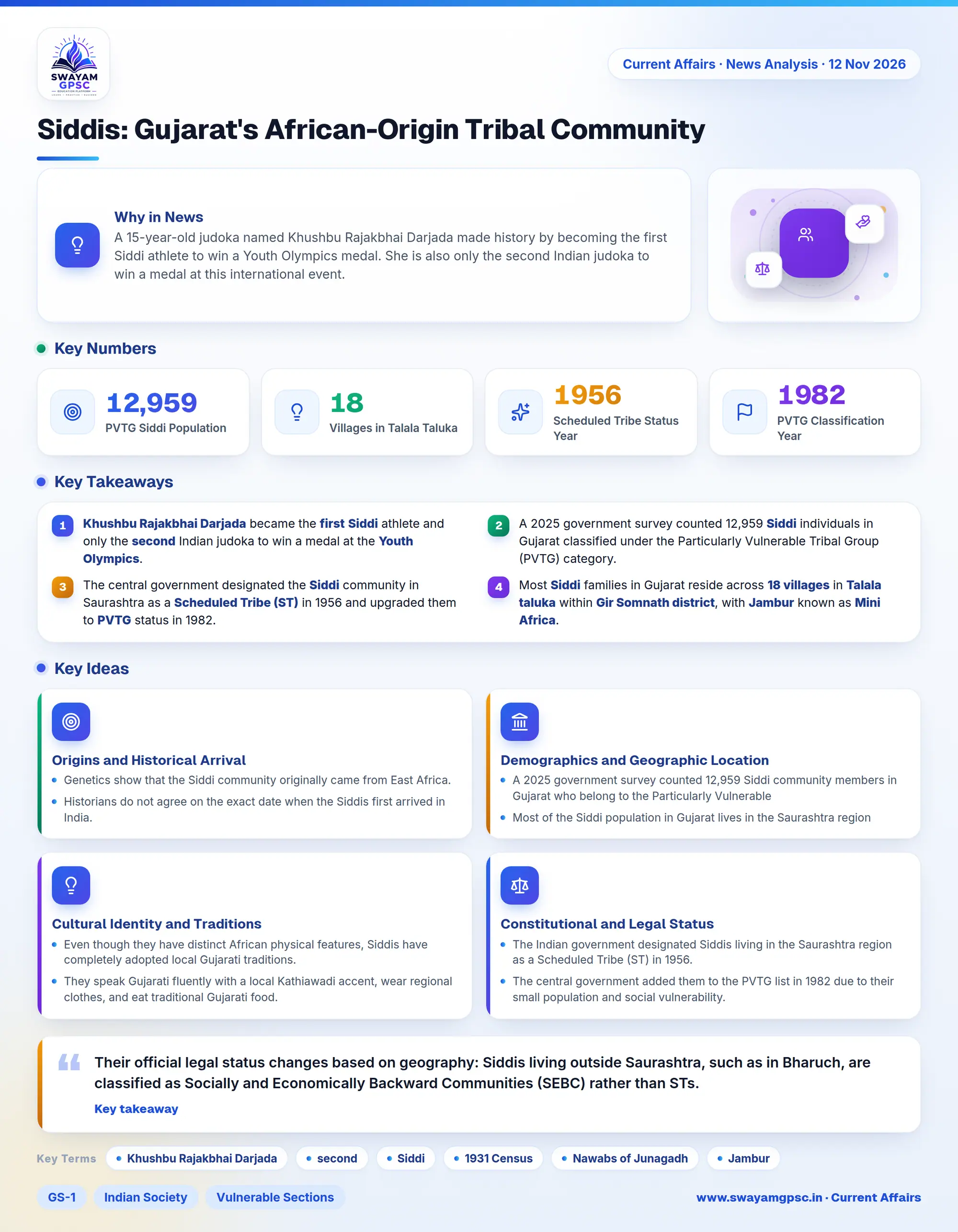
- Khushbu Rajakbhai Darjada became the first Siddi athlete and only the second Indian judoka to win a medal at the Youth Olympics.
- A 2025 government survey counted 12,959 Siddi individuals in Gujarat classified under the Particularly Vulnerable Tribal Group (PVTG) category.
- The central government designated the Siddi community in Saurashtra as a Scheduled Tribe (ST) in 1956 and upgraded them to PVTG status in 1982.
- Most Siddi families in Gujarat reside across 18 villages in Talala taluka within Gir Somnath district, with Jambur known as Mini Africa.
- The Siddi community preserves its heritage through Dhamal, a folk dance featuring African movements, while completely assimilating into Gujarati culture.
Why in News
- A 15-year-old judoka named Khushbu Rajakbhai Darjada made history by becoming the first Siddi athlete to win a Youth Olympics medal.
- She is also only the second Indian judoka to win a medal at this international event.
- Her victory brought national attention to the Siddi community, which is a unique tribal group of African descent living mainly in Gujarat.
Origins and Historical Arrival
- Genetics show that the Siddi community originally came from East Africa.
- Historians do not agree on the exact date when the Siddis first arrived in India.
- The 1931 Census suggests that Portuguese colonists brought them as enslaved people in the 17th century, or that invaders from Central and West Asia brought them during the 15th century.
- Local folklore tells a different story: it says the Nawabs of Junagadh brought them over 700 years ago to work as royal bodyguards, strongmen, and caretakers for captive lions.
Demographics and Geographic Location
- A 2025 government survey counted 12,959 Siddi community members in Gujarat who belong to the Particularly Vulnerable Tribal Group (PVTG) category.
- Most of the Siddi population in Gujarat lives in the Saurashtra region, specifically across 18 villages in Talala taluka of Gir Somnath district.
- The village of Jambur has earned the nickname Mini Africa because so many Siddi families live there.
- Smaller groups of Siddis also live in Maharashtra, Goa, Diu, and Daman.
Cultural Identity and Traditions
- Even though they have distinct African physical features, Siddis have completely adopted local Gujarati traditions.
- They speak Gujarati fluently with a local Kathiawadi accent, wear regional clothes, and eat traditional Gujarati food.
- Most Siddis follow the Muslim faith with strong Sufi traditions, while also incorporating some local Hindu customs.
- The community holds deep reverence for Baba Gor, an African Muslim saint who lived in the 15th or 16th century.
Constitutional and Legal Status
- The Indian government designated Siddis living in the Saurashtra region as a Scheduled Tribe (ST) in 1956.
- The central government added them to the PVTG list in 1982 due to their small population and social vulnerability.
- Their official legal status changes based on geography: Siddis living outside Saurashtra, such as in Bharuch, are classified as Socially and Economically Backward Communities (SEBC) rather than STs.
Livelihood and Cultural Practices
- Because their villages sit close to Gir National Park, many Siddis work as forest drivers, eco-guides, and local laborers.
- People often call them Siddi Badshah, which means carefree kings, reflecting their relaxed lifestyle.
- The men perform Dhamal, a traditional folk dance from Africa that features wild animal calls and energetic movements.
- Women in the community perform their own distinct traditional folk dances.
- Many Siddi youths show natural talent for sports like martial arts and athletics, though adjusting to rigid training regimes remains a cultural hurdle for some.