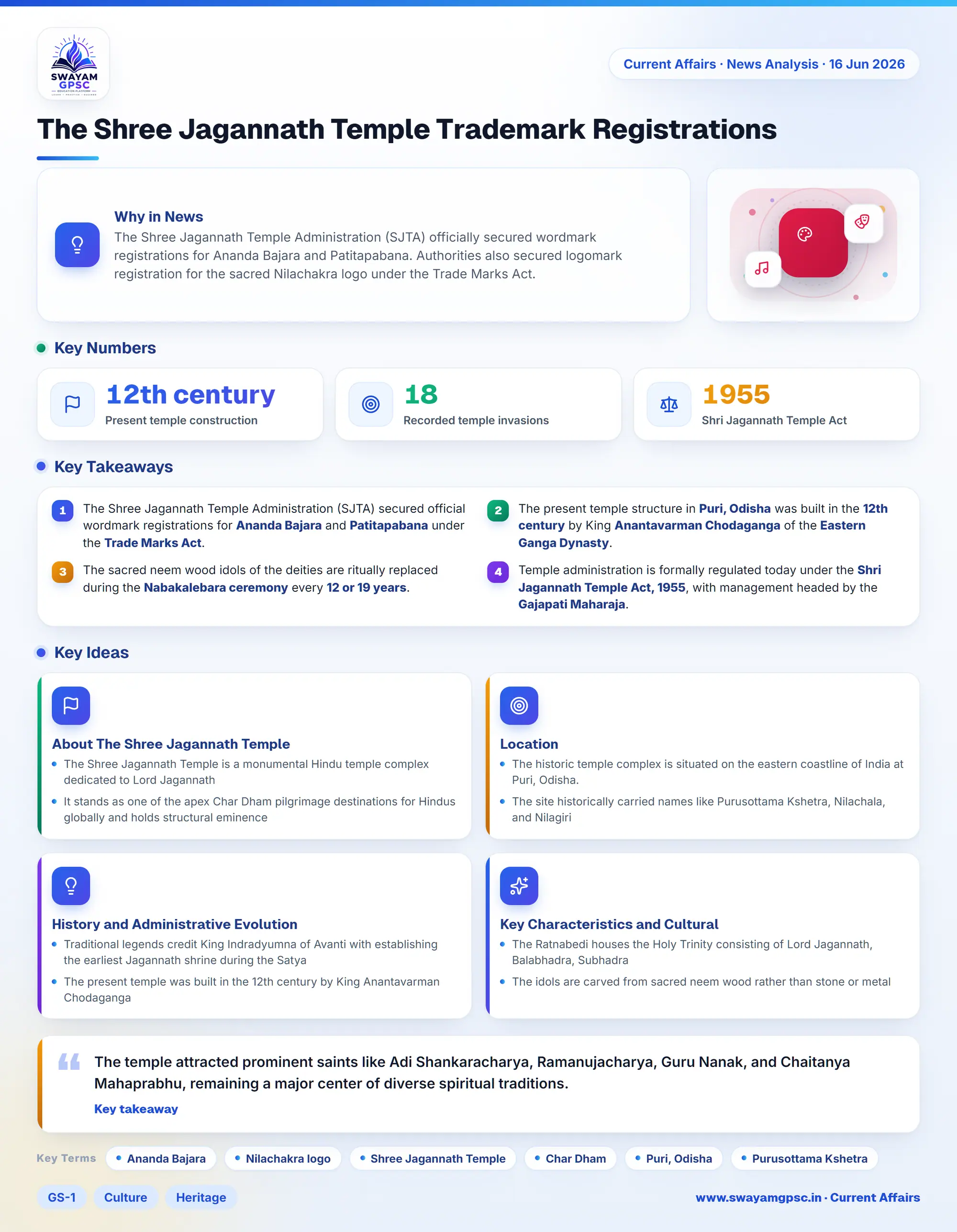
The Shree Jagannath Temple Trademark Registrations
#GS-1 #Culture #Heritage #Art & Architecture #Ancient India #Economy #IPR #Current Events #National
Key takeaways
- The Shree Jagannath Temple Administration (SJTA) secured official wordmark registrations for Ananda Bajara and Patitapabana under the Trade Marks Act.
- The present temple structure in Puri, Odisha was built in the 12th century by King Anantavarman Chodaganga of the Eastern Ganga Dynasty.
- The sacred neem wood idols of the deities are ritually replaced during the Nabakalebara ceremony every 12 or 19 years.
- Temple administration is formally regulated today under the Shri Jagannath Temple Act, 1955, with management headed by the Gajapati Maharaja.
Why in News
- The Shree Jagannath Temple Administration (SJTA) officially secured wordmark registrations for Ananda Bajara and Patitapabana.
- Authorities also secured logomark registration for the sacred Nilachakra logo under the Trade Marks Act.
About The Shree Jagannath Temple
- The Shree Jagannath Temple is a monumental Hindu temple complex dedicated to Lord Jagannath, who represents a synthesized manifestation of Lord Vishnu and Lord Krishna.
- It stands as one of the apex Char Dham pilgrimage destinations for Hindus globally and holds structural eminence as one of the 108 Abhimana Kshethrams within the Sri Vaishnavite theological tradition.
Location
- The historic temple complex is situated on the eastern coastline of India at Puri, Odisha.
- The site historically carried names like Purusottama Kshetra, Nilachala, and Nilagiri, and its sacred significance predates the construction of the modern monument.
History and Administrative Evolution
- Traditional legends credit King Indradyumna of Avanti with establishing the earliest Jagannath shrine during the Satya Yuga.
- The present temple was built in the 12th century by King Anantavarman Chodaganga, and his successor Anangabhima III dedicated the kingdom to Lord Jagannath.
- Temple records mention eighteen invasions, including the attack by Kalapahad in 1568 CE, during which the sacred Brahma Padartha was preserved and reinstalled.
- After occupying Odisha in 1803, the East India Company managed the temple and imposed a pilgrim tax before missionary opposition led to its abolition in 1840.
- The Shri Jagannath Temple Act, 1955 formalized temple administration after Independence, placing management under a statutory committee headed by the Gajapati Maharaja.
Key Characteristics and Cultural Syncretism
- The Ratnabedi houses the Holy Trinity consisting of Lord Jagannath, Balabhadra, Subhadra, and the Sudarshana Chakra as the central focus of worship.
- The idols are carved from sacred neem wood rather than stone or metal, and they are ritually replaced during the Nabakalebara ceremony every 12 or 19 years.
- Temple traditions blend tribal worship practices with classical Hindu rituals, where the Daitapati servitors trace their lineage to the ancient Sabar tribal community.
- During the annual Ratha Yatra, the deities are carried on massive wooden chariots through Puri with millions of devotees participating.
- The temple attracted prominent saints like Adi Shankaracharya, Ramanujacharya, Guru Nanak, and Chaitanya Mahaprabhu, remaining a major center of diverse spiritual traditions.