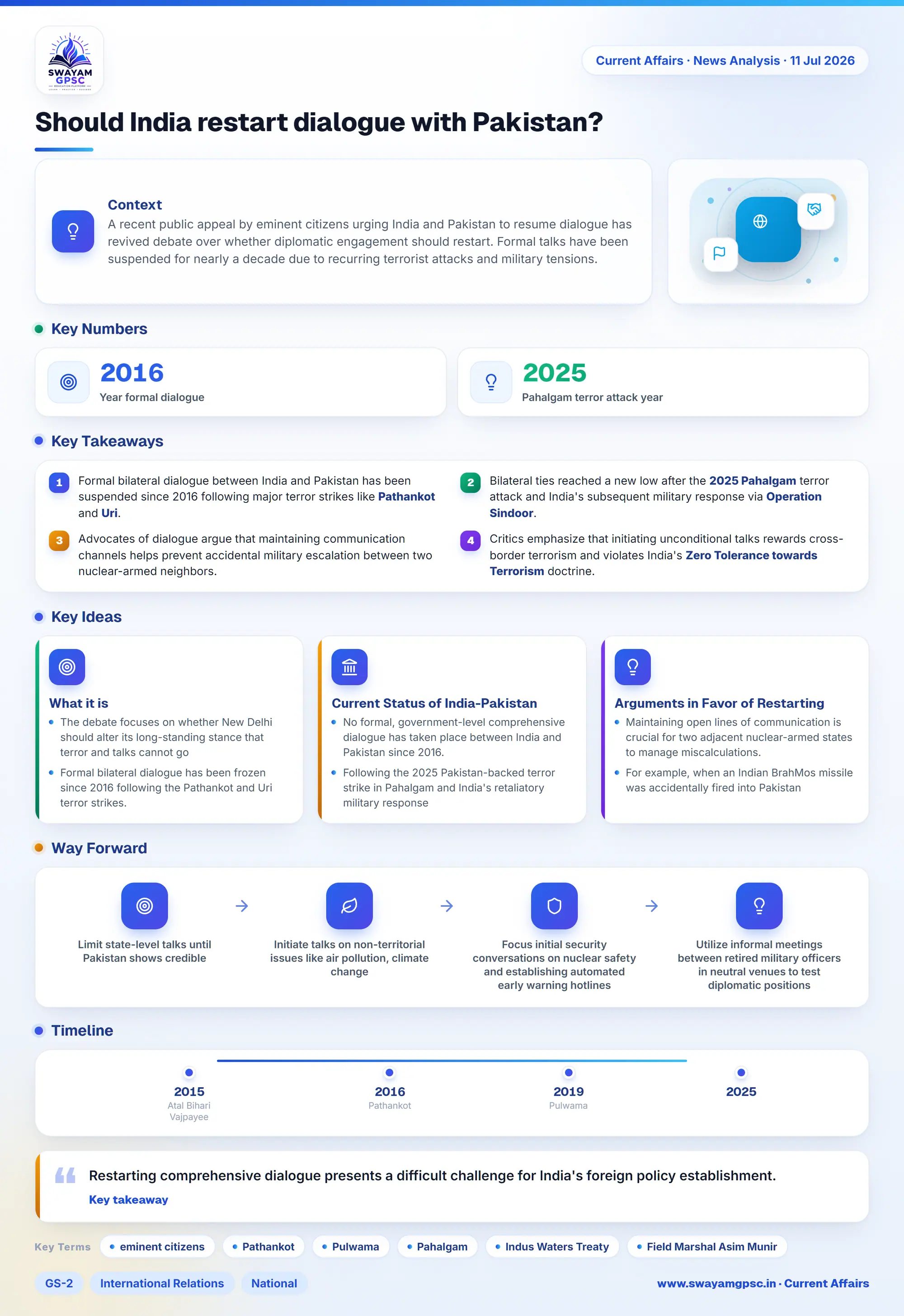
Should India restart dialogue with Pakistan?
#GS-2 #International Relations #National #Economy #Security #Environment
Key takeaways
- Formal bilateral dialogue between India and Pakistan has been suspended since 2016 following major terror strikes like Pathankot and Uri.
- Bilateral ties reached a new low after the 2025 Pahalgam terror attack and India's subsequent military response via Operation Sindoor.
- Advocates of dialogue argue that maintaining communication channels helps prevent accidental military escalation between two nuclear-armed neighbors.
- Critics emphasize that initiating unconditional talks rewards cross-border terrorism and violates India's Zero Tolerance towards Terrorism doctrine.
- Future engagement requires verified anti-terror actions and low-stakes functional cooperation on shared issues like air pollution rather than broad political talks.
Context
- A recent public appeal by eminent citizens urging India and Pakistan to resume dialogue has revived debate over whether diplomatic engagement should restart.
- Formal talks have been suspended for nearly a decade due to recurring terrorist attacks and military tensions.
What it is
- The debate focuses on whether New Delhi should alter its long-standing stance that terror and talks cannot go together.
- Formal bilateral dialogue has been frozen since 2016 following the Pathankot and Uri terror strikes.
- This breakdown was further exacerbated by major attacks in Pulwama in 2019 and Pahalgam in 2025, along with India's military response like Operation Sindoor.
Current Status of India-Pakistan Relations
- No formal, government-level comprehensive dialogue has taken place between India and Pakistan since 2016.
- Following the 2025 Pakistan-backed terror strike in Pahalgam and India's retaliatory military response, bilateral ties remain highly strained.
- India took unprecedented non-military punitive actions including closing the border, cutting off trade, and suspending the Indus Waters Treaty.
- Pakistan's internal power structure has shifted toward total military consolidation under Field Marshal Asim Munir, rendering the civilian government under Shehbaz Sharif weak.
- While formal state diplomacy is frozen, informal Track-II meetings between retired diplomats and military officers have continued in neutral venues like Sri Lanka and Thailand.
Arguments in Favor of Restarting Dialogue
- Maintaining open lines of communication is crucial for two adjacent nuclear-armed states to manage miscalculations.
- For example, when an Indian BrahMos missile was accidentally fired into Pakistan, raw military communication successfully prevented a conventional response.
- India has historically achieved its most significant breakthroughs when dealing directly with Pakistan's military leaders rather than weak civilian premiers.
- For instance, General Ayub Khan signed the Indus Waters Treaty, General Zia-ul-Haq broke the deadlock on Siachen, and General Pervez Musharraf formulated the four-point solution framework for Kashmir.
- Senior nationalist leaders have indicated a willingness to decouple regional deterrence from complete diplomatic isolation.
- Joint survival challenges require transnational cooperation independent of territorial disputes, such as seasonal stubble burning across Punjab and the Indus plains triggering a shared public health crisis.
- Lowering daily friction with Pakistan limits the risk of collusive military provocations coordinated alongside China.
Arguments Against Restarting Dialogue
- Yielding to unconditional talks rewards asymmetric warfare and undermines the sacrifices of security personnel.
- General Asim Munir's rise within Rawalpindi was directly accelerated by organizing the destructive 2025 Pahalgam terror strike.
- Initiating dialogue without verifiable security metrics violates India's established Zero Tolerance towards Terrorism doctrine.
- External Affairs Minister S. Jaishankar explicitly stated that the era of uninterrupted dialogue with Pakistan is over because actions carry heavy consequences.
- The Pakistani military elite lacks structural motivation to preserve long-term regional peace because permanent stability would erode their dominant political and economic hold.
- Internal economic crashes and deep political infighting leave Islamabad without a reliable representative to execute international treaties.
- Past attempts by Indian leaders to extend olive branches were met with immediate betrayals, such as Atal Bihari Vajpayee's 1999 bus journey to Lahore followed by the Kargil infiltration, and Prime Minister Modi's 2015 visit answered by the Pathankot airbase attack.
Way Forward
- Limit state-level talks until Pakistan shows credible, verifiable progress in closing terrorist training camps operating from its territory.
- Initiate talks on non-territorial issues like air pollution, climate change, and restoring limited medical visas.
- Focus initial security conversations on nuclear safety and establishing automated early warning hotlines to prevent accidental conventional conflicts.
- Utilize informal meetings between retired military officers in neutral venues to test diplomatic positions before bringing them to official tables.
- Gradually restore essential land-border commerce through the Attari-Wagah border to relieve supply chain pressures affecting ordinary citizens.
Conclusion
- Restarting comprehensive dialogue presents a difficult challenge for India's foreign policy establishment.
- While maintaining communication channels is vital, resuming unconditional talks without verifiable anti-terror commitments risks legitimizing cross-border violence.
- New Delhi must balance its hardline stance against terrorism with flexible functional cooperation on shared environmental threats to ensure regional stability.