Semaglutide Patent Expiry and Opportunities for the Indian Pharmaceutical Sector
#GS-2 #GS-3 #Health #Economy #Science & Technology #Indian Polity & Constitution #National #Intellectual Property Rights
Why in News
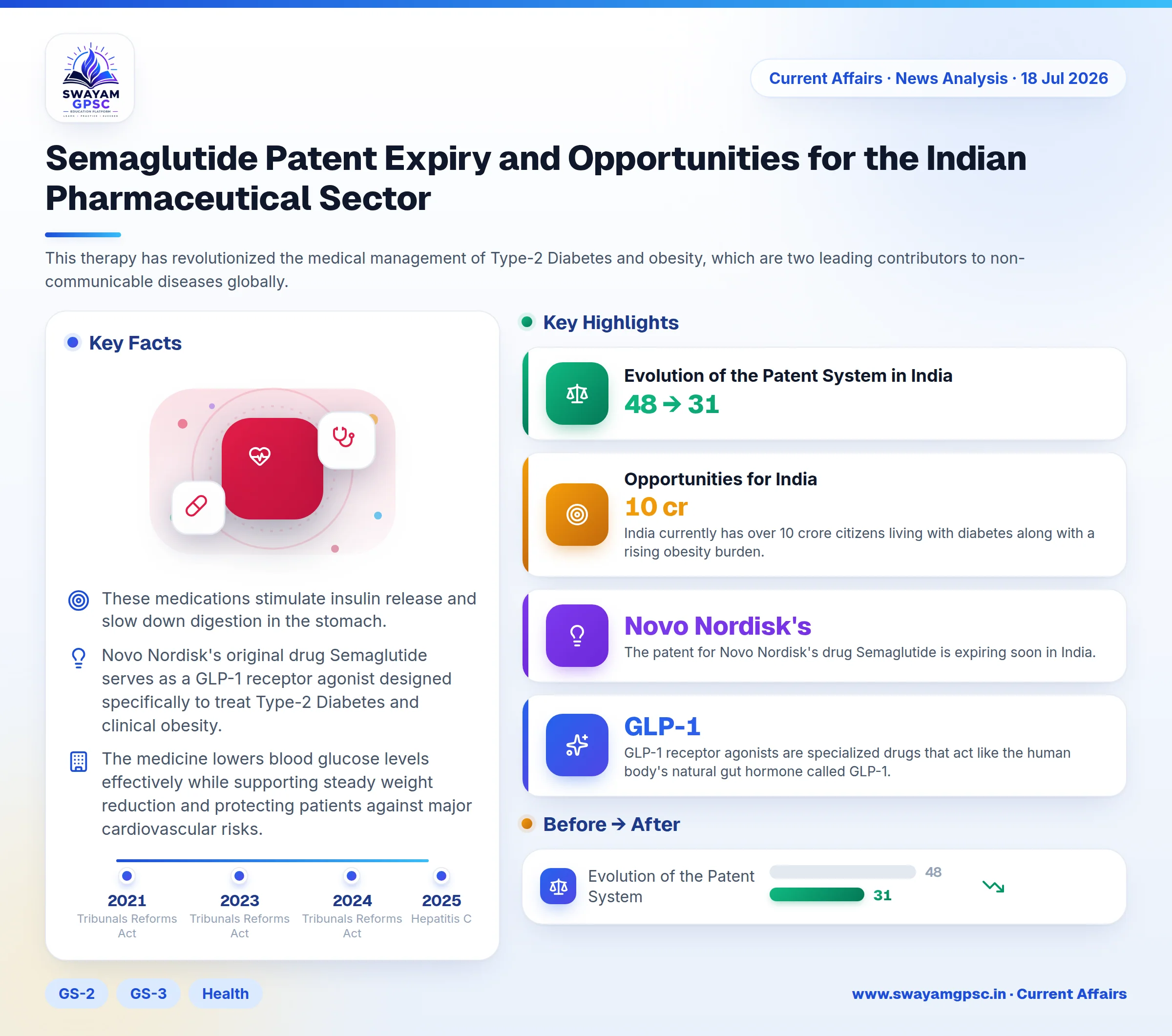
- The patent for Novo Nordisk's drug Semaglutide is expiring soon in India. This change allows domestic drug makers to produce affordable generic versions of GLP-1 receptor agonist medicines.
- GLP-1 receptor agonists are specialized drugs that act like the human body's natural gut hormone called GLP-1.
- These medications stimulate insulin release and slow down digestion in the stomach. As a result, they help patients control blood sugar levels, lower their appetite, and manage body weight effectively.
What is Semaglutide and Its Significance
- Novo Nordisk's original drug Semaglutide serves as a GLP-1 receptor agonist designed specifically to treat Type-2 Diabetes and clinical obesity.
- The medicine lowers blood glucose levels effectively while supporting steady weight reduction and protecting patients against major cardiovascular risks.
- This therapy has revolutionized the medical management of Type-2 Diabetes and obesity, which are two leading contributors to non-communicable diseases globally.
- Before this patent period ended, the high cost of branded Semaglutide kept this critical treatment out of reach for many patients.
- The upcoming patent expiry will lower medicine costs, broaden public access to quality care, and expand the domestic drug manufacturing market.
Opportunities for India
- India currently has over 10 crore citizens living with diabetes along with a rising obesity burden. Generic versions of Semaglutide will drastically lower treatment expenses for these patients.
- Patent expirations in nations like China, Brazil, Canada, South Africa, and Turkey create lucrative export channels for Indian generic manufacturers.
- Making generic Semaglutide helps Indian drug companies upgrade from simple small-molecule drugs to complex peptide therapies and novel delivery devices.
- Stronger domestic demand paired with support from the Production Linked Incentive (PLI) scheme will accelerate investments in research, active pharmaceutical ingredients, and advanced medicine production.
GLP-1 Therapies and Dermatological Health
- Beyond economic advantages, GLP-1 receptor agonist drugs influence overall body health, showing notable clinical impacts on skin and hair condition.
- Fast weight loss from these drugs can cause facial fat loss known informally as Ozempic face, while loose body skin may trigger skin infections like intertrigo and dark patches.
- Rapid weight loss places physical stress on the body and can deplete essential nutrients like protein, iron, and Vitamin B12, leading to temporary hair shedding known as Telogen Effluvium.
- Shifts in nutritional absorption during treatment frequently show up on nails, making them brittle, ridged, and slow-growing.
- Early clinical studies suggest these drugs reduce systemic inflammation, which might help relieve skin diseases like Psoriasis and Hidradenitis Suppurativa in patients with metabolic disorders.
Definition and Scope of Patents
- A patent acts as a legal protection given by the government to an inventor for 20 years in exchange for disclosing technical details publicly.
- This ownership right gives the patent holder exclusive control to manufacture, market, sell, license, or import the patented product.
- Once the 20-year tenure ends or official renewal fees remain unpaid, the invention becomes part of the public domain for everyone to use freely.
Evolution of the Patent System in India
- India introduced its first patent legislation through Act VI of 1856, followed by statutory updates in 1859, 1872, and finally the Indian Patents and Designs Act, 1911, which created the position of Controller of Patents.
- Independent India reviewed its framework through the Bakshi Tek Chand Committee (1949) and the Justice N. Rajagopala Ayyangar Committee (1959), culminating in the Patents Act, 1970 that authorized process patents to help domestic generic drug production.
- Joining the WTO in 1995 led India to amend its patent rules through the Patents (Amendment) Act, 1999 for the Mailbox System, the Patents (Amendment) Act, 2002 for 20-year terms, and the Patents (Amendment) Act, 2005 for product patents.
- Under the Patents (Amendment) Act, 2005, Section 3(d) prevents pharmaceutical companies from evergreening patents unless a minor modification shows significantly higher therapeutic efficacy.
- Recent legal updates include the Tribunals Reforms Act, 2021, which dissolved the Intellectual Property Appellate Board (IPAB), and the Jan Vishwas Act, 2023 alongside the Patents (Amendment) Rules, 2024 to speed up application checks from 48 to 31 months.
How Patent Expiries Driven India's Pharma Growth
- When Pfizer lost its patent for the cholesterol drug Lipitor (Atorvastatin) in 2011, Indian firms expanded rapidly into American and European cardiovascular drug markets.
- The 2012 patent expirations for Plavix (Clopidogrel) and Viagra (Sildenafil) allowed domestic companies to boost manufacturing volumes and provide low-cost treatments globally.
- In 2013, the Supreme Court of India delivered a historic ruling against Novartis to stop patent evergreening on the leukemia drug Imatinib, cutting annual treatment costs from USD 25,000 to a tiny fraction.
- Patent changes surrounding the Hepatitis C medicine Sofosbuvir in 2025 further cemented India's global reputation as the Pharmacy of the Developing World.
Frequently Asked Questions
- Why is the expiry of Semaglutide's patent significant for India? It allows domestic drug makers to introduce low-cost GLP-1 remedies, lowering healthcare bills for millions while spurring export opportunities.
- What are GLP-1 receptor agonists? These are medications that manage Type-2 Diabetes and obesity by promoting insulin production, curbing appetite, supporting weight loss, and protecting heart health.
- How can Semaglutide strengthen India's pharmaceutical industry? Producing generic Semaglutide boosts pharmaceutical exports, accelerates the adoption of complex peptide technologies, and drives new investments into research and active raw materials.