Seaweed Hydrogel Microbeads for Precision Micronutrient Delivery
#GS-3 #Science & Technology #Biotechnology #Agriculture #Current Events #National #Gujarat #Rapid Fire CA #Quick Facts For Prelims
Key takeaways
- Researchers at IIT Gandhinagar designed biodegradable 3.5 mm hydrogel microbeads using red seaweed to release micronutrients based on soil pH.
- In lab tests under pH 4 acidic conditions, the beads expanded by 80% in 2 days and released 68% of iron and 66% of zinc over 14 days.
- The innovation uses Kappa Carrageenan from coastal Kappaphycus seaweed and trans-ferulic acid from grains to deliver zinc, iron, manganese, and copper.
- Supported by the Department of Biotechnology (DBT), the team filed an Indian patent and earned first prize at the SOMS 2026 Summit in GIFT City.
Why in News
- Scientists at IIT Gandhinagar created smart hydrogel microbeads from seaweed that deliver plant micronutrients directly to roots.
- The team adapted targeted delivery techniques from human cancer therapies to build this agriculture system.
Understanding Hydrogels and Bead Composition
- Hydrogels are 3D polymer networks that soak up high volumes of water and release trapped nutrients slowly over time.
- Each biodegradable bead measures about 3.5 mm across and contains Kappa Carrageenan, a natural gel maker taken from red seaweed.
- Farmers harvest this Kappaphycus red seaweed along India's southern coast for commercial applications.
- The beads also contain trans-ferulic acid, a plant antioxidant present in rice, wheat, and oats.
- Researchers used calcium chloride to bond the ingredients and solidify the gel structure.
Rhizosphere Action Mechanism
- When crops face shortages of iron or zinc, their roots release organic acids into the soil zone nearby.
- This natural secretion lowers soil pH in the rhizosphere, making the environment acidic.
- The microbeads sense this acidity, swell up, and discharge zinc, iron, manganese, and copper next to the roots.
Laboratory Results
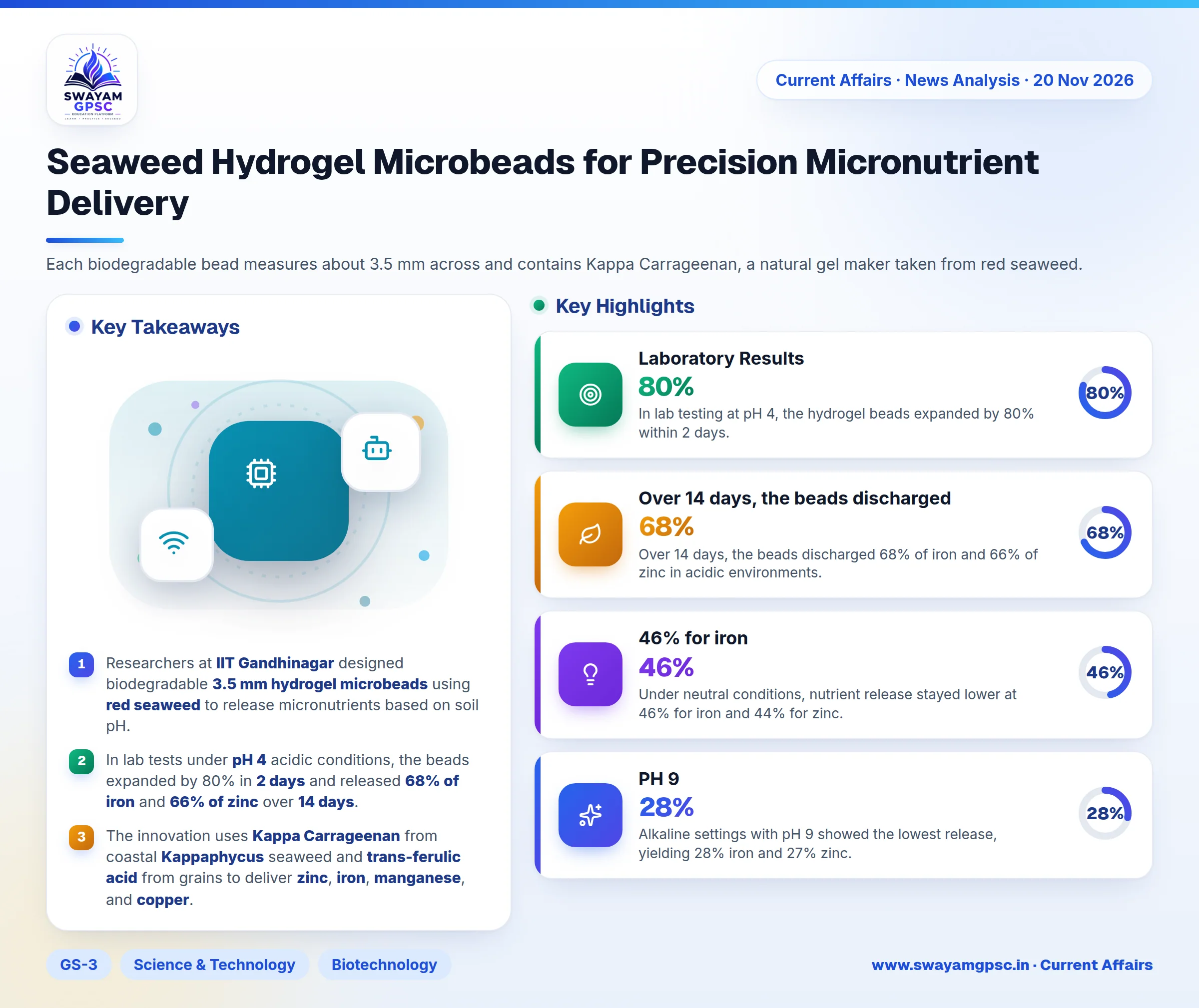
- In lab testing at pH 4, the hydrogel beads expanded by 80% within 2 days.
- Over 14 days, the beads discharged 68% of iron and 66% of zinc in acidic environments.
- Under neutral conditions, nutrient release stayed lower at 46% for iron and 44% for zinc.
- Alkaline settings with pH 9 showed the lowest release, yielding 28% iron and 27% zinc.
Overcoming Conventional Fertiliser Limits
- Standard mineral salts get locked up in soil chemicals or wash away during heavy rains before roots absorb them.
- Spraying liquid nutrients directly onto plant leaves remains hard to scale across expansive farm fields.
- Synthetic chelated micronutrients carry high price tags and do not break down easily inside soil.
Way Forward
- The project received funding support from IITGN grants and the Department of Biotechnology (DBT).
- The team published their discoveries in the journal ACS Omega and captured top honors at the SOMS 2026 Summit in GIFT City, Gandhinagar.
- With a patent application registered in India, researchers are now seeking commercial partners for field trials to test soil health impact, crop yield, and safety.