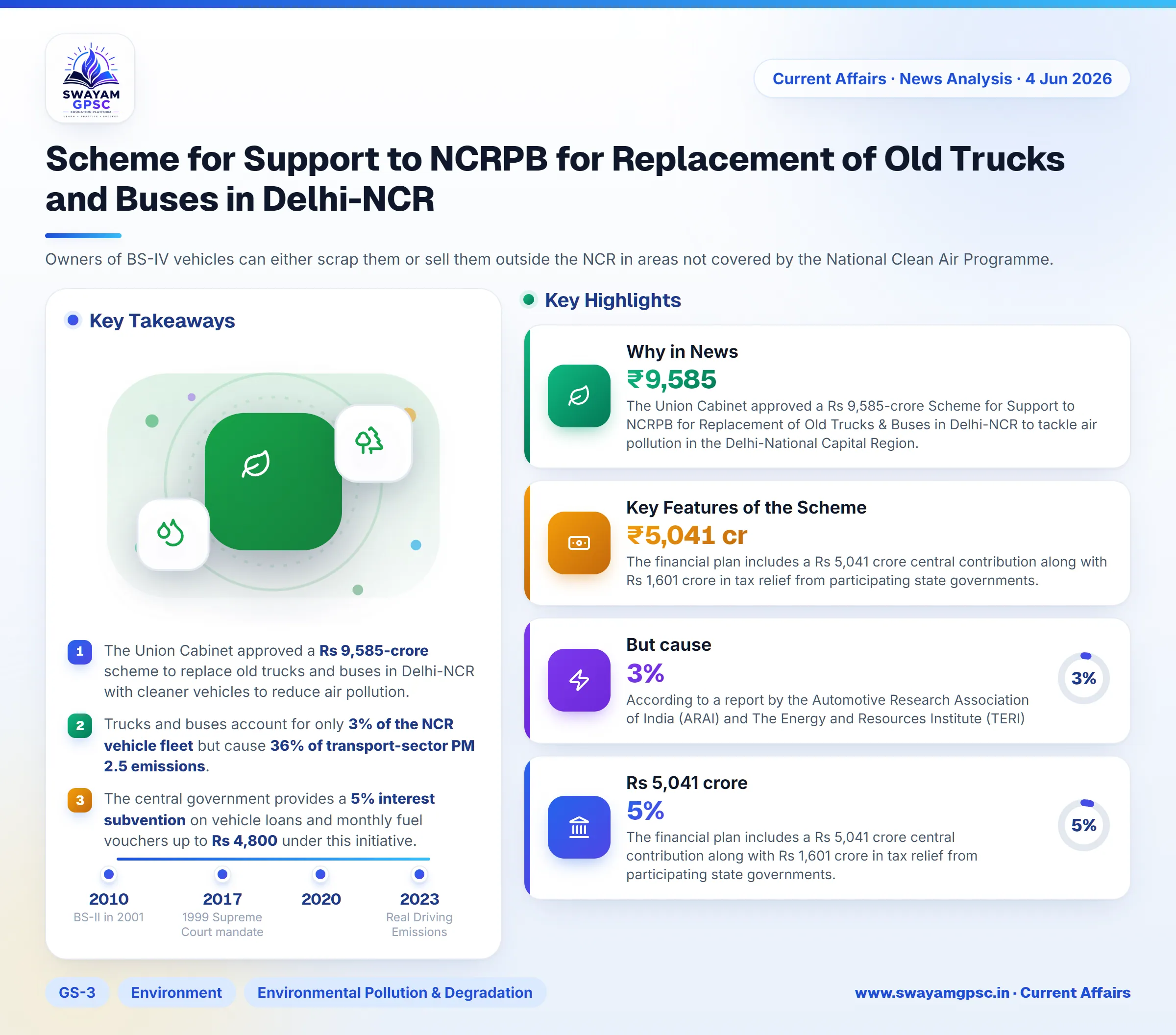
Scheme for Support to NCRPB for Replacement of Old Trucks and Buses in Delhi-NCR
#GS-3 #Environment #Environmental Pollution & Degradation #GS-2 #Government Policies & Interventions #Quick Facts For Prelims
Key takeaways
- The Union Cabinet approved a Rs 9,585-crore scheme to replace old trucks and buses in Delhi-NCR with cleaner vehicles to reduce air pollution.
- Trucks and buses account for only 3% of the NCR vehicle fleet but cause 36% of transport-sector PM 2.5 emissions.
- The central government provides a 5% interest subvention on vehicle loans and monthly fuel vouchers up to Rs 4,800 under this initiative.
- India skipped the BS-V stage entirely and moved directly to BS-VI nationwide in April 2020 to control vehicular pollution.
Why in News
- The Union Cabinet approved a Rs 9,585-crore Scheme for Support to NCRPB for Replacement of Old Trucks & Buses in Delhi-NCR to tackle air pollution in the Delhi-National Capital Region.
- This two-year program replaces old commercial vehicles like trucks and buses with cleaner Bharat Stage-VI (BS-VI) compliant models and Electric Vehicles (EVs).
Key Features of the Scheme
- The National Capital Region Planning Board (NCRPB) under the Ministry of Housing and Urban Affairs (MoHUA) funds this scheme, while the Ministry of Road Transport and Highways (MoRTH) and the Ministry of Petroleum and Natural Gas (MoPNG) manage its execution.
- The financial plan includes a Rs 5,041 crore central contribution along with Rs 1,601 crore in tax relief from participating state governments.
- According to a report by the Automotive Research Association of India (ARAI) and The Energy and Resources Institute (TERI), heavy trucks and buses make up only 3% of the NCR fleet but cause 36% of transport-sector PM 2.5 emissions.
- One older heavy vehicle pollutes as much as 14 BS-VI vehicles, while a BS-IV vehicle pollutes 2.7 times more than a new BS-VI model.
- Vehicles meeting BS-III or older standards must go to Registered Vehicle Scrapping Facilities (RVSFs) for mandatory scrapping.
- Owners of BS-IV vehicles can either scrap them or sell them outside the NCR in areas not covered by the National Clean Air Programme.
- In Delhi, any Light Goods Vehicles (LGVs) bought under this policy must run entirely on electricity, and new buses must use BS-VI CNG or electric power, while government vehicles stay excluded.
- The central government offers a 5% interest subvention on vehicle loans for five years, monthly fuel vouchers up to Rs 4,800, and cash benefits for buying electric vehicles.
- State governments provide complete relief from registration fees and up to 100% motor vehicle tax concessions for ten years on new vehicles.
- Participating automakers give an 8% discount on ex-showroom prices to support the transition.
- A dedicated digital portal handles all applications and subvention claims in real time to ensure complete transparency.
- An Empowered Committee led by the Cabinet Secretary supervises the policy, and District Collectors/Magistrates implement it locally.
Evolution of Bharat Stage Emission Norms
- Bharat Stage (BS) emission norms are strict legal standards set by the Ministry of Environment, Forest and Climate Change (MoEFCC) and applied by the Central Pollution Control Board (CPCB) based on European regulations.
- These rules force carmakers to improve engine designs and exhaust systems to limit Carbon Monoxide (CO), Hydrocarbons (HC), Nitrogen Oxides (NOx), and Particulate Matter (PM).
- The countrywide rollout of these standards began following the suggestions of the Mashelkar Committee (2002).
- After a 1999 Supreme Court mandate started the first phase, India moved to BS-IV by 2017 and skipped the BS-V stage entirely to adopt BS-VI nationwide in April 2020.
- Under BS-VI standards, petrol cars must cut NOx emissions by 25%, while diesel vehicles must slash HC+NOx by 43%, NOx by 68%, and PM by 82%.
- To protect advanced pollution control parts, fuel sulphur levels dropped from 50 mg/kg under BS-IV to just 10 mg/kg under BS-VI.
- Launched in April 2023 under BS-VI Phase-II, Real Driving Emissions (RDE) testing checks vehicle pollution levels during actual road driving rather than inside laboratories.
- Because of severe winter smog, Delhi adopted stricter rules early, launching BS-II in 2001, BS-III in 2005, and BS-IV in 2010.
Major Causes of Delhi Air Pollution
- Burning crop residue in Punjab and Haryana releases large amounts of PM 2.5, CO, CH4, and volatile organic compounds that travel toward Delhi.
- Exhaust from transport vehicles creates heavy ground-level ozone pollution across the urban area.
- About 72% of Delhi winter winds blow from the northwest, carrying dust and smoke from neighboring regions into the capital.
- Low wind speeds and dry winter weather trap pollutants near the ground and stop them from clearing away.
- Temperature inversion acts like a warm blanket over the city, trapping bad air near the ground and creating thick smog.
- Local burning of wood and waste, seasonal firecrackers, and dust storms further damage winter air quality.
Government Initiatives Related to Air Pollution
- The Graded Response Action Plan sets emergency measures for bad air quality days in Delhi.
- The System of Air Quality and Weather Forecasting and Research (SAFAR) Portal tracks pollution levels and weather patterns.
- The Air Quality Index helps citizens understand daily pollution levels easily.
- The Turbo Happy Seeder (THS) Machine helps farmers manage crop stubble without burning it.
- The National Air Quality Monitoring Programme (NAMP) tracks air quality across the country.
- The Polluter Pay principle makes polluters pay for the environmental damage they cause.