Scaling India's Technology Ecosystem
#GS-3 #Economy #Growth #Infrastructure #Science & Technology #ICT #IT & Computers #Technology Missions #GS-2 #Government Policies & Interventions
Key takeaways
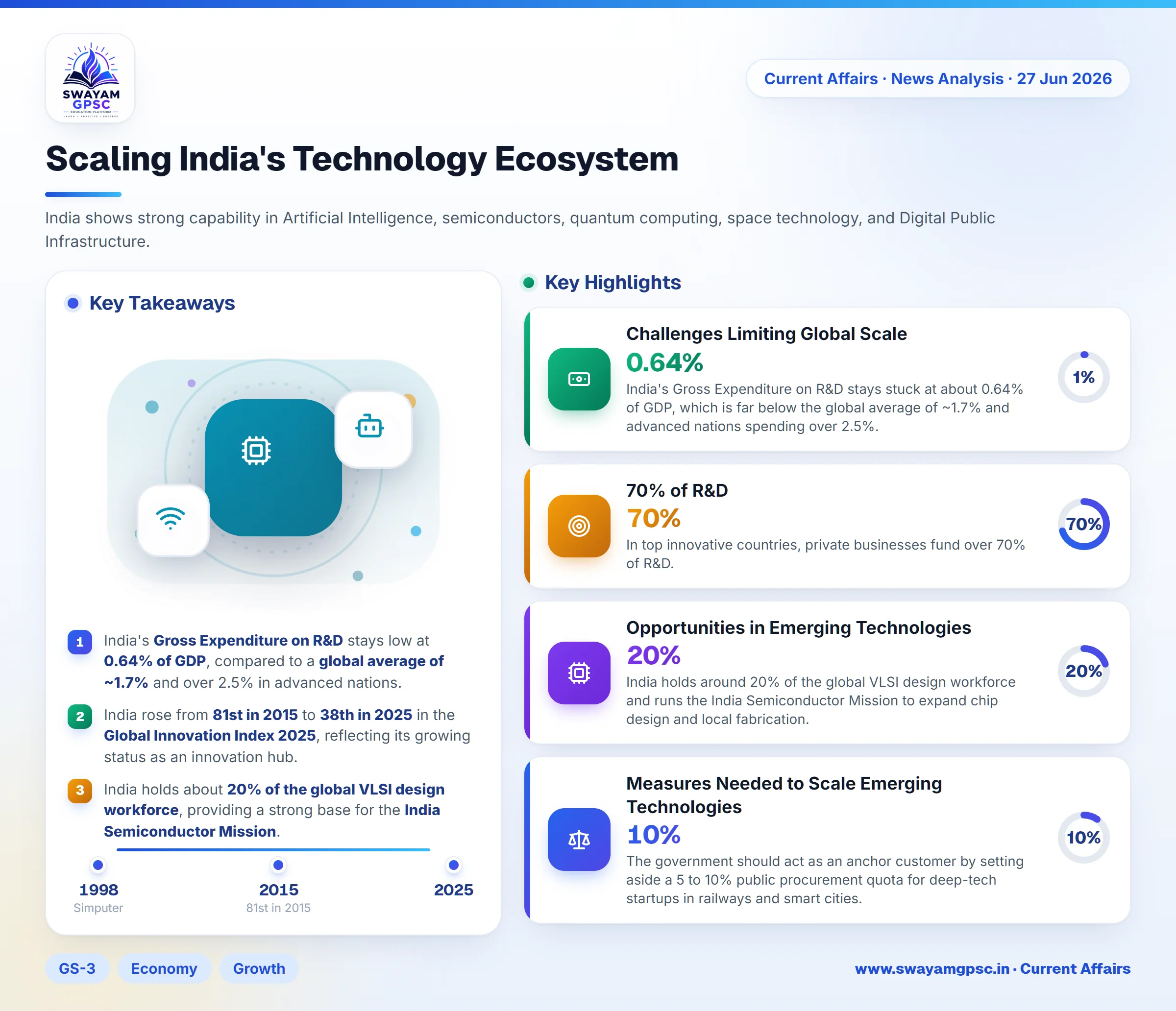
- India's Gross Expenditure on R&D stays low at 0.64% of GDP, compared to a global average of ~1.7% and over 2.5% in advanced nations.
- India rose from 81st in 2015 to 38th in 2025 in the Global Innovation Index 2025, reflecting its growing status as an innovation hub.
- India holds about 20% of the global VLSI design workforce, providing a strong base for the India Semiconductor Mission.
- The government plans to bridge the research commercialisation gap by expanding the Research, Development and Innovation Scheme and building Translational Research Centres as suggested in the Economic Survey 2025-26.
Why in News
- India is launching major national missions in Artificial Intelligence, Semiconductors, Quantum Computing, and Space Technologies.
- A major debate focuses on why India struggles to cross the Valley of Death between local prototypes and global commercial success.
- India has a proud history of scientific invention, but it now needs to turn local success into global market leadership.
Summary
- India shows strong capability in Artificial Intelligence, semiconductors, quantum computing, space technology, and Digital Public Infrastructure.
- To reach global scale, India must fix low research spending, weak links between industry and colleges, and a shortage of deep-tech funding.
- Crossing the Valley of Death requires long-term capital, shared research centres, smart public buying, and strong global partnerships to achieve Viksit Bharat 2047.
Challenges Limiting Global Scale
- India's Gross Expenditure on R&D stays stuck at about 0.64% of GDP, which is far below the global average of ~1.7% and advanced nations spending over 2.5%.
- In top innovative countries, private businesses fund over 70% of R&D.
- Government policies and the Anusandhan National Research Foundation try to attract private funds, but the public sector still carries most of the R&D burden.
- Scientific ideas stay locked inside government research labs instead of turning into successful commercial products.
- India's industrial setup has giant companies and tiny informal firms, but misses mid-sized deep-tech businesses needed for complex supply chains.
- Research excellence remains trapped in academic centers like CSIR and DRDO labs instead of reaching large industrial markets.
- While software startups get plenty of venture capital, risk capital for hardware and deep-tech remains very hard to find.
- India excels in service delivery and process engineering, but struggles to create and own critical standard-essential patents in new technologies.
Historical Trajectory of Tech Innovation in India
- India often suffers from the Stopping Too Soon habit, where policy measures success by early local capability rather than global commercial scale.
- The Semiconductor Complex Limited started in the 1970s to build integrated circuits.
- It failed to match Taiwan's TSMC because of low funding, small manufacturing size, and inconsistent public support.
- The Electronics Corporation of India Limited was set up in 1967 to build computers and control systems during technology embargoes.
- Its focus stayed limited to government strategic needs rather than competitive commercial products.
- The Simputer of 1998 previewed modern smartphone features.
- It failed to grow because the supporting venture capital and component supply chains did not exist back then.
- Apple used similar ideas later by building a strong business ecosystem to achieve worldwide dominance.
Models of Success
- By focusing on process innovation and exports, India grew into the Pharmacy of the World and a top vaccine maker.
- Platforms like Aadhaar and Unified Payments Interface were built for massive population scale from day one, proving that large user bases drive global leadership.
- The PARAM program showed that steady public funding with clear commercial targets can build world-class computing capabilities.
- The Indian Space Research Organisation shifted from a local developmental agency into a global commercial launch provider through frugal engineering.
- It deployed hundreds of foreign satellites using PSLV and LVM3 rockets and completed missions like the Mars Orbiter Mission at very low costs.
Opportunities in Emerging Technologies
- India has strong AI talent and multilingual datasets, which help in building Sovereign AI models for health, education, and farming.
- The National Quantum Mission and strong physics expertise help India build quantum tools for drug discovery and cybersecurity.
- India holds around 20% of the global VLSI design workforce and runs the India Semiconductor Mission to expand chip design and local fabrication.
- Frugal innovation seen in Chandrayaan and Mangalyaan helps India lead in satellite manufacturing and orbital computing.
- Platforms like Aadhaar, UPI, DigiLocker, ONDC, and CoWIN allow India to export its digital public goods to developing nations.
- Global leadership in pharmaceuticals opens doors into genomics, synthetic biology, and precision medicine.
- Strong engineering and Production Linked Incentive schemes help promote robotics and smart manufacturing.
- Leadership in renewable energy helps India become a hub for green hydrogen and battery storage.
- A growing digital economy allows India to build indigenous cybersecurity products and secure cloud systems for global markets.
Measures Needed to Scale Emerging Technologies
- India improved from 81st in 2015 to 38th in 2025 in the Global Innovation Index 2025, showing its rise as an innovation hub.
- To bridge the gap between research and commercial products highlighted in the Economic Survey 2025-26, India must expand the Research, Development and Innovation Scheme by building Translational Research Centres.
- Passing a law similar to the US Bayh-Dole Act of 1980 will help universities own and monetize federally funded inventions.
- The Anusandhan National Research Foundation should provide long-term risk capital through industry partnerships, similar to Israel's Yozma program.
- The government should act as an anchor customer by setting aside a 5 to 10% public procurement quota for deep-tech startups in railways and smart cities.
- Financial support for groups like the International Telecommunication Union, 3rd Generation Partnership Project, and International Organization for Standardization will help Indian firms secure standard essential patents.
- Programs like VAJRA and the Ramanujan Fellowship should bring diaspora scientists back as mentors and investors, much like Taiwan did with Hsinchu Science Park.
- Regulatory sandboxes should be set up for drones, AI, and crypto so innovators can test products safely.
- Diplomatic platforms like the US-India iCET and the Quad will help secure advanced technology transfers.
- Expanding KABIL will help India secure critical mineral supplies from Africa, Australia, and South America for manufacturing batteries and chips.
Conclusion
- The leading nations of the 21st century will be those that scale innovations best rather than just invent them first.
- As India moves toward Viksit Bharat 2047, it must shift from basic self-reliance to bold global ambition.