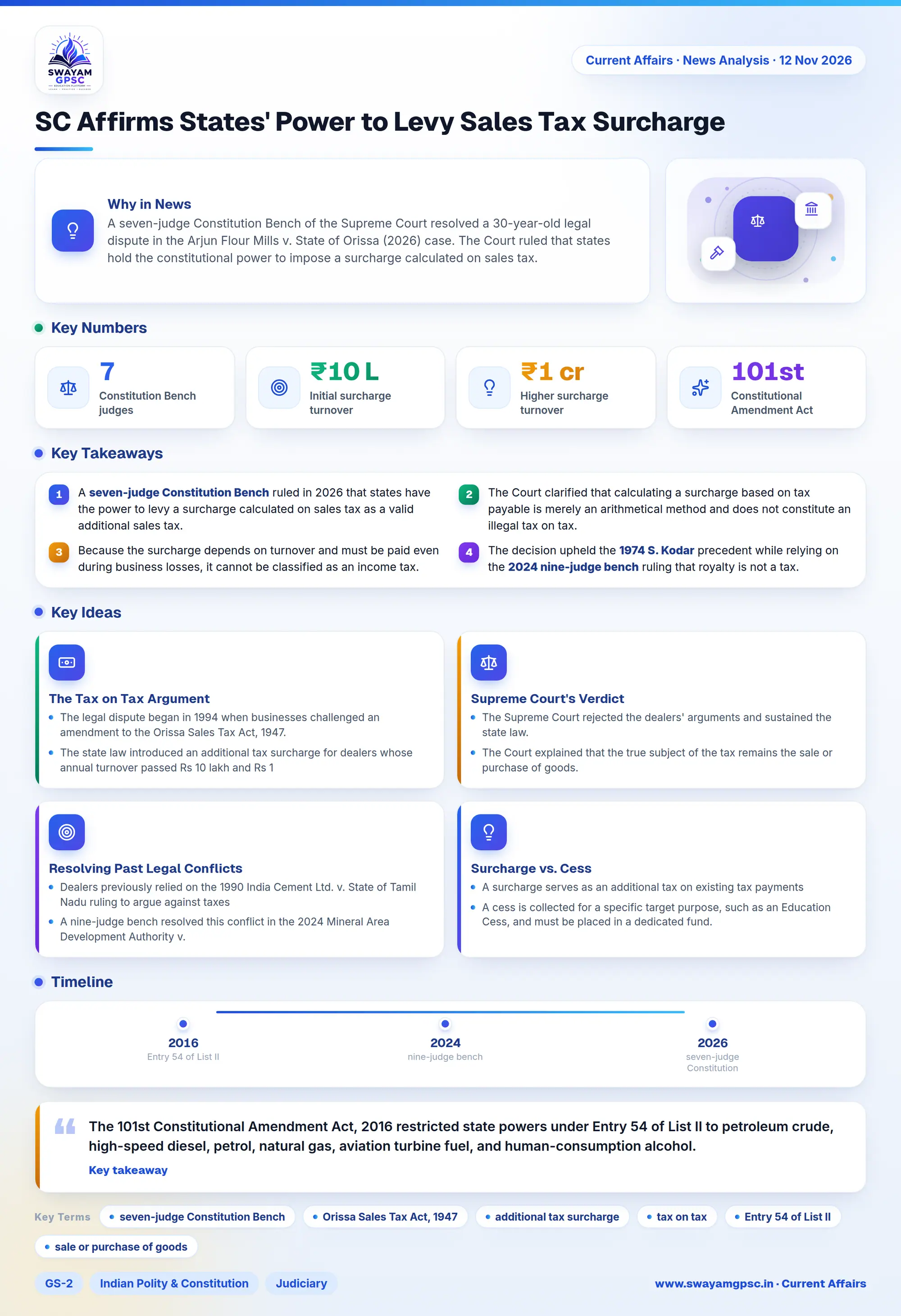
SC Affirms States' Power to Levy Sales Tax Surcharge
#GS-2 #Indian Polity & Constitution #Judiciary #Constitution #Rapid Fire CA #Quick Facts For Prelims #Judgements & Cases
Key takeaways
- A seven-judge Constitution Bench ruled in 2026 that states have the power to levy a surcharge calculated on sales tax as a valid additional sales tax.
- The Court clarified that calculating a surcharge based on tax payable is merely an arithmetical method and does not constitute an illegal tax on tax.
- Because the surcharge depends on turnover and must be paid even during business losses, it cannot be classified as an income tax.
- The decision upheld the 1974 S. Kodar precedent while relying on the 2024 nine-judge bench ruling that royalty is not a tax.
- Under the 101st Constitutional Amendment Act, 2016, state sales tax powers under Entry 54 of List II are limited to select petroleum items and alcoholic liquor.
Why in News
- A seven-judge Constitution Bench of the Supreme Court resolved a 30-year-old legal dispute in the Arjun Flour Mills v. State of Orissa (2026) case.
- The Court ruled that states hold the constitutional power to impose a surcharge calculated on sales tax.
- The judgment declared this levy a valid additional sales tax instead of an unconstitutional tax on tax.
The Tax on Tax Argument
- The legal dispute began in 1994 when businesses challenged an amendment to the Orissa Sales Tax Act, 1947.
- The state law introduced an additional tax surcharge for dealers whose annual turnover passed Rs 10 lakh and Rs 1 crore thresholds.
- Dealers argued that calculating the surcharge from tax payable created an invalid tax on tax.
- They claimed the surcharge acted like an income tax, placing it outside state powers under Entry 54 of List II in the Seventh Schedule.
Supreme Court's Verdict
- The Supreme Court rejected the dealers' arguments and sustained the state law.
- The Court explained that the true subject of the tax remains the sale or purchase of goods.
- Using a percentage of tax payable is simply a mathematical method to set the final tax amount.
- Because dealers must pay the surcharge even when suffering financial losses, it cannot be classified as an income tax.
Resolving Past Legal Conflicts
- Dealers previously relied on the 1990 India Cement Ltd. v. State of Tamil Nadu ruling to argue against taxes calculated on existing taxes.
- A nine-judge bench resolved this conflict in the 2024 Mineral Area Development Authority v. SAIL case by ruling that royalty is not a tax.
- The Supreme Court reaffirmed its 1974 judgment in S. Kodar v. State of Kerala, confirming state powers to levy additional sales tax on high-turnover dealers.
Surcharge vs. Cess
- A surcharge serves as an additional tax on existing tax payments, and its revenues flow into the Consolidated Fund for general spending.
- A cess is collected for a specific target purpose, such as an Education Cess, and must be placed in a dedicated fund.
Post-GST Taxation Powers
- The 101st Constitutional Amendment Act, 2016 restricted state powers under Entry 54 of List II to petroleum crude, high-speed diesel, petrol, natural gas, aviation turbine fuel, and human-consumption alcohol.
- Article 246A gives both Parliament and State Legislatures the authority to pass GST laws, while Article 269A gives Parliament exclusive control over inter-state trade.