Sairang Express Accident: Causes and Railway Safety Measures
#GS-3 #Infrastructure #Disaster Preparedness #Disaster Management #Current Events #National
Key takeaways
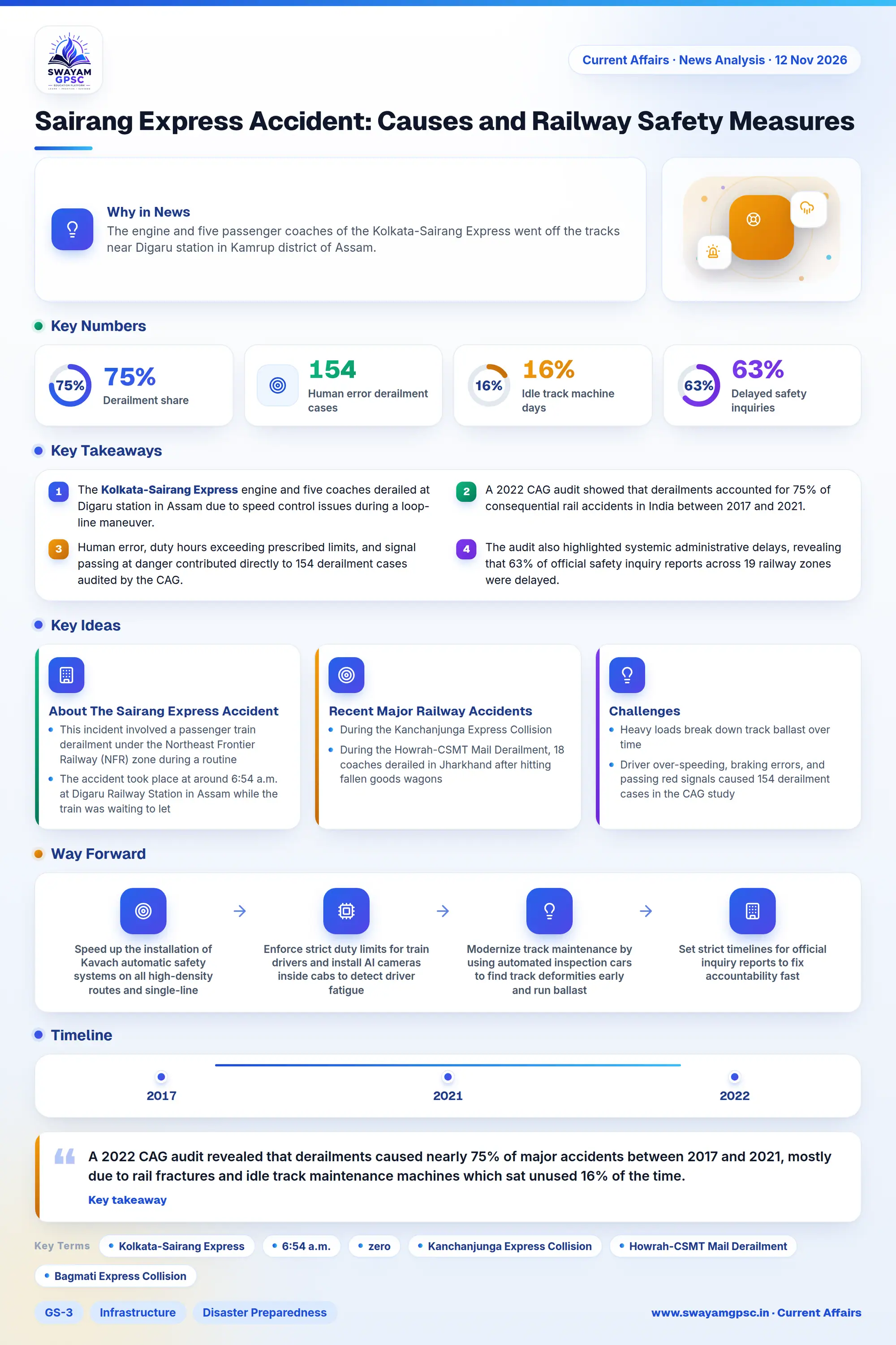
- The Kolkata-Sairang Express engine and five coaches derailed at Digaru station in Assam due to speed control issues during a loop-line maneuver.
- A 2022 CAG audit showed that derailments accounted for 75% of consequential rail accidents in India between 2017 and 2021.
- Human error, duty hours exceeding prescribed limits, and signal passing at danger contributed directly to 154 derailment cases audited by the CAG.
- The audit also highlighted systemic administrative delays, revealing that 63% of official safety inquiry reports across 19 railway zones were delayed.
- India is mitigating derailment risks by expanding the indigenous Kavach automatic train protection system and phasing out legacy coaches for safer LHB models.
Why in News
- The engine and five passenger coaches of the Kolkata-Sairang Express went off the tracks near Digaru station in Kamrup district of Assam.
About The Sairang Express Accident
- This incident involved a passenger train derailment under the Northeast Frontier Railway (NFR) zone during a routine movement onto a loop line.
- The accident took place at around 6:54 a.m. at Digaru Railway Station in Assam while the train was waiting to let a higher-priority train pass.
- Railway authorities reported that the driver lost control of the speed, while some unverified reports claimed that the emergency brakes failed.
- Official statements confirmed that zero passengers died and all were safe, though local reports mentioned a few minor injuries during rescue operations.
Recent Major Railway Accidents in India
- During the Kanchanjunga Express Collision, a goods train hit a standing passenger train in West Bengal due to signalling failure, causing 10 deaths.
- During the Howrah-CSMT Mail Derailment, 18 coaches derailed in Jharkhand after hitting fallen goods wagons, leading to 2 fatalities.
- During the Chandigarh-Dibrugarh Express Derailment, multiple coaches went off the track in Uttar Pradesh due to track alignment defects, killing 4 people.
- During the Bagmati Express Collision, a passenger train collided with a stationary freight train near Chennai after entering a loop line by mistake.
Challenges
- A 2022 CAG audit revealed that derailments caused nearly 75% of major accidents between 2017 and 2021, mostly due to rail fractures and idle track maintenance machines which sat unused 16% of the time.
- Heavy loads break down track ballast over time, which traps water and shifts concrete sleepers out of position during heavy rains.
- Driver over-speeding, braking errors, and passing red signals caused 154 derailment cases in the CAG study, often due to long working hours.
- Faulty electronic signalling switches and communication gaps can accidentally direct fast trains onto tracks occupied by stationary trains.
Initiatives Taken So Far
- The government introduced Kavach, an automatic train protection system that applies brakes automatically if a train passes a red signal or overspeeds.
- India created the Rashtriya Rail Sanraksha Kosh (RRSK) as a special dedicated fund to renew old tracks, upgrade bridges, and replace old coaches.
- The railways are replacing older ICF coaches with modern LHB stainless-steel coaches that do not pile up on top of each other during accidents.
- Railways use Ultrasonic Flaw Detection (USFD) to scan rails for internal micro-cracks and central electronic systems to prevent manual track setting mistakes.
Way Forward
- Speed up the installation of Kavach automatic safety systems on all high-density routes and single-line mountain sections in the Northeast.
- Enforce strict duty limits for train drivers and install AI cameras inside cabs to detect driver fatigue and sound emergency alerts within 60 seconds.
- Modernize track maintenance by using automated inspection cars to find track deformities early and run ballast cleaning machines without idle time.
- Set strict timelines for official inquiry reports to fix accountability fast, addressing the CAG finding that 63% of accident inquiries faced delays across all 19 railway zones.
Conclusion
- The Sairang Express derailment shows that speed control and track maintenance need urgent attention even when no lives are lost.
- India must shift from post-accident investigations to proactive technology solutions like Kavach to build a safe, zero-accident rail network.