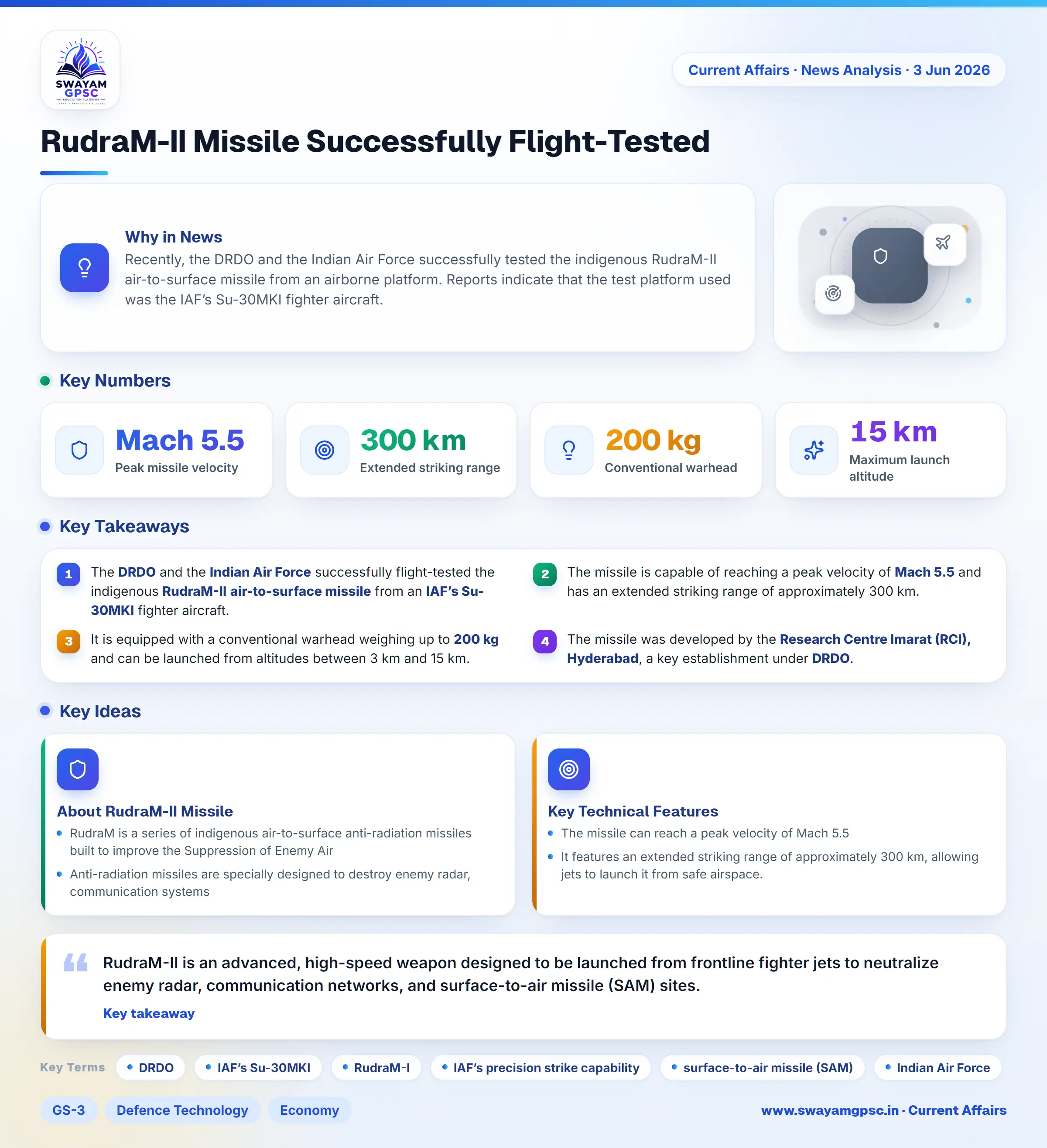
RudraM-II Missile Successfully Flight-Tested
#GS-3 #Defence Technology #Economy #Current Events #National
Key takeaways
- The DRDO and the Indian Air Force successfully flight-tested the indigenous RudraM-II air-to-surface missile from an IAF’s Su-30MKI fighter aircraft.
- The missile is capable of reaching a peak velocity of Mach 5.5 and has an extended striking range of approximately 300 km.
- It is equipped with a conventional warhead weighing up to 200 kg and can be launched from altitudes between 3 km and 15 km.
- The missile was developed by the Research Centre Imarat (RCI), Hyderabad, a key establishment under DRDO.
Why in News
- Recently, the DRDO and the Indian Air Force successfully tested the indigenous RudraM-II air-to-surface missile from an airborne platform.
- Reports indicate that the test platform used was the IAF’s Su-30MKI fighter aircraft.
- The trial took place under extreme release conditions and met all mission objectives successfully.
- The Integrated Test Range (ITR), Chandipur, Odisha, which is a key facility for testing missiles and rockets, fully supported the test.
About RudraM-II Missile
- RudraM is a series of indigenous air-to-surface anti-radiation missiles built to improve the Suppression of Enemy Air Defence (SEAD) capability of the air force.
- Anti-radiation missiles are specially designed to destroy enemy radar, communication systems, and other radio-frequency sources belonging to hostile air defence networks.
- India has developed three variants in this series, namely RudraM-I, RudraM-II, and RudraM-III, after conducting comprehensive testing on the earlier models.
- During SEAD operations, these missiles strike enemy air defence assets from stand-off ranges in the early phase of a conflict, keeping friendly aircraft safe during later missions.
- The DRDO developed RudraM-II domestically, with the Research Centre Imarat (RCI), Hyderabad acting as the main nodal laboratory alongside other establishments.
- This successful test strengthens the IAF’s precision strike capability, supports Aatmanirbharta in defence, and shows the maturity of India's weapon technology.
- RudraM-II is an advanced, high-speed weapon designed to be launched from frontline fighter jets to neutralize enemy radar, communication networks, and surface-to-air missile (SAM) sites.
- The primary goal of the missile is to give the Indian Air Force a reliable Suppression of Enemy Air Defences (SEAD) capability.
- By destroying hostile radar and infrastructure early in a conflict, it ensures safe operations for our strike aircraft.
- This new missile is set to replace older Russian-origin Kh-31 missiles by offering better range, speed, accuracy, and guidance systems.
Key Technical Features
- The missile can reach a peak velocity of Mach 5.5, making it extremely fast and reducing the reaction time for targets.
- It features an extended striking range of approximately 300 km, allowing jets to launch it from safe airspace.
- The missile is equipped with a conventional warhead weighing up to 200 kg, which is ideal for destroying hard radar installations and bunkers.
- It features a dynamic launch envelope, meaning it can be released from aircraft flying at altitudes between 3 km and 15 km.
- It uses a hybrid guidance system combining an Inertial Navigation System (INS), GPS, and a Passive Homing Head (PHH) to lock onto enemy radio frequencies.