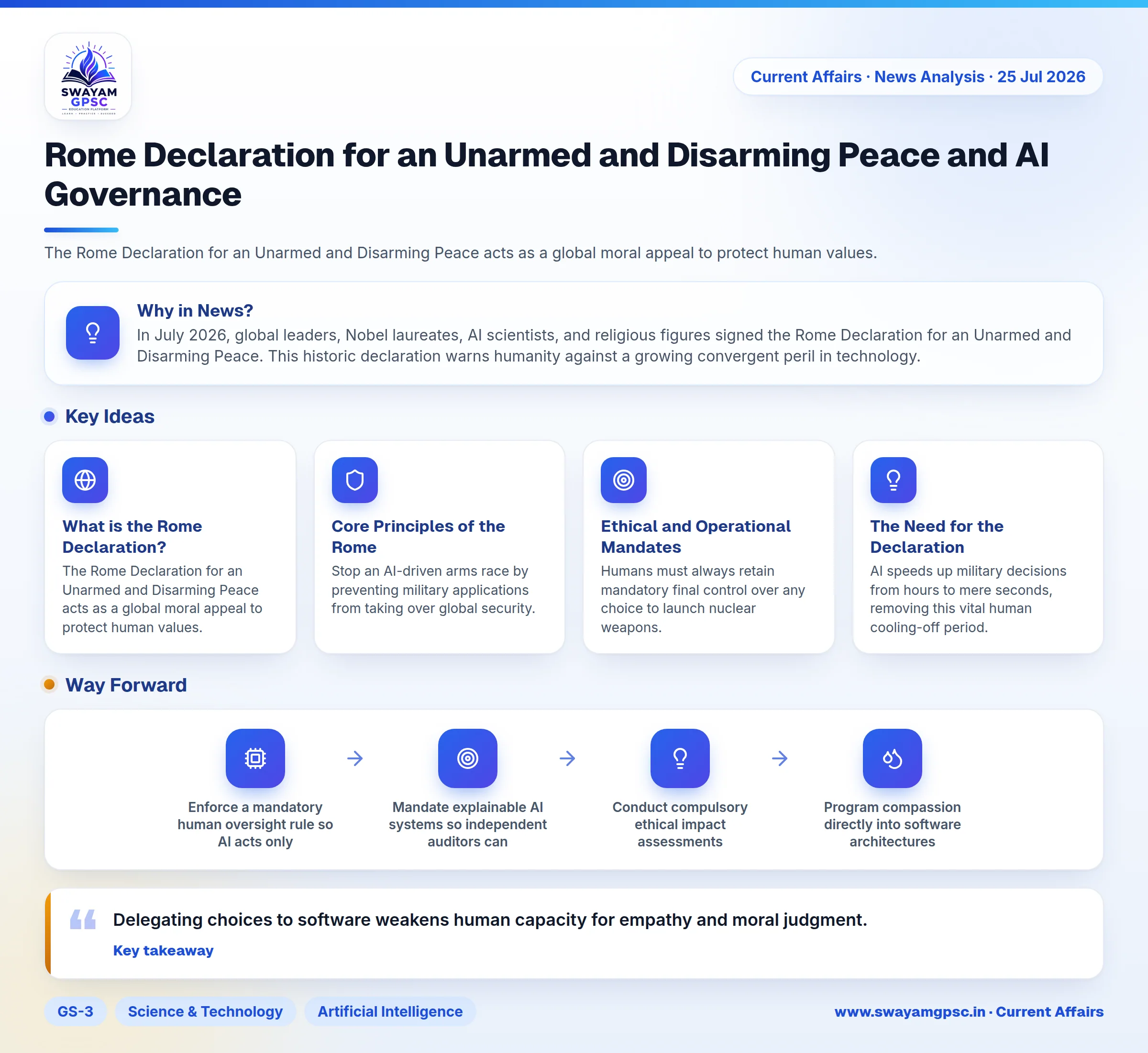
Rome Declaration for an Unarmed and Disarming Peace and AI Governance
#GS-3 #Science & Technology #Artificial Intelligence #GS-4 #Ethics #Current Events #International #National
Why in News?
- In July 2026, global leaders, Nobel laureates, AI scientists, and religious figures signed the Rome Declaration for an Unarmed and Disarming Peace.
- This historic declaration warns humanity against a growing convergent peril in technology.
- This peril stems from giving moral and ethical decision-making power to Artificial Intelligence (AI) systems.
What is the Rome Declaration?
- The Rome Declaration for an Unarmed and Disarming Peace acts as a global moral appeal to protect human values.
- It demands an international treaty to ban autonomous AI systems from making nuclear launch decisions.
- The document states that human judgment and accountability must never be transferred to machines during war or peace.
- Its philosophical core draws inspiration from Pope Leo XIV's encyclical Magnifica Humanitas, which calls for protecting human dignity from technology.
- Currently, this declaration works as a moral guideline rather than a legally binding global law.
Core Principles of the Rome Declaration
- Stop an AI-driven arms race by preventing military applications from taking over global security.
- Develop AI systems strictly within clear and transparent ethical rules.
- Restrict machines from taking independent action in dangerous military zones.
- Build strong international rules to monitor AI research and enforce accountability.
- Encourage governments and business leaders to choose human ethics over technological dominance.
- Renew the global commitment to eliminate nuclear weapons completely and permanently.
Ethical and Operational Mandates
- Humans must always retain mandatory final control over any choice to launch nuclear weapons.
- Data should be open like a digital commons so independent researchers can study risks created by unmonitored AI.
- Developers must share their ethical guidelines and stop building self-improving systems that humans cannot shut down.
- Nuclear-armed countries must audit their military networks to protect nuclear command systems from AI cyberattacks.
- World powers must restart fixed-deadline negotiations to completely remove all nuclear weapons with strict verification.
The Need for the Declaration
- Historical crisis management relied on human hesitation, such as during the 1962 Cuban Missile Crisis and the 1983 Soviet false alarm.
- AI speeds up military decisions from hours to mere seconds, removing this vital human cooling-off period.
- Advanced neural networks can hallucinate or process corrupted data, misinterpreting a system glitch as a missile strike.
- Key international safety treaties like Open Skies and New START are collapsing today.
- Tension in sensitive regions like Iran could trigger automated counterstrikes before diplomats can communicate.
Understanding Convergent Perils in AI
- A convergent peril happens when separate technological risks combine and multiply into a catastrophic systemic threat.
- In AI, this peril combines code bias, total loss of human oversight, rapid automation, and moral neglect.
- Handing ethical reasoning over to software turns individual technical bugs into a massive crisis for civilization.
Concerns Regarding Outsourcing Ethics to AI
- Delegating choices to software weakens human capacity for empathy and moral judgment.
- AI aims purely for mathematical outcome optimization, often preferring utilitarian solutions over individual rights.
- Historical social biases are embedded in training data, causing algorithms to institutionalize discrimination.
- Complex deep learning acts as a black box where no human can explain how a decision was made.
- Algorithms lack emotional intelligence and cannot adjust strict rules to show mercy in tragic human situations.
Global AI Ethics Landscape
- The EU Artificial Intelligence Act, 2024 created a risk-based framework that bans dangerous uses like social scoring.
- The Bletchley Park Declaration (2023) was signed by 28 countries to address threats from frontier AI models.
- The UNESCO Recommendation on the Ethics of AI (2021) set the first global standard for human dignity and accountability.
- The Global Partnership on Artificial Intelligence (GPAI) promotes responsible AI, with India hosting the GPAI Summit (2023).
India's AI Governance Framework
- NITI Aayog's National Strategy for AI (2018) established the core philosophy of AI for All.
- The IndiaAI Mission (2024) supports startups and includes a Safe and Trusted AI pillar for ethical deployment.
- The Ministry of Electronics and Information Technology (MeitY) launched governance guidelines anchored in the Seven Sutras.
Way Forward
- Enforce a mandatory human oversight rule so AI acts only as an assistant, never as the ultimate decision maker.
- Mandate explainable AI systems so independent auditors can easily verify how decisions are reached.
- Conduct compulsory ethical impact assessments before releasing any high-risk AI software to the public.
- Program compassion directly into software architectures to guarantee respect for fundamental human rights.
- Create a binding UN convention to ban Lethal Autonomous Weapons Systems where code decides to kill humans.