The River Thames: Geography, Characteristics, and Significance
#GS-3 #Geography #Physical Geography #Resources #GS-2 #Current Events #International #River Thames #Mapping
Key takeaways
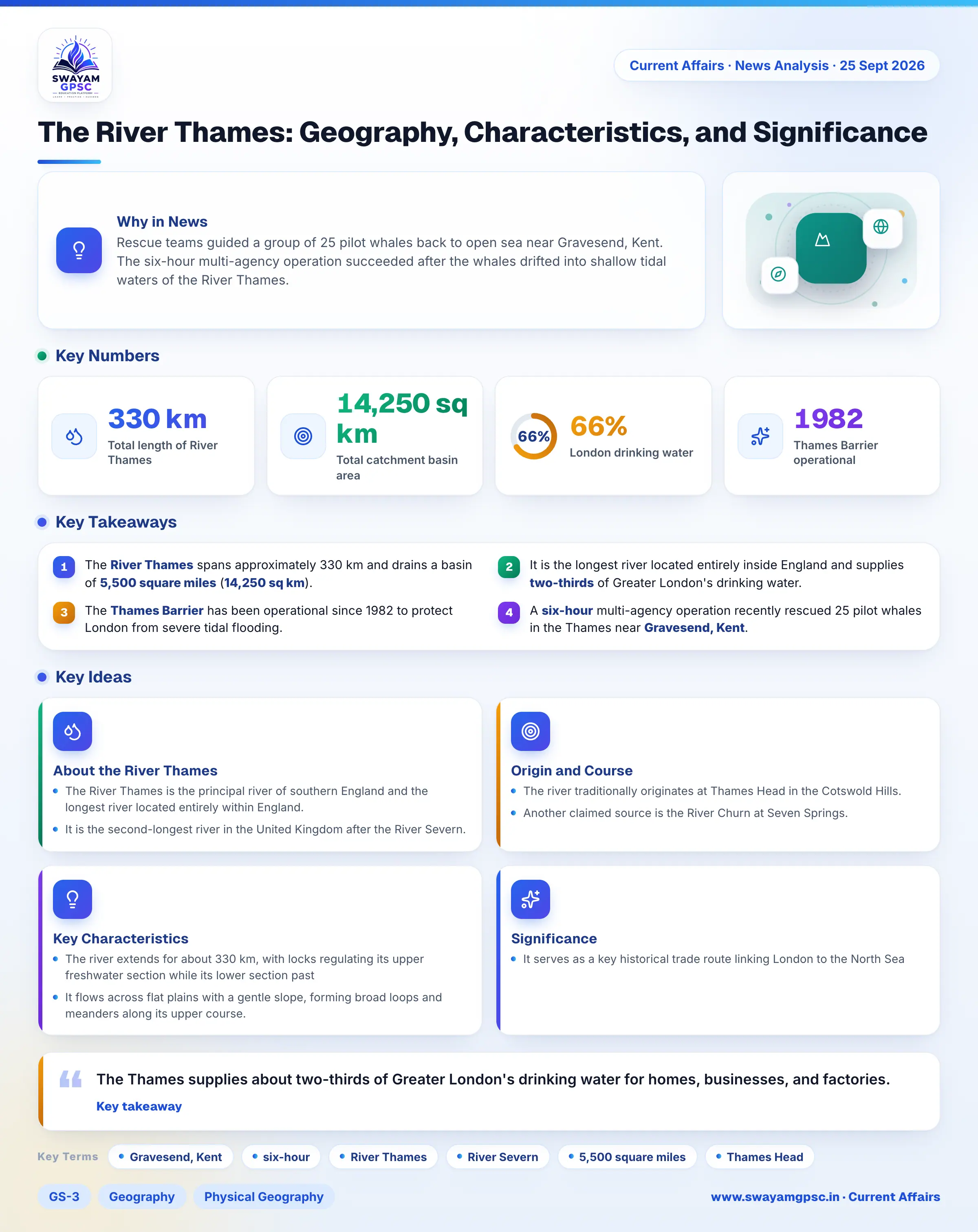
- The River Thames spans approximately 330 km and drains a basin of 5,500 square miles (14,250 sq km).
- It is the longest river located entirely inside England and supplies two-thirds of Greater London's drinking water.
- The Thames Barrier has been operational since 1982 to protect London from severe tidal flooding.
- A six-hour multi-agency operation recently rescued 25 pilot whales in the Thames near Gravesend, Kent.
Why in News
- Rescue teams guided a group of 25 pilot whales back to open sea near Gravesend, Kent.
- The six-hour multi-agency operation succeeded after the whales drifted into shallow tidal waters of the River Thames.
About the River Thames
- The River Thames is the principal river of southern England and the longest river located entirely within England.
- It is the second-longest river in the United Kingdom after the River Severn.
- The river drains a catchment basin covering roughly 5,500 square miles or 14,250 sq km.
Origin and Course
- The river traditionally originates at Thames Head in the Cotswold Hills.
- Another claimed source is the River Churn at Seven Springs.
- It flows eastward through major towns like Oxford, Reading, Windsor, and London.
- It finally empties into the North Sea through the Thames Estuary.
Key Characteristics
- The river extends for about 330 km, with locks regulating its upper freshwater section while its lower section past Teddington is tidal.
- It flows across flat plains with a gentle slope, forming broad loops and meanders along its upper course.
- The estuary experiences strong tidal changes, with spring tides rising nearly 7 metres at London Bridge.
- Operational since 1982, the Thames Barrier uses ten movable steel gates to protect London from storm surges and flood tides.
- Major tributaries include the Windrush, Cherwell, Kennet, Colne, Wey, and Lea, while the River Medway enters the outer estuary.
Significance
- The Thames supplies about two-thirds of Greater London's drinking water for homes, businesses, and factories.
- It serves as a key historical trade route linking London to the North Sea, flowing past landmarks such as Windsor Castle, Westminster, the Tower of London, and Greenwich.