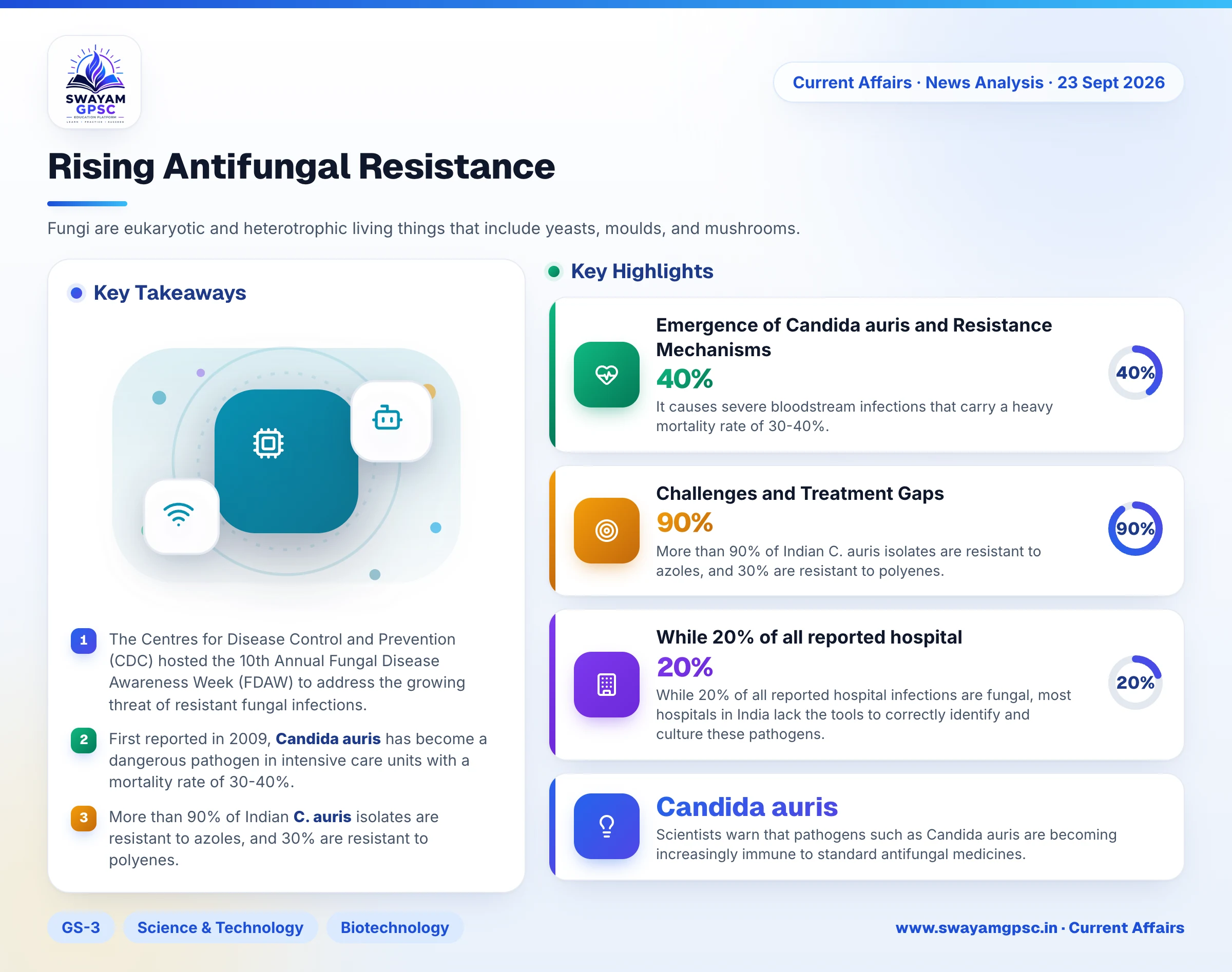
Rising Antifungal Resistance
#GS-3 #Science & Technology #Biotechnology #Rapid Fire CA #Quick Facts For Prelims
Key takeaways
- The Centres for Disease Control and Prevention (CDC) hosted the 10th Annual Fungal Disease Awareness Week (FDAW) to address the growing threat of resistant fungal infections.
- First reported in 2009, *Candida auris* has become a dangerous pathogen in intensive care units with a mortality rate of 30-40%.
- More than 90% of Indian *C. auris* isolates are resistant to azoles, and 30% are resistant to polyenes.
- Fungal infections account for 20% of all reported hospital infections, yet many facilities lack proper identification tools.
Why in News
- The Centres for Disease Control and Prevention (CDC) organized the 10th Annual Fungal Disease Awareness Week (FDAW) recently.
- This event aims to shine a light on the rising danger of multidrug-resistant fungal infections across the globe.
- Scientists warn that pathogens such as *Candida auris* are becoming increasingly immune to standard antifungal medicines.
- This growing immunity raises serious questions about how well our current medical treatments will work in the future.
Understanding Fungi
- Fungi are eukaryotic and heterotrophic living things that include yeasts, moulds, and mushrooms.
- Unlike plants, they do not have chlorophyll and feed by releasing extracellular enzymes to absorb organic matter.
- They work as important decomposers to recycle nutrients back into the environment.
- They are also useful in food production, biotechnology, and making medicines like yeast for fermentation and *Penicillium* for antibiotics.
- However, certain harmful fungi cause fungal infections known as mycoses, which can range from simple ringworm to severe body-wide illnesses.
- These severe infections are especially dangerous for people with weak immune systems.
Emergence of Candida auris and Resistance Mechanisms
- First found in 2009, the yeast *Candida auris* has turned into a dangerous multidrug-resistant pathogen in intensive care units.
- It causes severe bloodstream infections that carry a heavy mortality rate of 30-40%.
- Experts suggest that rising global temperatures put pressure on fungi to adapt, helping heat-tolerant variants survive the normal human body temperature of 37°C.
- To fight azole drugs, fungi make extra copies of the Erg11 gene, which boosts the production of ergosterol to cancel out the drug.
- Mutations in the Fks1 gene help pathogens survive high doses of echinocandin medicines like caspofungin.
- Under the Eagle Effect, fungi exposed to very high drug doses activate backup pathways to produce massive amounts of chitin, which is the raw material of the fungal cell wall, letting them survive treatment.
Challenges and Treatment Gaps
- Traditional azoles and polyenes attack ergosterol in the fungal cell membrane, while echinocandins attack the cell wall directly.
- More than 90% of Indian *C. auris* isolates are resistant to azoles, and 30% are resistant to polyenes.
- While 20% of all reported hospital infections are fungal, most hospitals in India lack the tools to correctly identify and culture these pathogens.
- Instead of trying to wipe out fungi completely, which causes them to evolve faster, researchers suggest using combination therapies.
- Scientists also recommend targeting less critical molecular pathways to stop the disease without forcing the fungi to build resistance.
Comparison: Fungi vs. Bacteria vs. Viruses
- Fungi are eukaryotic organisms with a true nucleus and membrane-bound organelles, while bacteria are prokaryotic without a true nucleus, and viruses have no cell structure at all.
- Fungi and bacteria carry DNA as their genetic material, whereas viruses can contain either DNA or RNA.
- In terms of physical size, fungi are generally larger than bacteria, and viruses are the smallest of the three groups.
- Fungi get their food through heterotrophic absorption, bacteria can be autotrophic or heterotrophic, and viruses cannot get nutrients on their own.
- Fungi reproduce through spores, budding, or fragmentation, bacteria mainly use binary fission, and viruses replicate only inside a host cell.
- Examples of fungal diseases include mycoses and ringworm, bacterial diseases include tuberculosis and cholera, and viral diseases include COVID-19 and influenza.