Rise of India's Electric Vehicles Ecosystem
#GS-2 #Governance & Social Justice #Government Policies & Interventions #GS-3 #Economy #Infrastructure #Environment #Sustainable Development #Climate Change
Key takeaways
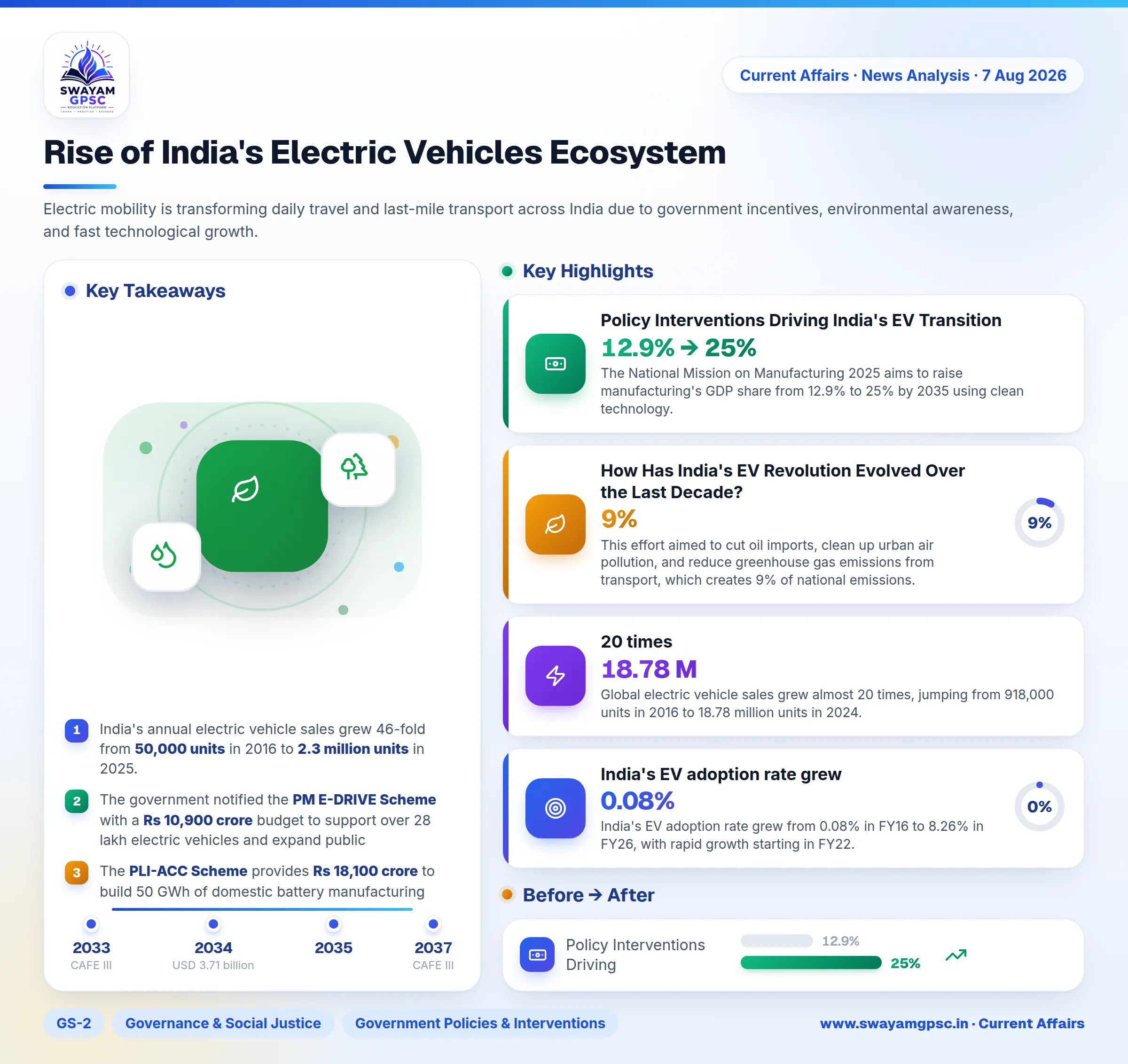
- India's annual electric vehicle sales grew 46-fold from 50,000 units in 2016 to 2.3 million units in 2025.
- The government notified the PM E-DRIVE Scheme with a Rs 10,900 crore budget to support over 28 lakh electric vehicles and expand public charging.
- The PLI-ACC Scheme provides Rs 18,100 crore to build 50 GWh of domestic battery manufacturing, targeting components that represent 35% to 40% of EV costs.
- India aims for electric vehicles to account for 30% of total vehicle sales and set up 1.32 million charging stations by 2030.
Why in News
- Electric mobility is transforming daily travel and last-mile transport across India due to government incentives, environmental awareness, and fast technological growth.
- The shift to electric vehicles supports India's climate strategy while reducing fossil fuel imports and building a low-carbon economy.
How Has India's EV Revolution Evolved Over the Last Decade?
- India began its electric mobility journey in 2015 by introducing the National Electric Mobility Mission Plan and the FAME scheme.
- This effort aimed to cut oil imports, clean up urban air pollution, and reduce greenhouse gas emissions from transport, which creates 9% of national emissions.
- The NEMMP 2020 created a long-term roadmap to boost domestic manufacturing and encourage clean transport.
- Launched under NEMMP in 2015, the FAME scheme provided incentives for buyers, charging station setup, and local manufacturing through two distinct phases.
- Global electric vehicle sales grew almost 20 times, jumping from 918,000 units in 2016 to 18.78 million units in 2024.
- India's EV adoption rate grew from 0.08% in FY16 to 8.26% in FY26, with rapid growth starting in FY22.
- Electric rickshaws led the early adoption phase in FY20, but electric two-wheelers became the largest segment by FY25.
- Annual EV sales in India grew 46-fold from 50,000 units in 2016 to 2.3 million units in 2025.
- Uttar Pradesh led state sales in 2025 with over 4 lakh units, followed by Maharashtra with 2.66 lakh units and Karnataka with 2 lakh units.
- India's EV exports increased from USD 1.2 million in 2020 to USD 84 million in 2024, sending vehicles to Nepal, Indonesia, and Japan.
Expanding Infrastructure
- The e-Amrit tool helps drivers locate nearby charging stations, while private companies like Hyundai are installing ultra-fast chargers in major cities.
- Domestic manufacturing has expanded beyond basic assembly to produce battery packs, motors, power electronics, and charging equipment locally.
- Global automakers like Suzuki are making India an export hub by launching vehicles such as the e VITARA for over 100 countries.
- Around 400 EV startups operate in India, driving innovation in battery technology, charging networks, and low-cost manufacturing.
- Artificial intelligence improves the EV driving experience through smart route planning, live traffic updates, and voice commands.
India Electric Mobility Index
- NITI Aayog created the India Electric Mobility Index in August 2025 to track and compare state progress on EV adoption.
- The framework measures performance across 16 indicators split into transport electrification, charging readiness, and innovation.
- States and Union Territories are grouped into three categories: Frontrunners, Performers, and Aspirants.
- Delhi, Maharashtra, and Chandigarh earned top spots as Frontrunners for their well-developed EV systems.
Policy Interventions Driving India's EV Transition
- By December 2025, 29 States and Union Territories notified dedicated EV policies offering capital subsidies and tax waivers to attract investors.
- Industrial hubs like Tamil Nadu, Maharashtra, Gujarat, and Karnataka created strong regional manufacturing ecosystems.
- The Delhi EV Policy offers strong incentives to lower vehicle emissions and clean up city air.
- In June 2026, the government approved a Rs 9,585-crore plan to replace nearly 2.07 lakh old commercial vehicles across the capital region.
- The National Mission on Manufacturing 2025 aims to raise manufacturing's GDP share from 12.9% to 25% by 2035 using clean technology.
- The mission targets creating 143 million jobs and generating USD 1.2 trillion in merchandise exports by 2035.
- The policy promotes advanced technology and cluster development to expand local production capacity.
- Notified in 2024 with Rs 10,900 crore, the PM E-DRIVE Scheme supports upfront subsidies for over 28 lakh electric vehicles.
- By January 2026, buyers purchased over 22.12 lakh electric vehicles using PM E-DRIVE incentives.
- The scheme sets aside Rs 4,391 crore for 14,028 electric buses to clean up public transport in major cities.
- The government allocated Rs 2,000 crore for public chargers and Rs 780 crore to upgrade testing agencies under PM E-DRIVE.
- The Phased Manufacturing Programme forces companies to make key EV parts locally to lower dependence on imports.
- The PM e-Bus Sewa-PSM Scheme provides Rs 3,435.33 crore in payment security to protect bus operators against payment defaults.
- This payment security mechanism covers up to 12 years per vehicle to help deploy over 38,000 electric buses.
- Cities will deploy 10,000 electric buses through public-private partnerships under this framework.
- The SPMEPCI scheme launched in 2024 requires carmakers to invest at least Rs 4,150 crore to build factories in India.
- Companies must achieve 25% domestic value addition within three years and 50% within five years under SPMEPCI.
- The PLI-Auto Scheme provides incentives for making advanced automotive technology with at least 50% domestic content.
- By January 2026, the government disbursed Rs 2,377.56 crore to manufacturers under the PLI-Auto Scheme.
- This scheme aligns with Aatmanirbhar Bharat to boost global manufacturing competitiveness in clean mobility.
- The PLI-ACC Scheme offers Rs 18,100 crore to build 50 GWh of local battery storage production capacity.
- Advanced chemistry cells convert stored chemical energy into electric power to run long-range electric vehicles.
- Local battery production lowers vehicle costs because batteries make up 35% to 40% of total EV price.
- The government charges a lower GST rate of 5% on electric vehicles to make them affordable for buyers.
India's EV Growth Outlook
- India aims to build a complete domestic EV supply chain under Make in India to reach its 2070 net-zero target.
- The domestic EV market is projected to grow from USD 3.71 billion in 2025 to USD 191.04 billion by 2034.
- India aims for electric vehicles to make up 30% of total vehicle sales and build 1.32 million charging stations by 2030.
- Increasing local production could turn India into a top global exporter of two-wheelers, compact EVs, and batteries.
Corporate Average Fuel Efficiency (CAFE) Norms
- India introduced CAFE norms in 2017 to force automakers to build vehicles that consume less fuel and emit less carbon dioxide.
- These standards encourage companies to sell more electric vehicles to lower their fleet-wide emission averages.
- The government is preparing CAFE III standards for 2027 to 2032 and CAFE IV for 2033 to 2037.
- Proposed emission targets demand 91.7 g CO2/km under CAFE III and 70 g CO2/km under CAFE IV.
Conclusion
- India's electric vehicle transition is entering a strong growth phase driven by supportive policies, rising sales, and expanding local manufacturing.
- Initiatives like PM E-DRIVE, PLI-Auto, and PLI-ACC are creating a self-reliant manufacturing base to lower fuel imports and create green jobs.