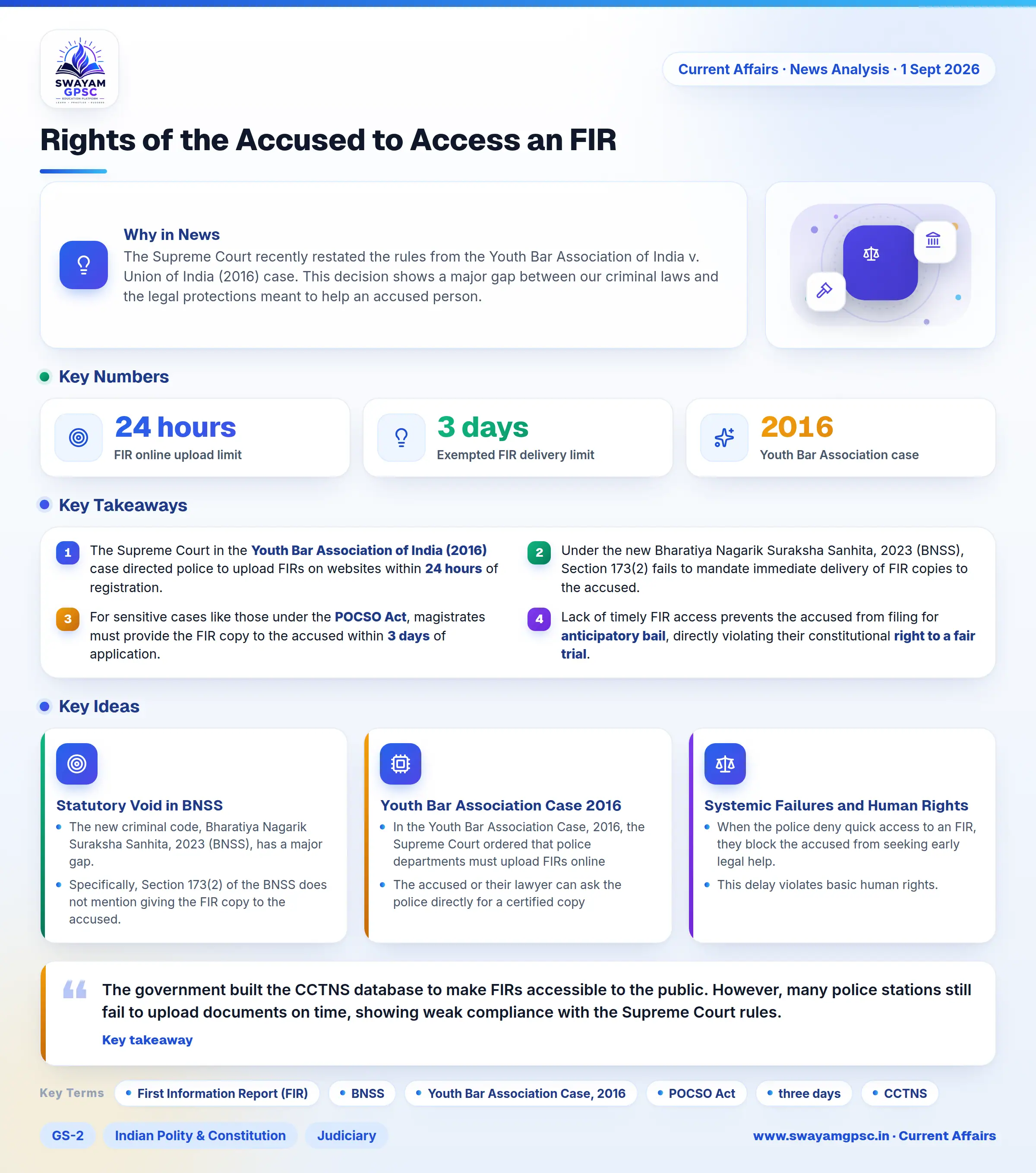
Rights of the Accused to Access an FIR
#GS-2 #Indian Polity & Constitution #Judiciary #Constitution #Current Events #National #Judgements & Cases
Key takeaways
- The Supreme Court in the Youth Bar Association of India (2016) case directed police to upload FIRs on websites within 24 hours of registration.
- Under the new Bharatiya Nagarik Suraksha Sanhita, 2023 (BNSS), Section 173(2) fails to mandate immediate delivery of FIR copies to the accused.
- For sensitive cases like those under the POCSO Act, magistrates must provide the FIR copy to the accused within 3 days of application.
- Lack of timely FIR access prevents the accused from filing for anticipatory bail, directly violating their constitutional right to a fair trial.
Why in News
- The Supreme Court recently restated the rules from the Youth Bar Association of India v. Union of India (2016) case.
- This decision shows a major gap between our criminal laws and the legal protections meant to help an accused person.
- Getting quick access to a First Information Report (FIR) is crucial for a fair trial. Without it, an accused person cannot defend themselves properly.
Statutory Void in BNSS
- The new criminal code, Bharatiya Nagarik Suraksha Sanhita, 2023 (BNSS), has a major gap. It does not clearly order the police to give a copy of the FIR to the accused immediately after filing.
- Specifically, Section 173(2) of the BNSS does not mention giving the FIR copy to the accused. Instead, this section only focuses on sharing the document with the victim or the person who reported the crime.
- Furthermore, Section 230 of the BNSS says the Magistrate must give the FIR and other documents to the accused. However, this happens only after the court takes notice of the case, which is often too late for an early defense.
Youth Bar Association Case 2016
- In the Youth Bar Association Case, 2016, the Supreme Court ordered that police departments must upload FIRs online within 24 hours of registration. If there are internet or geographical issues, they can take up to 48 to 72 hours.
- The accused or their lawyer can ask the police directly for a certified copy, which the police must deliver within 24 hours. Alternatively, they can get it from the local magistrate within two working days.
- The court created an exemption for sensitive crimes to protect privacy. FIRs involving sexual offenses, the POCSO Act, or terrorism do not have to be published online.
- To keep an FIR private, an officer of the rank of Deputy Superintendent of Police (DSP) or higher must write down the official reasons. Even then, the magistrate must still give a copy to the accused within three days of their request.
Systemic Failures and Human Rights Impact
- The government built the CCTNS database to make FIRs accessible to the public. However, many police stations still fail to upload documents on time, showing weak compliance with the Supreme Court rules.
- When the police deny quick access to an FIR, they block the accused from seeking early legal help. For example, the accused cannot apply for anticipatory bail or ask the court to dismiss the case.
- This delay violates basic human rights. It damages the right to a fair trial and goes against the core principles of natural justice.